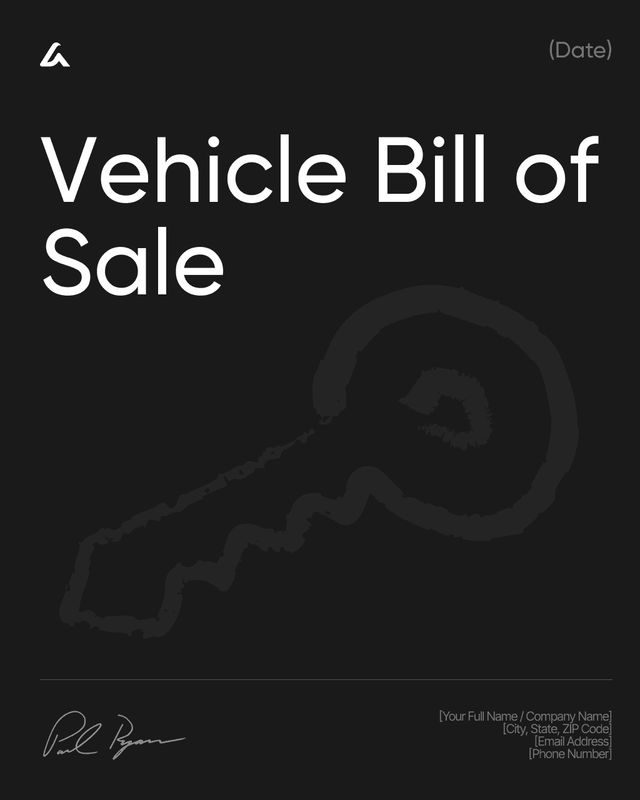
Vehicle Bill of Sale (New York)
This Vehicle Bill of Sale (“Agreement”) is made on [Date] in the State of New York by and between:
Seller:
[Full Legal Name(s), as shown on the title]
[Street Address]
[City, State, ZIP]
Co-Seller (if any):
[Full Legal Name]
[Street Address]
[City, State, ZIP]
Buyer:
[Full Legal Name(s)]
[Street Address]
[City, State, ZIP]
Co-Buyer (if any):
[Full Legal Name]
[Street Address]
[City, State, ZIP]
New York’s Vehicle Bill of Sale, form MV-912, reads: “I, [Seller], of [address], in consideration of $[amount], do hereby sell, transfer and convey to [Buyer], of [address], the following vehicle”, followed by the description, terms and conditions, and the names, signatures and dates of seller and buyer. This template carries the same statement and details.
Price, Method, and Receipt
In consideration of $[Amount] (enter $0 and mark “gift” if the Vehicle is a gift), Seller sells, transfers and conveys the Vehicle to Buyer. Payment method: [Cash / Cashier’s check / Bank transfer / Financing]. Date of payment: [Date of Payment]. Seller acknowledges receipt in full, inclusive of any prior deposit of $[Deposit or “None”]. Value of any property given, traded or swapped, or services performed instead of cash: $[Amount or “None”]. The total is the purchase price both Parties report on form DTF-802. Relationship of Buyer to Seller: [None / Spouse / Parent / Child / Stepparent / Stepchild / Other].
Delivery / Transfer Timing
Delivery occurs at [Location] on [Delivery Date/Time]. From delivery forward, Buyer bears risk of loss and responsibility for operation. Seller keeps the license plates and registration: they are surrendered to the DMV or transferred to another vehicle Seller owns, and do not go with the Vehicle. Buyer registers the Vehicle and receives plates before driving it.
Vehicle Identification Details
Description of Vehicle:
Vehicle Identification Number: [VIN]
Year: [Year]
Make: [Make]
Model: [Model]
Body Type: [Body Type]
Color: [Color]
New York title number: [Title Number]
Title brand, if any: [None / Salvage / Rebuilt Salvage / Flood / other, as shown on the title]
Lienholder, if any: [Name, or “None”]
Odometer Statement
At the time of transfer the odometer shows [Mileage] miles (no tenths). Indicate one:
☐ Actual mileage ☐ Not the actual mileage, WARNING – ODOMETER DISCREPANCY ☐ Mileage in excess of the odometer mechanical limits ☐ Exempt (model year 2010 or older, or a 2011-or-newer vehicle 20 or more model years old)
Federal law (49 U.S.C. 32705; 49 CFR 580.5) requires the seller to state the mileage on every transfer of a model year 2011 or newer vehicle during its first 20 model years; model year 2010 and older vehicles are exempt (49 CFR 580.17). New York records the reading in the transfer section on the back of the title. Providing a false statement may result in fines and/or imprisonment.
Title, Liens, and Payoff
Seller warrants title and states the Vehicle is free of liens except: [Lienholder name and address, or “None”]. Seller completes and signs the transfer of ownership section of the New York Certificate of Title and delivers it to Buyer together with this bill of sale. A registration or title cannot simply be changed into another person’s name; ownership passes only by this transfer. Any listed lien will be released upon payoff and the release evidence delivered within [X] business days after funds clear.
Taxes, Registration, and Fees
Buyer will register and title the Vehicle at a New York DMV office, within 180 days of the effective date on Buyer’s insurance ID card, presenting the signed title, the original of this bill of sale, form DTF-802 completed by both Parties, proof of New York insurance and the Vehicle Registration/Title Application (MV-82). Buyer pays all applicable taxes and fees: sales tax at the rate for Buyer’s place of residence (or shows an exemption), the title certificate fee, and registration, plate and any regional supplemental fees. If the Vehicle is a gift to, or sold below fair market value to, a person other than a spouse, parent, child, stepparent or stepchild, Seller completes Section 6 of DTF-802.
Condition and Inspection Acknowledgment
Buyer confirms a chance to inspect and test-drive the Vehicle and accepts it AS-IS, with all faults, unless a written warranty is attached. Promised items after closing: [List or “None”]. Buyer has had the opportunity to check the VIN in the National Insurance Crime Bureau’s VINCheck for flood damage or theft. Buyer understands that the Vehicle must pass a New York State inspection within the 10-day extension issued at registration; an inspection issued to Seller is not valid for Buyer.
Terms and Conditions
[Any additional terms, e.g., included accessories, known defects, spare keys, delivery of service records, or “None”]
Optional Notary Acknowledgment
New York does not require MV-912, a vehicle bill of sale or the title transfer to be notarized. The Parties may nonetheless have this Agreement acknowledged:
State of New York, County of [County]. On [Date] before me personally appeared [Names], known to me or proved on the basis of satisfactory evidence.
Notary Public Signature: ____________________ Commission expires: [Date]
Governing Law / Venue
This Agreement is governed by the laws of the State of New York. Venue lies in [County] County, New York.
Entire Agreement; Changes
This Agreement supersedes all prior communications. Revisions must be signed by both Parties. The original goes to the DMV with Buyer’s registration; each Party keeps a photocopy.
New York Filing Checklist
Reference information for the parties. It is not part of this agreement and does not bind either party.
What the DMV needs. Proof of ownership (the title, with the transfer section completed and signed by the seller) and proof of sale (the bill of sale, MV-912 or equivalent, signed by seller and buyer, even for a gift). The buyer hands the original bill of sale to the DMV.
An acceptable bill of sale shows the year and make, the VIN, the date of sale, the purchase price, and the names and signatures of buyer and seller. For a gift, write “gift” and a price of $0.
Seller, at and after the sale:
-
Complete and sign the transfer section of the title, with the odometer reading (no reading is required for model year 2010 and older)
-
Sign the bill of sale (MV-912) and give the buyer the original; keep a photocopy
-
Complete your part of DTF-802, and Section 6 if it is a gift or a below-value sale to anyone other than a spouse, parent, child, stepparent or stepchild
-
Remove the plates; transfer them to another vehicle you own or surrender them with form PD-7 before cancelling the insurance
Buyer, at a DMV office. Bring:
-
The signed title (or transferable registration for vehicles without a title)
-
The original bill of sale
-
DTF-802, completed by you and the seller
-
Proof of New York insurance (register within 180 days of the insurance card’s effective date)
-
MV-82, Vehicle Registration/Title Application, and proof of identity
-
Payment: sales tax at your local rate, $50 title fee, registration and plate fees, regional supplemental fees where they apply
After registration. You receive plates, a registration and a 10-day inspection extension; get the car inspected before it runs out. The title certificate arrives by mail within 90 days.
Sales tax. Collected by the DMV at the rate for the buyer’s place of residence, with a sales tax receipt even when exempt. Gifts and purchases from a spouse, parent, child, stepparent or stepchild are exempt on DTF-802. Willfully issuing a false statement on DTF-802 to evade tax is a misdemeanor.
Sources: New York DMV, “Buy, Sell, or Transfer Vehicle Ownership”, “Register and Title a Vehicle”, “Sales Tax Information”, “Surrender Your Vehicle Plates and Registration”, “Certificate of Title”; forms MV-912 (Vehicle Bill of Sale, rev. 11/21), MV-82, PD-7; New York State Department of Taxation and Finance, form DTF-802 (Statement of Transaction – Sale or Gift of Motor Vehicle). Verified 28 September 2026.
Signatures
Seller’s Name: _____________________________
Seller’s Signature: _______________________ Date: __________
Co-Seller’s Name (if any): _____________________________
Co-Seller’s Signature: _______________________ Date: __________
Buyer’s Name: _____________________________
Buyer’s Signature: ________________________ Date: __________
Co-Buyer’s Name (if any): _____________________________
Co-Buyer’s Signature: ________________________ Date: __________


 Vehicle Bill of Sale
  Equipment Bill of Sale Template
  Motorcycle Bill of Sale Template
 Furniture Bill of Sale Template
 Heavy Equipment Bill of Sale Template
  Gifted Car Bill of Sale Template
  Vehicle Bill of Sale (Florida)
  Vehicle Bill of Sale (Texas)
  Vehicle Bill of Sale (Illinois)
  Vehicle Bill of Sale (Washington)
  WARRANTY BILL OF SALE TEMPLATE
 Vehicle Bill of Sale (California)
  As-Is Bill of Sale Template
  Tractor Bill of Sale Template
  Boat Bill of Sale Template