01
Basics
What is a vehicle bill of sale?
It is a short document that records the sale of a car, motorcycle, truck or other vehicle from one person to another: who sold it, who bought it, which vehicle it was (VIN, make, model, year, mileage), the price and the date.
The title is what proves ownership. The bill of sale adds what the title usually does not show, for instance how and when the price was paid, whether the car was sold as is, and who kept the plates. If there is a dispute later about the payment or the condition of the car, this is the paper both sides signed.
02
By state
Is a bill of sale required to transfer a car title?
It depends on the state. New York asks for the original bill of sale (MV-912) at the DMV, and Washington asks for one unless the price and date are written on the title. In Texas and Illinois the buyer is titled on the signed title and the state application, and in most private sales in California, Georgia and Ohio a bill of sale is not needed either.
Even where the office does not ask for it, it is worth signing one. Several states tax the sale on the price, and the bill of sale is the simplest proof of that price. In Utah, for instance, the DMV taxes the car's market value when there is no valid bill of sale or other written proof of the price, and in Alabama the county office uses it to set the sales tax. Florida does not require a bill of sale, but the seller must file a notice of sale (HSMV 82050) within 30 days, and in Michigan a seller who does not go to the Secretary of State office together with the buyer must keep a record of the sale for 18 months.
03
Signing
Does a vehicle bill of sale need to be notarized?
In most states it does not. Of the states in the table, only Arizona's own forms end with an acknowledgment by a notary or an MVD agent.
A notary can still appear in another part of the transfer. In Ohio the seller signs the title assignment in front of a notary and the buyer's title application is sworn as well. In Washington the bill of sale is not notarized, but the buyer's title application is, and the licensing agent can do it at the office. In North Carolina the seller signs the title in front of a notary and the buyer's title application is notarized too, although the state has no bill of sale form for private sales. The notary block in this template is optional, for people who want an acknowledged copy.
04
When
When should you use a vehicle bill of sale?
Whenever you sell or buy a car, motorcycle, truck, trailer or boat in a private sale, that is, without a dealer.
It matters most when the price is low or the car is a gift, because the tax office may question the value, and when the car is sold as is, because the signed wording shows that the buyer accepted its condition. Keep a signed copy each: the buyer needs it to title and register the vehicle, and the seller needs it if a ticket or a toll arrives after the date of the sale.
05
Writing it
What should a vehicle bill of sale include?
The full names and addresses of the seller and the buyer, the VIN, make, model, year, color and odometer reading, the price and how it is paid, the date of the sale, and the signatures of both sides.
Add whether the car is sold as is or with any promise about its condition, and whether the price includes anything else, such as a trailer or spare tires. For most cars from model year 2011 on, federal law also requires an odometer disclosure during the vehicle's first 20 model years; it can be on the title or on a separate form.



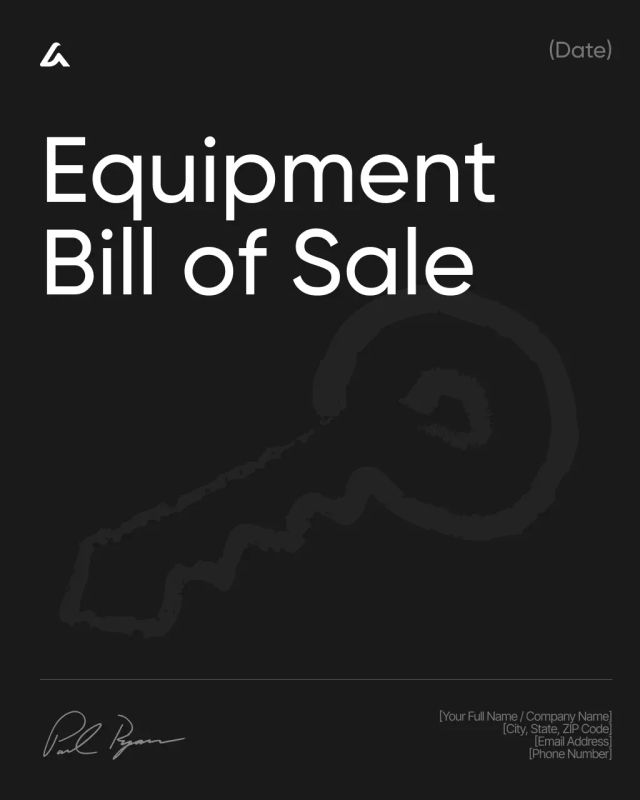 Equipment Bill of Sale Template
 Motorcycle Bill of Sale Template
 Furniture Bill of Sale Template

 Heavy Equipment Bill of Sale Template
 Gifted Car Bill of Sale Template
 Vehicle Bill of Sale (Florida)
 Vehicle Bill of Sale (New York)
 Vehicle Bill of Sale (Arizona)
 Tractor Bill of Sale Template
 Vehicle Bill of Sale (California)

 Personal Property Bill of Sale Template
 Vehicle Bill of Sale (Illinois)
 Mobile Home Bill of Sale Template
 General Bill of Sale
 Vehicle Bill of Sale (Texas)