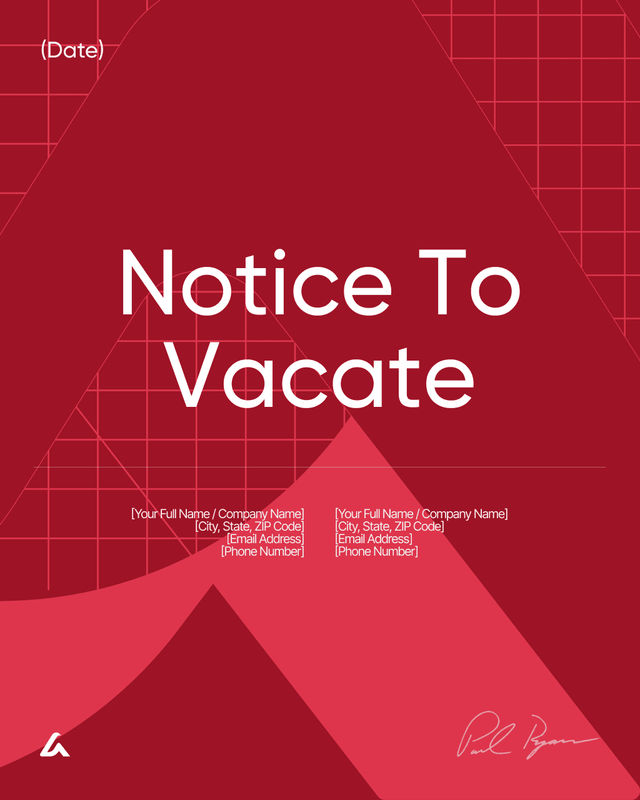

30-Day Notice to Terminate Tenancy (Month-to-Month) Template

30-Day Notice to Terminate Tenancy (Month-to-Month) Template

30-Day Notice to Terminate Tenancy (Month-to-Month) Template

30-Day Notice to Terminate Tenancy (Month-to-Month) Template

Typical length: 4-6 pages

Length: 4-6 pages

AI Assisted

Export: PDF & DOCX

Multi-jurisdiction ready

Multi-jurisdiction

Get your custom agreement in minutes

4.8 Rating

Downloaded 4168 times

Google For Startups

Google For Startups

NVIDIA Inception Program

NVIDIA Inception Program

30-Day Notice to Terminate Tenancy (Month-to-Month) Template


Date of Notice: [Date]

From: [Landlord/Property Manager or Tenant Name]
Address: [Address]
Phone/Email: [Phone/Email]

To (Tenant(s) or Landlord): [Name(s)]
Rental Property Address: [Street Address, City, State, ZIP]


1. Notice of Termination

This letter is formal notice that the month-to-month tenancy for the above rental property will terminate in 30 days (or as required by applicable law) from the date this notice is served.


2. Termination Date

The tenancy will end on: [Move-Out Date] (the “Termination Date”).
Tenant must vacate and deliver possession of the property by the Termination Date.


3. Move-Out Instructions (Optional)

3.1 Keys and Access Devices. Return keys, garage remotes, and access devices to: [Location/person].
3.2 Condition. Leave the unit in clean condition and remove all personal property.
3.3 Forwarding Address. Provide a forwarding address for deposit return and notices: [Instructions].
3.4 Final Walkthrough (Optional). Final walkthrough requested on: [Date/time], contact: [Name].


4. Security Deposit (Optional)

4.1 Deposit Return. Security deposit will be handled according to applicable law and the lease terms.
4.2 Deductions. Any deductions may include unpaid rent, damages beyond normal wear, and other lawful charges.


5. Proof of Service

I declare that I served this notice on [Service Date] by the following method (check one):

☐ Personal delivery
☐ Certified mail / return receipt
☐ Delivery to a person of suitable age at the premises and mailing a copy
☐ Posting the notice at the premises and mailing a copy (if allowed)
☐ Other: [Method]


Signatures

[Name]
Role: ☐ Landlord/Agent ☐ Tenant
Date: [Date]
Signature: ___________________________

30-Day Notice to Terminate Tenancy (Month-to-Month) Template


Date of Notice: [Date]

From: [Landlord/Property Manager or Tenant Name]
Address: [Address]
Phone/Email: [Phone/Email]

To (Tenant(s) or Landlord): [Name(s)]
Rental Property Address: [Street Address, City, State, ZIP]


1. Notice of Termination

This letter is formal notice that the month-to-month tenancy for the above rental property will terminate in 30 days (or as required by applicable law) from the date this notice is served.


2. Termination Date

The tenancy will end on: [Move-Out Date] (the “Termination Date”).
Tenant must vacate and deliver possession of the property by the Termination Date.


3. Move-Out Instructions (Optional)

3.1 Keys and Access Devices. Return keys, garage remotes, and access devices to: [Location/person].
3.2 Condition. Leave the unit in clean condition and remove all personal property.
3.3 Forwarding Address. Provide a forwarding address for deposit return and notices: [Instructions].
3.4 Final Walkthrough (Optional). Final walkthrough requested on: [Date/time], contact: [Name].


4. Security Deposit (Optional)

4.1 Deposit Return. Security deposit will be handled according to applicable law and the lease terms.
4.2 Deductions. Any deductions may include unpaid rent, damages beyond normal wear, and other lawful charges.


5. Proof of Service

I declare that I served this notice on [Service Date] by the following method (check one):

☐ Personal delivery
☐ Certified mail / return receipt
☐ Delivery to a person of suitable age at the premises and mailing a copy
☐ Posting the notice at the premises and mailing a copy (if allowed)
☐ Other: [Method]


Signatures

[Name]
Role: ☐ Landlord/Agent ☐ Tenant
Date: [Date]
Signature: ___________________________

Get your complete
agreement in minutes

Select template illustration
Select a template

Each template already follows legal structure and best practices.

Provide details illustration
Provide details

The agreement is automatically filled and adapted to your inputs.

Review & download illustration
Review & download

Check the generated document, make edits if needed, and download a ready-to-use agreement.

Details

Learn more about

30-Day Notice to Terminate Tenancy (Month-to-Month) Template

Click below for detailed info on the template.
For quick answers, scroll below to see the FAQ.

Click below for detailed info on the template.
For quick answers, scroll below to see the FAQ.

Frequently asked · Landlord & tenant law

30-Day Notice to Terminate Tenancy · Both directions, all 50 states

Eight questions tenants and landlords ask before sending a 30-day notice on a month-to-month tenancy. Includes state-by-state notice requirements (some states require 60 or 90 days), sample paragraphs for both directions, and the delivery rules that decide whether the notice actually starts the clock.

01 Basics

What is a 30-day notice to terminate a month-to-month tenancy?

A 30-day notice is a written statement that one party (tenant or landlord) is ending a month-to-month rental relationship in 30 days from delivery. It is the document state landlord-tenant law requires to end an indefinite, no-fixed-term rental cleanly.

The notice does three jobs: it identifies the rental, it states the termination date, and it gives the other party legally required advance warning to plan around. Without a written notice that meets the state's requirements, the tenancy continues by default and the next month's rent comes due as if nothing happened.

This is not the same document as an eviction notice (also called a notice to quit or pay-or-quit), which is used when a tenant has breached the lease and the landlord wants them out faster. The 30-day notice ends a tenancy on no-fault terms; eviction notices respond to non-payment, damage, or other breach.
02 Who uses it

Who can use this notice, landlord or tenant?

Both. The same document works in either direction, with one structural change. A tenant uses it to give the landlord notice they are moving out; a landlord uses it to give the tenant notice the tenancy is ending.

The difference is in the salutation, the move-out wording, and the contact information for the final inspection:

  • Tenant to landlord: "I, [tenant name], am giving 30 days' notice to vacate the premises at [address]. My final day of occupancy will be [date]." Plus forwarding address for the security deposit refund.
  • Landlord to tenant: "Pursuant to [state statute citation], you are hereby given 30 days' notice to vacate the premises at [address]. Your tenancy will terminate on [date]." Plus the address where the tenant should deliver keys and contact the landlord for the move-out inspection.

Several states require the landlord-direction notice to include a statutory citation or a statement of rights; the tenant-direction notice typically does not. See the BONUS section below for the state-by-state requirements.

03 Timing

Do you always need exactly 30 days?

No. About a third of US states require more than 30 days when the landlord is the one terminating, especially for tenancies that have lasted a year or more. The 30-day default is just that, a default.

Common patterns across states:

  • 30 days minimum, both directions: most states (TX, AZ, GA, IL, MO, NV, OH, PA, and others)
  • 60 days minimum from landlord if tenant has lived there 12+ months: California (Civil Code §1946.1), Oregon, Washington for rent-controlled jurisdictions
  • 60 or 90 days for any landlord-initiated no-fault termination: Hawaii (45 days from landlord; 28 from tenant), New York (90 days if tenant has been there 2+ years under Housing Stability and Tenant Protection Act)
  • Special protections for elderly or disabled tenants: several states require extended notice (60-120 days) for vulnerable tenants regardless of tenancy length

Always check the state-by-state matrix in the BONUS section before deciding the notice period.

04 Reason

Does the notice need a reason?

For a tenant ending a tenancy, no. For a landlord, it depends on the jurisdiction. Most states treat month-to-month termination as no-fault on either side; a handful require landlords to state and document a permissible "just cause" reason.

Jurisdictions where landlords MUST state a just-cause reason (as of 2026):

  • California (statewide): The Tenant Protection Act of 2019 (AB 1482) requires just cause after 12 months of tenancy in covered units
  • Oregon (statewide): SB 608 limits no-cause terminations after the first year of tenancy
  • Washington (statewide, for tenancies over 12 months): RCW 59.18.650 enumerates 16 permitted just-cause grounds
  • Several cities: Berkeley, Oakland, San Francisco, Seattle, Portland, New York City, Newark and others have local just-cause ordinances that go further than the state minimum

In all other states, no reason is required from either direction. Even where no reason is required, including a brief, neutral one is good practice: it reduces tenant confusion and creates a record if a discrimination claim is later raised.

05 Delivery

How should the notice be delivered?

State law decides what counts as effective delivery, and the 30-day clock only starts on the date the notice was effectively delivered, not the date it was signed. Using the wrong delivery method is the most common reason notices fail.

Delivery methods accepted by most states, in order of certainty:

  1. Personal hand delivery to the other party, with a witness or photo timestamp
  2. Certified mail, return receipt requested, to the address in the lease (or the rental property itself, for landlord-to-tenant)
  3. Posting and mailing ("nail and mail"): physically posting the notice on the door AND mailing a copy. Several states (California CCP §1162, NY RPAPL §735, FL §83.56) require this for landlord-initiated notices when personal delivery has failed
  4. Email or text, only if the lease explicitly allows electronic notice OR state law has been updated to accept it (a growing list including Texas, Florida for some notices, and a few others)

Whichever method you use, keep proof: a return receipt, a photograph of the posted notice with a timestamp, or a delivery confirmation. The proof is what makes the notice enforceable if the other side claims they never received it.

06 Compare

What is the difference between a 30-day notice, a notice to vacate, and an eviction notice?

They sound similar but do different legal work, and the wrong one buys you a delay or a lawsuit.

  • 30-day notice (or 60/90-day, depending on state). No-fault termination of a month-to-month tenancy. Used when neither side has breached the lease. The tenancy ends on a stated date.
  • Notice to vacate. Often used interchangeably with "30-day notice", but in some jurisdictions specifically refers to a tenant's notice of intent to move out. Same legal effect when the time period and form match the state requirement.
  • Eviction notice (notice to quit, pay-or-quit, cure-or-quit). Used when there is a breach (non-payment, damage, lease violation). Notice period is much shorter (often 3-14 days) and is a precondition to filing an eviction lawsuit. The tenant has the option to cure (pay back rent, fix the violation) before the clock runs.
  • Court eviction order (judgment for possession). The actual court order, issued after the eviction lawsuit, that authorises a sheriff to remove the tenant. Only this final step legally forces a tenant out; landlords cannot self-help even after the notice period expires.
07 State law

What if my state requires more than 30 days?

Use the longer period, not 30 days, and cite the relevant state statute in the notice. Filing or relying on a 30-day notice when state law required 60 means the notice is legally invalid, the tenancy continues, and the clock has to restart.

Quick check: the state-by-state matrix in the BONUS section shows the current 2026 notice requirements for landlord-initiated no-fault terminations. The most common over-30-day requirements:

  • California (statewide): 60 days for tenancies over 12 months (Civil Code §1946.1)
  • Oregon (statewide): 90 days for landlord-initiated, no-fault after first year (SB 608)
  • New York (NYC and elsewhere): 90 days for tenancies over 2 years (HSTPA, 2019, updated 2024)
  • Washington (state, for tenancies over 12 months): 60 days with just-cause requirement (RCW 59.18.650)
  • Hawaii: 45 days from landlord, 28 from tenant (HRS §521-71)
  • New Jersey (Anti-Eviction Act jurisdictions): Just-cause required; no-fault terminations are limited or prohibited
08 Customise

Need a customized 30-day notice?

Use AI Lawyer to generate one tailored to your state, your tenancy length, and your direction. Pick tenant-to-landlord or landlord-to-tenant, pick the state, set the move-out date; the assistant produces a notice with the correct notice period for your jurisdiction, the right statutory citation, and the required just-cause language if your jurisdiction needs it. Have a local tenant or landlord attorney review on contested or rent-controlled tenancies before serving.

Draft a state-compliant notice in two minutes

Free template, with tenant-to-landlord and landlord-to-tenant variants, automatic state notice period, and the right statutory citation for landlord-initiated notices.

Use the template

Similar templates

Other templates from

Eviction Notice

Money back guarantee

Free trial

Cancel anytime

AI Lawyer protects

your rights and wallet

🌐

Company

Learn

Terms

©2026 AI Lawtech Sp. z O.O. All rights reserved.

Money back guarantee

Free trial

Cancel anytime

AI Lawyer protects

your rights and wallet

🌐

Company

Learn

Terms

AI Lawtech Sp. z O.O.

©2026

Money back guarantee

Free trial

Cancel anytime

AI Lawyer protects

your rights and wallet

🌐

Company

Learn

Terms

©2026 AI Lawtech Sp. z O.O. All rights reserved.

Money back guarantee

Free trial

Cancel anytime

AI Lawyer protects

your rights and wallet

🌐

Company

Learn

Terms

©2026 AI Lawtech Sp. z O.O. All rights reserved.