Frequently asked · Eviction & rent
3-Day Notice to Pay Rent or Quit · Rules, states, and how to serve it
A landlord's first legal step when rent is late. Here is who can use the 3-day version, how many days your state really gives, what the notice must say, how to serve it so the clock actually starts, and what changed for federally assisted housing in 2026. It is also the document tenants most often defeat in court when a landlord rushes it.
What is a 3-day notice to pay rent or quit?
It is a written demand giving a tenant a short, fixed deadline to either pay all overdue rent or move out. If the tenant does neither by the deadline, the landlord can file an eviction lawsuit, called an unlawful detainer in many states.
The notice itself removes no one. Only a court order and a sheriff or marshal can do that, usually weeks later.
Self-help eviction, such as changing the locks or shutting off utilities, is illegal in every state and can expose a landlord to damages.
The notice itself does not report to credit bureaus or appear in court records; that only happens if an eviction case is later filed.
3-day notice vs other eviction notices
A pay-or-quit notice is for unpaid rent and lets the tenant fix the problem by paying. A cure-or-quit notice covers other lease violations the tenant can correct, and an unconditional quit notice gives no chance to fix the issue at all.
Using the wrong notice for your situation is a common reason a case gets dismissed, so match the notice to the problem.
| Notice type | When you use it | Can the tenant fix it? |
|---|---|---|
| Pay or quit | Unpaid rent | Yes, by paying in full by the deadline |
| Cure or quit | A fixable lease violation | Yes, by correcting it in time |
| Unconditional quit | Serious or repeated violations, illegal activity | No, the tenant must move out |
Which states actually use a 3-day period?
The strict 3-day deadline is mainly a California rule, and California excludes weekends and judicial holidays from the count. Florida and Texas also use a three-day notice, while most other states give five, seven, ten, or fourteen days.
Using too few days for your state voids the notice, so always confirm your statute before you set the deadline.
| State or program | Notice to pay or quit | Note |
|---|---|---|
| California | 3 days | Count excludes weekends and judicial holidays |
| Florida | 3 days | Excludes weekends and legal holidays |
| Texas | 3-day notice to vacate | The lease can shorten or lengthen it |
| Arkansas | 3 days | For a civil unlawful-detainer action |
| Arizona, Illinois | 5 days | Common 5-day pay-or-quit states |
| Alaska, Nevada | 7 days | Seven-day demand |
| Connecticut | 9 days | Confirm current statute |
| New York | 14 days | 14-day rent demand |
| HUD subsidized housing | 30 days | Federal rule, still in place in 2026 (see below) |
Federal update for 2026: in February 2026 HUD moved to revoke the 30-day notice rule for nonpayment evictions in public housing and project-based rental assistance, but after a lawsuit it delayed that change in March 2026 and reopened it for comment. The 30-day federal notice still applies to most HUD-assisted housing for now; private rentals follow state law.
What must the notice include?
A valid notice names every tenant on the lease, identifies the property, states the exact past-due amount, says where and how to pay, sets the deadline, and clearly states pay or vacate. It must be signed and paired with proof of service.
- Full names of all tenants on the lease.
- The complete rental address, including unit number.
- The exact past-due rent amount and the period it covers.
- Where, how, and to whom rent can be paid.
- The deadline to pay or move out.
- A clear statement that failure to pay or vacate may lead to eviction.
- The landlord or agent signature, the date, and a proof-of-service section.
Do not demand more than rent. Adding late fees or utilities to the rent figure can invalidate the notice in some states.
List only rent for periods already past due, not rent that has not yet come due, or the whole demand can be challenged.
How do you fill out the notice, step by step?
Work top to bottom: tenants, address, the past-due amount only, where to pay, the deadline using your state count, then sign, date, and serve with proof. Keep a copy of everything you send.
- Enter all tenant names exactly as on the lease.
- Add the complete rental address, including unit number.
- List only past-due rent, not late fees or other charges.
- State where, how, and to whom payment can be made.
- Set the deadline using your state's day count.
- Sign and date the notice as landlord or agent.
- Serve it correctly and complete the proof of service.
How do you count the days?
Counting almost always starts the day after service, not the day you deliver the notice, and California, Florida, and several other states also skip weekends and court holidays.
In California a 3-day notice served on a Monday expires at the end of Thursday; served on a Friday, it runs to the end of the following Wednesday.
Miscounting is a top reason cases fail, so confirm whether your state counts calendar days or business days before you set the deadline.
When in doubt, give the tenant an extra day rather than one too few. A generous count is rarely a problem, but a short one restarts the whole process.
How do you serve a 3-day notice?
Most states allow personal delivery, substituted service on an adult at the home plus a mailed copy, or posting on the door plus mailing when no one can be reached. Certified mail with a return receipt creates a paper trail.
Follow your state's method exactly and complete the proof of service, because improper service alone can sink an eviction.
Keep the original signed notice and the proof of service together. A judge will want to see exactly how and when the tenant received it, and that one document often decides whether the case can move forward at the first hearing.
What happens after the deadline passes?
If the tenant pays in full within the deadline, the tenancy continues; if not, the landlord can file an unlawful-detainer or eviction case in court. Only after a court order can a sheriff or marshal remove the tenant.
A typical sequence is the notice, then a filed complaint, the tenant's response window, a hearing, a judgment, and finally a lockout only if the tenant still does not leave.
Many states let a tenant stop the eviction by paying the full amount before the court date, so keep records of every payment.
Court timelines vary widely by state and county, from roughly two weeks in fast jurisdictions to a few months where dockets are backed up.
Can a tenant fight a 3-day notice?
Yes, and a defective notice is one of the strongest defenses. Common arguments are an incorrect amount, a deadline shorter than the law allows, improper service, a disputed balance, or a landlord who refused a valid payment.
- The notice demanded the wrong amount or added late fees.
- The deadline was shorter than state law allows.
- Service did not follow the state method.
- The tenant tried to pay in full and was refused.
- Serious habitability problems went unrepaired.
None of these pause the deadline on their own, so tenants should respond in writing and keep proof of any payment offered.
Common mistakes that get notices thrown out
The frequent errors are demanding the wrong amount, counting the days wrong, using too short a deadline, leaving off a tenant on the lease, adding late fees, skipping proof of service, and trying self-help eviction.
Any one of these can force you to start over and delay the case by weeks, so slow down and check each field before you serve.
Reading the notice out loud once before you serve it catches most of these errors in under a minute, especially a wrong amount or a missing tenant name.
Quick answers
Does the notice evict the tenant? No, it is only the first step; an eviction needs a court order.
Can I include late fees? Often no; demanding more than the rent due can void the notice, so check your state.
What if the tenant pays part? Accepting partial rent can waive the notice in some states, so get advice before you accept it.
Can I email or text it? Usually no; most states require personal delivery, posting plus mail, or certified mail.
Need a 3-day notice built for your state?
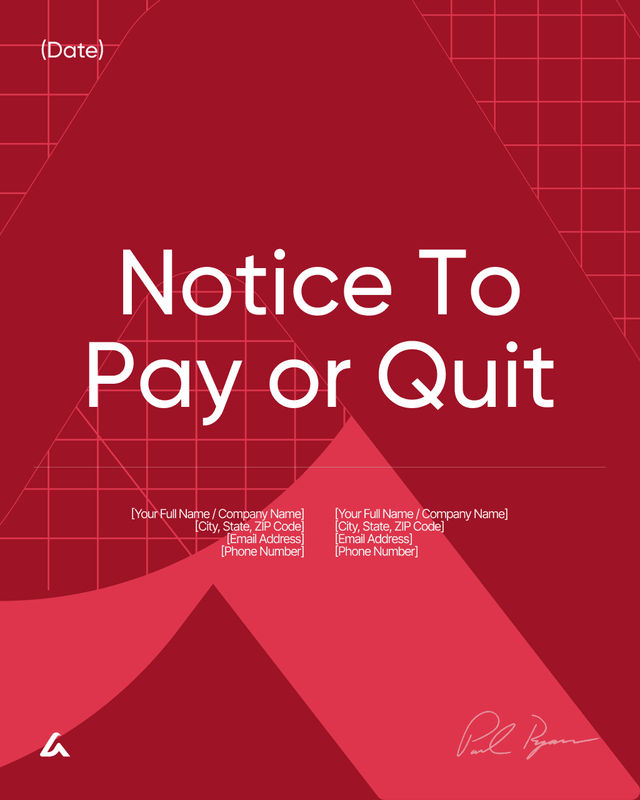
Use AI Lawyer to generate a pay-or-quit notice tailored to your state, your tenant, and the exact amount due. Pick the state, enter the past-due rent and the deadline, and the assistant produces a notice with the correct notice period and the right service language.
It also flags states that exclude weekends from the count and reminds you to attach proof of service. Have a local attorney review contested or rent-controlled cases first. Start a free draft with AI Lawyer.
Serve a pay-or-quit notice that holds up
Use the template above, then let AI Lawyer set the correct deadline, wording, and service steps for your state and answer your questions in plain English. Legal information and document help, not a law firm.
Try AI Lawyer freeRelated templates: Eviction Notice · Residential Lease · Remove a Roommate · Late Rent Notice