I am writing to formally express my interest in being considered for the [Job Title] position recently [posted/announced] within [Department/Company Name]. Having served as [Current Position] for [Duration], I have developed a deep understanding of our company’s operations and culture and believe I am well-positioned to contribute even more in this new capacity.
Qualifications and Achievements
During my time with [Company Name], I have successfully [list key accomplishments — e.g., improved efficiency, led projects, increased sales, enhanced team performance]. My work has consistently supported the company’s goals, and I have taken pride in demonstrating leadership, reliability, and initiative.
Intent and Contribution
I am confident that my skills in [specific areas — e.g., project management, communication, or client relations] align closely with the responsibilities of the [Job Title] role. I am eager to bring continued dedication and results-driven focus to this new challenge, contributing to the growth and success of our team.
Closing
Thank you for considering my application for promotion. I would appreciate the opportunity to discuss my qualifications and how I can contribute further to [Company Name]. Please let me know a convenient time for us to meet.
Frequently asked · Internal promotions & career moves
Job Promotion Letter of Intent · What to say, who to send it to, and what it can (and can't) do
Eight questions to settle before you send a letter of intent for a promotion. This is a career document, not a legal contract: it expresses your interest in a specific internal role and makes the business case for you. The letters that work lead with a quantified result, name the exact role, and land on the right desk. Below the FAQ: a part-by-part guide with sample language for the target role, your accomplishments, your readiness, and the ask, plus a do-and-don't checklist.
Internal role · Quantified achievements · Timing · Who to addressPart-by-part guide with sample languageAt-will employment context explainedReviewed July 2026
01Basics
What is a job promotion letter of intent?
A job promotion letter of intent is a formal written statement in which an employee tells their employer they want to be considered for a specific higher-level role inside the same organization, and lays out the case for why they are ready. It is an expression of interest, not an application to an outside company and not a contract.
The letter does three jobs. It puts your candidacy for a named internal role on the record with the people who decide. It summarizes the concrete results and skills that qualify you, framed around what you would deliver in the new position. And it opens a conversation — it usually closes by asking for a meeting to discuss the move. Unlike a resume, which is a factual inventory, a letter of intent is a persuasive, forward-looking document: it argues that promoting you is a good decision for the business, not just a reward for tenure.
02When to use
When should you write a job promotion letter of intent?
Write one when there is a specific role to aim at and a natural reason to raise it — most often when an internal opening is posted, when a manager encourages you to apply, or when your performance and scope have clearly outgrown your current title.
An internal opening is announced or posted. The cleanest trigger: a defined role exists, so you can name it and map yourself to it directly.
A manager or leader encourages you. If a supervisor has hinted the door is open, a letter turns an informal nudge into a documented, considered request.
You are already doing the bigger job. When your responsibilities have expanded well beyond your title, a letter makes the case to formalize what you have effectively been doing.
Ahead of review or budget cycles. Timing the letter to land before performance reviews, promotion rounds, or annual headcount planning gives decision-makers a window to act.
Avoid sending one in the middle of a hiring freeze, right after a layoff round, or immediately following a visible miss on your part — timing shapes how the letter is received as much as its content does.
03Compare
How is a letter of intent different from a cover letter or a performance review?
A cover letter accompanies a formal application and sells you as a candidate; a performance review looks backward at how you did in your current role; a promotion letter of intent is your own forward-looking pitch to be moved up into a named internal role. They overlap but are not interchangeable.
Vs cover letter. A cover letter is part of an application process and focuses on your fit for the job as advertised. A letter of intent is initiated by you, is not necessarily tied to a formal posting, and leans more on what you will do for the organization in the new role than on rehearsing your history.
Vs performance review. A review is your manager's assessment of past performance, on the company's schedule. A letter of intent is your assessment of your future value, on your schedule — you are proposing a change, not being evaluated.
Vs resume. A resume is a neutral inventory of experience. A letter of intent selects a few high-impact, quantified achievements and ties each to the responsibilities of the target role.
04What to include
What should a job promotion letter of intent include?
Six elements, in roughly this order, on one page. Decision-makers skim; structure the letter for the skim and put your strongest quantified result near the top.
The specific target role. Name the exact position and, if it exists, the requisition or posting. "The Senior Project Manager role posted on [date]" beats "a more senior position."
Your current role and tenure. One line establishing where you sit today and how long you have been building context in the organization.
Quantified achievements. Two to four results with numbers attached — revenue, hours saved, error rates, retention, project outcomes. "Reduced onboarding time from three weeks to eleven days" carries far more than "improved processes."
Skills mapped to the new role. Connect your strengths to the specific responsibilities of the target position, so the reader sees the fit without doing the work.
The benefit to the company. A sentence on what the organization gains by promoting you, not just what you gain.
The ask and a thank-you. A clear request to be considered and to meet, closing with appreciation for their time.
05Logistics
Who should you address the letter to?
Address it to the person who actually decides on the promotion — usually your direct manager, the hiring manager for the target role, or the department head — and copy HR when the role is formally posted. A letter sent to the wrong desk is a letter that gets forwarded, diluted, or lost.
Direct manager first, in most cases. Even when someone else owns the decision, routing around your manager can read as going over their head. Where possible, give them a heads-up or address them directly.
The hiring manager for the target role, when the promotion is into a different team and that person owns the requisition.
Department head or a skip-level leader, when they are the true decision-maker and your manager is aware.
HR / talent, as a copy when there is a formal posting or a structured internal-mobility process, so your interest is on the record.
Use the person's actual name and title. A specific salutation signals you understand who owns the decision; "To Whom It May Concern" signals the opposite.
06Legal effect
Is a job promotion letter of intent legally binding?
No. A promotion letter of intent is an expression of interest, not a contract. It does not obligate your employer to promote you, and it does not obligate you to accept if offered. It has persuasive weight, not legal force.
At-will employment is the default. In almost every US state, employment is at-will unless a written contract says otherwise. That means your employer can decline the promotion, restructure or cancel the role, or promote someone else for any lawful reason — and a letter of intent does not change that.
It creates no promise on either side. Sending the letter does not commit you, and receiving it does not commit them. It simply starts a documented conversation.
Narrow exceptions exist. If your employer makes a clear, specific promise of promotion that you reasonably rely on to your detriment, a doctrine called promissory estoppel can, in some cases, make that promise enforceable. And a promotion withheld for a discriminatory or retaliatory reason can raise separate legal issues. Both are fact-specific and warrant an employment attorney — the letter itself is not the binding instrument.
07Style
What tone, format, and length should it have?
Keep it professional and confident, one page, in standard business-letter format. Aim for three to four short paragraphs — an opening that names the role, a body that proves your case with numbers, and a close that asks for a meeting.
Practical rules that separate a strong letter from a forgettable one:
Lead with a specific, quantified result in the first two sentences, not with tenure or enthusiasm.
Confident, not entitled: make the business case, avoid implying you are owed the role.
Concrete over generic: "increased renewal rate from 71% to 84%" beats "consistently exceeded targets."
Forward-looking: spend at least as much space on what you will do in the new role as on what you have already done.
Proofread ruthlessly. A typo in a letter arguing you are ready for more responsibility undercuts the argument.
Match the channel to your culture — email is fine at most companies; a formatted PDF or printed letter suits more traditional ones.
08Customise
Need a customized job promotion letter of intent?
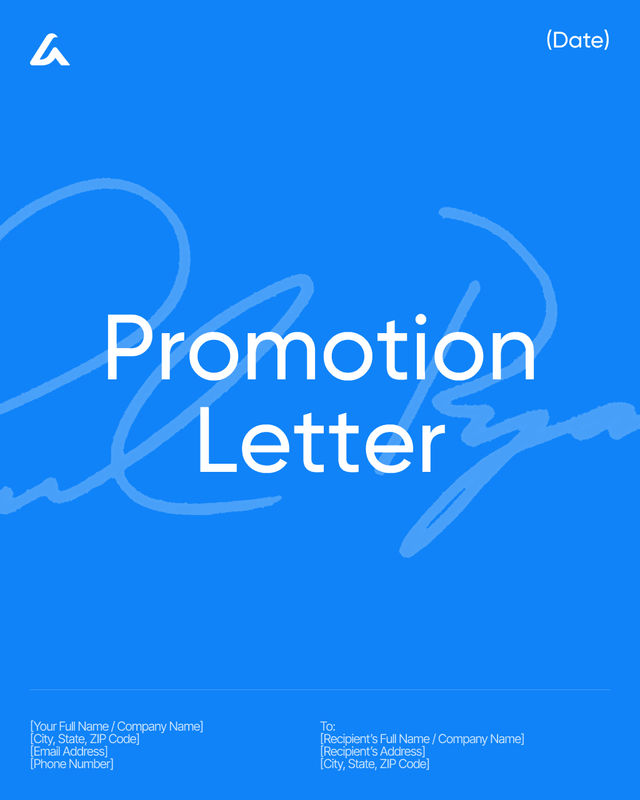
Use AI Lawyer to generate one tailored to your situation. Set your current role and tenure, name the target position, and drop in two or three quantified achievements; the assistant produces a one-page letter with the right structure — a specific opening, achievements mapped to the new role, the business benefit, and a clear ask — in a professional business-letter format ready to send to your manager or HR. Edit the numbers and names to fit, and read it once out loud before sending.
Make the case that promoting you is the obvious call
Free template, part-by-part sample language, structured to lead with a quantified result and map your strengths to the exact role you want.


 Promotion Letter Template
 Employee Handbook
  Personal Injury Questionnaire Template
  OSHA Form 300A – Summary of Work-Related Injuries and Illnesses Template
 Employment Termination Letter
  Employment Verification Letter Template
  Unpaid Internship Agreement Template
  Loss of Income Statement Template
  Job Description Template
  Medical Expense Summary Template
  Invention Assignment Agreement Template
  Medical Injury Report Template
  Internship Verification Letter Template
  Medical Records Request Form Template
  Internship Training Plan Template
  MIOSHA Form 300 – Log of Work-Related Injuries and Illnesses Template
  Internship Rejection Letter Template
  MIOSHA Form 300A – Summary of Work-Related Injuries and Illnesses Template
  Internship Recommendation Letter Template
 Internship Performance Review Template
  Motor Vehicle Accident Report Template