

Most disputes don’t escalate because one side is “more right.” They escalate because the other side keeps doing the thing — and you never put a clear stop-demand in writing. A Cease and Desist Letter is used to put the other party on notice and demand the conduct stop before the situation becomes harder (and more expensive) to fix.
This guide explains when a Cease and Desist is worth using (and when it isn’t), how the U.S. “letter” differs from an enforceable “order,” how to choose the right template by scenario, and how to send it in a way that preserves proof and reduces avoidable risk.
Disclaimer: This article is general information, not legal advice, and state laws and outcomes vary. If the stakes are high (safety concerns, major financial exposure, multi-state facts, or a sophisticated opponent), consider a U.S. lawyer review before you send anything.
TL;DR
-
A Cease and Desist is a practical pre-litigation tool used to put the other side on notice and demand that specific conduct stop, in writing.
-
Use a Cease and Desist Letter when you need a clear record (what happened, what must stop, and by when) before you spend money on escalation or formal filings.
-
Most Cease and Desist Letter drafts are not automatically enforceable like a court order, but they can create leverage and a paper trail that matters if the conduct continues.
-
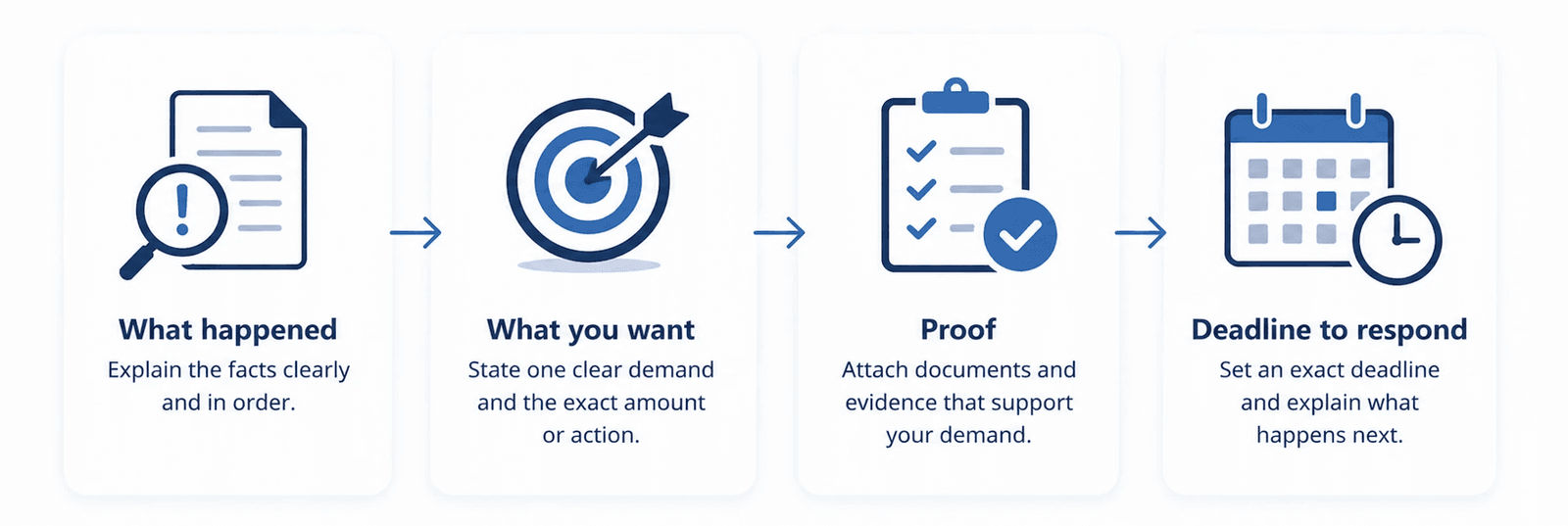
A strong Cease and Desist Letter makes the next phase executable: what must stop, the deadline to comply, what proof you’re preserving, and what you’ll do next if it doesn’t stop (e.g., report, formal demand, lawsuit, injunction request).
-
Start with the closest template for your scenario (harassment/stalking, defamation (libel/slander), IP (copyright/trademark/patent/cybersquatting), debt collection, breach of contract, non-compete, trespass) so you don’t force the wrong facts or legal theory into the draft.
-
If the stakes are high (safety concerns, major financial exposure, multi-state issues, or a sophisticated opponent), consider a U.S. lawyer review before you send anything.
You Might Also Like:
What Is Cease and Desist? (Meaning, Definition, and Purpose)
Meaning and definition
Working definition: Cease and Desist is a formal demand that someone stop specific conduct and not repeat it.
Plain-English meaning: It’s a written “stop” message that creates clear notice and a record you can point to if the conduct continues.
In U.S. practice, that demand is most often delivered through a Cease and Desist Letter—a cautionary letter describing the alleged misconduct and demanding it stop. For a plain-language baseline definition, see Cornell Law School’s Legal Information Institute (LII) entry on Cease and Desist Letters.
Cease and desist letters are especially common in trademark disputes, where businesses try to stop confusing use early; the USPTO explains how cease-and-desist (or demand) letters/emails work in the trademark context. See USPTO: “I Received a Letter/Email”.
What Cease and Desist does (and what it doesn’t)
A practical Cease and Desist Letter is useful because it:
-
Pins down the conduct (so the demand is measurable, not vague)
-
Creates a paper trail (who was told what, and when)
-
Sets a deadline and a clear path to comply (stop, remove, confirm)
-
Signals what you may do next if it doesn’t stop (without turning the letter into a lawsuit)
What it typically doesn’t do on its own:
-
It doesn’t automatically function like a court order
-
It doesn’t guarantee compliance just because it sounds formal
Pro tip: If your demand can’t be read and understood in under 20 seconds, it’s usually too broad. Narrow letters are harder to ignore and easier to escalate later.
What a Cease and Desist Letter typically includes (high level)
Most strong drafts include:
-
the parties (names + contact info)
-
a short facts section (what happened, where, and key dates)
-
the specific conduct to stop (clear and concrete)
-
the demand (stop/remove/correct/preserve evidence)
-
a compliance deadline (date)
-
a “no waiver / reserve rights” line
-
a response path (how to confirm compliance or propose resolution)
Short Cease and Desist example (style-only)
Date: March 5, 2025
Re: Unauthorized Use of XYZ Brand Name
This letter provides notice that you are using the XYZ name and logo in a manner likely to cause confusion. We demand that you cease and desist from all use of the XYZ mark, including on your website and social media accounts.
Conduct at issue: Use of “XYZ” on your Instagram profile and in promotional posts dated February 10–March 2, 2025.
Demand: Remove the XYZ name/logo from all online materials and stop using it in advertising.
Deadline: Confirm in writing by March 12, 2025 that you have complied.
If you want to start fast, start with a general Cease and Desist Letter template to get a clean first draft on the page, or use AI Lawyer to generate a draft from your scenario — then keep reading for templates tailored to specific Cease and Desist categories (harassment/stalking, defamation (libel/slander), intellectual property (copyright/trademark/patent/cybersquatting), debt collection/creditors, breach of contract, non-compete, and trespass).
Cease and Desist vs Similar Tools (Demand Letter, Restraining Order, Injunction, “Order”)
These tools solve the same practical problem: they help you stop harmful conduct and make the next step clear (comply, negotiate, or escalate). The difference is what kind of outcome you need right now: notice, money, safety, or an enforceable “stop.”
Cease and Desist Letter: best when you need a clear stop-demand (and a clean notice record)
A Cease and Desist Letter is the right tool when your goal is to define the conduct that must stop, set a deadline, and create a paper trail that the other side can’t credibly “misunderstand later.” It’s especially useful when the dispute is likely to escalate and you need the record to be clean.
Best fit: “Stop doing X, remove Y, confirm by date Z.”
Demand letter: best when money (or contract performance) is the real negotiation
A demand letter is usually the better fit when the center of gravity is payment (refund, damages, settlement) or performance (deliver goods, return property, cure a breach). It can include “stop doing X,” but it’s built to negotiate terms: amounts, deadlines, releases, and what happens if the demand isn’t met.
Best fit: “Pay/perform by date Z, or we’ll pursue legal remedies.”
Restraining order: best when safety and enforceable boundaries are the priority
A restraining order (often called a protective order) is the lane for immediate safety—threats, stalking, harassment, abuse—when you need enforceable boundaries like no-contact or stay-away provisions. This is not about writing a “stronger letter.” It’s a different process with eligibility rules and procedures that vary by state.
Best fit: “I need enforceable no-contact/stay-away rules now.”
Pro tip: If there’s immediate danger, don’t treat a letter as your safety plan.
Injunction / “Order”: best when you need an enforceable stop through a court or agency
If you need a judge to stop conduct quickly, the emergency lane is often a Temporary Restraining Order (TRO)—a short-term court order forbidding certain actions until a full hearing can be held. See U.S. Courts — Temporary restraining order (TRO).
A Cease and Desist Order is different from a letter: it’s an actual order issued through a government process (often an administrative adjudication). For example, the FTC describes how it can issue a final cease and desist order after an administrative proceeding and, in certain circumstances, seek civil penalties for violations. See FTC — Enforcement Authority.
Best fit: “I need an enforceable stop, not just notice.”
One quick “pick the tool” rule:
-
Use a Cease and Desist Letter when you need a measurable stop-demand + a clean notice record.
-
Use a demand letter when the negotiation is primarily about money or contract performance.
-
Use a restraining order when safety and enforceable boundaries are the priority.
-
Use a TRO / injunction / Cease and Desist Order when you need an enforceable stop through a court or agency process.
When Do You Need a Cease and Desist Letter?
A Cease and Desist Letter is worth using when writing down the stop-demand will save you time, money, or leverage. If you can resolve the issue immediately with a simple agreement (or the other side is already cooperating), a letter can be extra paperwork. But if the situation has moving parts—repeat conduct, unclear boundaries, evidence you need to preserve, or a real risk the story changes later—a Cease and Desist is often the cheapest way to prevent a costly “we never agreed on what had to stop” problem.
You’re most likely in Cease and Desist territory when someone is about to cause ongoing harm before any formal process exists: repeated harassment or unwanted contact, escalating defamation, continued brand misuse, ongoing copyright posting, or persistent collection pressure. That’s when notice and documentation matter—because the cost of “figuring it out later” spikes once the conduct continues, evidence disappears, or third parties get pulled in.
A practical reference point: in the debt collection context, the CFPB explains that if you don’t want a debt collector to contact you again, you can write and tell them to stop (and the CFPB even points to sample letters). See CFPB: “How do I get a debt collector to stop calling or contacting me?”.
The 30-second decision logic (in plain English)
If you need to draw a clear boundary (“stop this specific conduct”), set a deadline, and create a clean record of notice, use a Cease and Desist Letter. If your real goal is money or contract performance, a demand letter may fit better. If you need an enforceable stop immediately (especially safety situations), a letter is usually not the right primary tool. And if the issue is online copyright copying hosted by a platform, you may be better served (or at least faster) using the DMCA notice-and-takedown process—see the U.S. Copyright Office’s overview of the DMCA framework.
When you can usually skip it
You can often skip a Cease and Desist Letter when the issue is minor, the other party is already cooperating, or you can get a signed agreement right away that fully addresses the problem. It’s also commonly unnecessary when you’re not trying to change behavior (you’re only documenting for your files), or when you’re ready to move straight to a formal process and a letter won’t add meaningful leverage.
Micro-takeaway: A Cease and Desist Letter is a tool, not a requirement. Use it when it turns “please stop” into a boundary you can actually enforce or escalate—then move to the next step.
What a Cease and Desist Letter Can (and Can’t) Achieve
People often treat a Cease and Desist Letter as if it’s a legal “stop button.” In practice, it’s a strategy tool: it can sharpen the facts, raise the cost of ignoring you, and set up the next step — but it doesn’t magically replace an enforceable order.
What it can realistically accomplish
A strong Cease and Desist Letter can change the situation fast because it forces clarity and creates a record. As a practical overview of how these letters are commonly used (and why people send them), see Nolo’s explanation.
What it can’t do on its own
A letter typically can’t do the job of a court remedy. If what you actually need is an enforceable “stop,” that’s when you’re in injunction territory — governed in federal court by Federal Rule of Civil Procedure 65 (and state rules vary).
How to aim the letter at the outcome (without overreaching)
-
Can: create clear notice (who, what, where, when), define the exact conduct to stop, set a deadline, and make later escalation cleaner if the conduct continues.
-
Can: move leverage by making the dispute “real” for business counterparts (platforms, partners, vendors) who don’t want ambiguous risk.
-
Can’t: function like an injunction or restraining order just because it uses legal language.
-
Can’t: guarantee compliance — so it should always be written with a realistic “what’s next” path.
Practical takeaway: A Cease and Desist Letter works best when it turns a messy complaint into a measurable demand + deadline + record — and quietly sets you up to escalate if the behavior doesn’t stop.
Cease and Desist Letter Format (Core Structure + Key Drafting Points)
A strong Cease and Desist Letter doesn’t work because it sounds “legal.” It works because it’s specific enough to comply with and specific enough to document. The recipient should be able to read it once and understand what must stop, what “compliance” means, and when you expect confirmation.
In the U.S., you might send it as a formal letter, a PDF attached to an email, or a structured email. The wrapper can vary, but the must-have content is basically the same. (In trademark disputes, the USPTO describes cease-and-desist/demand letters as correspondence alleging potential infringement and demanding the recipient stop using the accused mark.) See USPTO: “I Received a Letter/Email”.
The core structure (plain order)
Date + recipient details: Date, recipient name/entity, and their mailing/email address (whatever you’re using for delivery).
Sender details: Your name (or business/entity), address, email, and phone (enough to identify you and route replies).
Subject line (or “Re:”): A short subject that identifies the issue (e.g., “Unauthorized Use of [Brand]” / “Stop Unwanted Contact” / “Defamatory Statements”).
Authority/relationship (if applicable): One sentence stating who you are to the matter (e.g., owner, authorized representative, counsel, or the person being contacted/targeted).
The conduct at issue: A direct description of what must stop, written so there’s no ambiguity (what the person is doing + where it’s happening).
Identifying examples: The minimum needed to identify the conduct (links/handles/post dates/message dates/order numbers, etc.). Reference attachments if you’re including screenshots.
Your basis (high level): A brief statement of why you say the conduct is wrongful (harassment/unwanted contact, defamation, infringement, breach of contract, etc.). Keep it readable and factual.
Your demand (what compliance looks like): The specific actions required to comply (stop doing X; remove Y; stop contacting via Z; stop using the name/logo; take down specified content; etc.).
Deadline + confirmation: A specific compliance deadline (date, and time zone if helpful) and exactly how you want confirmation (reply email, written confirmation, designated contact).
Preservation request (when relevant): If evidence matters, include a short request to preserve relevant records/content (messages, posts, logs). Keep it narrow.
Reserve rights: One line that you’re not waiving rights and you reserve remedies.
Signature block: A clear sign-off (“Sincerely,”) + typed name + title/company (if any) + contact info. If you’re sending a physical letter/PDF, you can add a handwritten/e-signature, but the signature block should be there either way.
Table: key points to specify (fast reference)
| Must-have item | What to include (minimum) | Purpose |
|---|---|---|
| Date | Date sent | Anchors the timeline |
| Recipient | Name/entity + delivery address/email | Ensures it reaches the right party |
| Sender | Name/entity + contact info | Identifies who is making the demand |
| Subject/Re | One-line description of the issue | Makes the purpose obvious |
| Authority | Who you are to the matter (if not obvious) | Prevents “wrong person” confusion |
| Conduct | Clear statement of what must stop | Defines the boundary |
| Where | URL/handle/platform/phone/email/location | Makes the issue trackable |
| Examples | A few specific instances with dates | Identifies the exact conduct |
| Basis | High-level reason (not a long brief) | Explains why the demand is being made |
| Demand | Concrete compliance steps | Makes the request executable |
| Deadline | Specific date (and time zone if needed) | Creates a measurable compliance window |
| Confirmation | How they confirm compliance | Closes the loop in writing |
| Preserve rights | “Reserve rights / no waiver” line | Avoids unintended concessions |
| Signature block | Sign-off + name + title/company + contacts | Confirms authorship and reply path |
Cease and Desist Types and Templates by Scenario
A Cease and Desist Letter works best when it matches the situation you’re actually in. Different scenarios require different “must-have” facts and different definitions of compliance. This section helps you pick the right category first—then the next section will point you to the closest template for that category.
Harassment / stalking / unwanted contact
Use this category when the core issue is repeated contact you want to stop across specific channels (calls, texts, email, social DMs, in-person visits). The letter should define “contact” in plain terms, list the channels involved, and state exactly what behavior must stop (and what counts as a violation).
Defamation (libel / slander)
Use this category when the harm comes from false statements being published or repeated. The letter should identify the statements with enough precision (quotes, links, dates, screenshots referenced) and specify what you want done (remove, correct, retract, stop repeating). The tighter you are on “what was said” and “where it appears,” the less room there is for denial or ambiguity.
Intellectual property (copyright / trademark / patent / cybersquatting)
Use this category when someone is using protected material or identifiers without permission—content, branding, inventions, or domains. The letter should point to the asset you’re claiming rights in, show the allegedly infringing use, and define the fix (stop use, remove content, transfer a domain, etc.). If the issue is copyrighted content hosted online, the U.S. process often overlaps with DMCA notice-and-takedown; the U.S. Copyright Office summarizes that framework here: U.S. Copyright Office — DMCA.
Debt collection / creditors / collection agencies
Use this category when your immediate goal is to stop (or limit) a collector’s communications. These letters should be short and direct: identify the consumer, identify the debt/account if known, and make the stop-contact request unambiguous — then keep proof of delivery. The baseline federal framework is the Fair Debt Collection Practices Act (FDCPA); the FTC hosts the statutory text here: FTC — FDCPA text.
Breach of contract / business disputes
Use this category when the conduct violates a business agreement or a defined obligation (misuse of confidential information, violating a restriction, continuing prohibited activity). The most effective drafts connect the conduct to the obligation (at a high level) and then spell out a concrete cure: what must stop, what must be returned/removed, and how compliance will be confirmed.
Non-compete / post-employment restrictions
Use this category when the dispute is tied to post-employment obligations (non-compete, non-solicit, confidentiality, return of materials). The letter should focus on what activity is allegedly restricted and what narrow steps you’re demanding (stop specific actions, confirm cessation, return company property, preserve records).
Trespass / property access
Use this category when you need to clearly revoke permission to enter or remain on property. The letter should identify the property, state that access is not authorized, and define the boundary (no entry, no return, no contact with occupants, etc.), plus how violations will be handled.
Cease and Desist Template Library
Once you’ve identified your category, the fastest way to draft a clean Cease and Desist Letter is to start with the closest matching template — then customize the facts (what happened, where it happened, key dates), the demand (what “compliance” means), and the deadline.
Here’s a practical library organized by scenario, so you can pick a template that already matches your underlying logic.
| Category | Best for | Templates |
|---|---|---|
| General (baseline) | A general stop-demand when you need a clear notice record but you’re not sure which specialized lane fits yet | - Cease and Desist Letter - Cease and Desist Email Template |
| Harassment / Stalking / Unwanted Contact | Repeated contact, intimidation, boundary violations across calls/texts/email/DMs/in-person | - Harassment Cease and Desist Letter Template - Stalking Cease and Desist Letter Template |
| Defamation (Libel / Slander) + Warnings | False statements, reputational harm, requests to remove/correct/stop repeating statements | - Cease and Desist Letter for Defamation Template - Libel Cease and Desist Letter Template - Slander Cease and Desist Letter Template - Defamation Warning Letter Template - Demand Letter for Defamation Template |
| Intellectual Property (General) | Broad IP disputes when you need one framework that covers rights + infringing use + required fix | - Intellectual Property Cease and Desist Letter Template |
| Copyright | Unlicensed copying/posting/distribution of protected content | - Cease and Desist Letter for Copyright Infringement Template |
| Trademark | Brand/name/logo use likely to cause confusion, marketplace misuse, competing identifiers | - Trademark Infringement Cease and Desist Letter Template - Trademark Infringement Warning Letter Template |
| Patent | Alleged use/sale of an invention covered by patent rights | - Patent Infringement Cease and Desist Letter Template |
| Cybersquatting / Domains | Domain disputes and bad-faith domain use tied to a brand | - Cybersquatting Cease and Desist Letter Template |
| Debt Collection / Creditors / Collections | Stopping or limiting collector communications; documenting a clear “stop contact” position | - Cease and Desist Letter to Debt Collector Template - Cease and Desist Letter to Collection Agency Template - Cease and Desist Letter for Creditors Template |
| Breach of Contract | Ongoing contract violations where the fix is “stop this conduct” and/or “cure this breach” | - Cease and Desist Letter for Breach of Contract Template |
| Non-Compete / Employment Restrictions | Post-employment restrictions and business-protection obligations | - Non-Compete Cease and Desist Letter Template |
| Trespass / Property Access | Revoking permission to enter/return; clear property boundary setting | - Trespassing Cease and Desist Letter Template |
How to Use a Cease and Desist Letter Template Safely (Step-by-Step)

A template is a shortcut, not a shield. Using it “safely” means you match it to the right scenario, anchor it to verifiable facts, and write the demand so compliance can be checked—without overreaching.
Step 1 — Start with the right scenario (don’t force a generic draft)
Pick the template that matches what you’re trying to stop (harassment, defamation, IP, debt collection, contract, etc.). The closer the match, the less you’ll have to invent—and the fewer “wrong-lane” statements you’ll accidentally include.
Output: One chosen template, plus a single-sentence case statement you can paste into the opening (who is doing what conduct, on which channel/platform, and what you want to stop).
Step 2 — Build your facts first (so the letter can’t be “misunderstood”)
Before you polish wording, assemble the identifiers that make the issue unmistakable: URLs/handles, post dates, message timestamps, listing IDs, screenshots, call logs—whatever applies to your scenario.
Output: A short timeline (3–8 lines) and a labeled set of examples you can reference in the letter (e.g., “Example 1: [platform] post dated…,” “Example 2: email sent on…,” “Screenshot A: profile page on…”).
Step 3 — Define compliance so it’s measurable (not emotional)
Write the demand in a way that can be objectively verified. Broad requests (“stop harassing,” “stop defaming,” “stop infringing”) should turn into specific actions (stop contacting via X channels, remove Y posts, stop using Z name/logo, delete specific listings, stop repeating the quoted statement, etc.).
Output: A compliance definition that reads like a checklist: exactly what must stop, what must be removed/corrected, what must be preserved (if relevant), and what “done” looks like.
Step 4 — Run a quick “risk check” before you send
Do a fast sanity pass to make sure the letter is defensible and doesn’t create avoidable problems:
-
Are you stating facts you can support (and clearly separating facts from conclusions)?
-
Are you demanding specific conduct changes rather than making sweeping accusations?
-
Is the tone firm but not theatrical (no threats you can’t or won’t follow through on)?
-
Is your request limited to what you actually need to stop the harm?
Output: A cleaned-up draft where each key claim is either supported by an example you’ve collected or rewritten as a narrower, provable statement—and where the demand is tight enough that a neutral reader could understand it without additional context.
Step 5 — Set the deadline, deliver with proof, sign, and save a “proof file”
Pick a clear deadline date for compliance and written confirmation, then send the letter in a way that leaves documentation. In the debt-collection context, the FTC specifically recommends sending a stop-contact request by certified mail and paying for a return receipt so you have a record the collector received it—this is a useful model for “proof-first” delivery. See FTC: Debt Collection FAQs.
Output: A ready-to-send final letter with a complete signature block, a documented delivery record (saved email thread and PDF copy, or mailing receipt/return receipt if used), and one organized folder containing the final draft + evidence + delivery proof + any response received.
Legal Requirements and Regulatory Context (U.S.)
This section is general U.S. information (not legal advice). The U.S. doesn’t have one “cease-and-desist statute”—what matters is the legal lane your issue falls into (state tort/contract law, federal IP law, regulated communications, or an agency process).
State law is the default lane (harassment + defamation + many business/property disputes)
Most Cease and Desist Letter disputes are primarily state-law matters, so standards and defenses can change by state. For reputation disputes, these U.S. definitions are a reliable baseline: Defamation, Libel, and Slander.
If you’re in a defamation lane, keep wording narrow and provable because some states have anti-SLAPP procedures (quick dismissal tools that may shift fees). See RCFP: anti-SLAPP overview and RCFP: anti-SLAPP legal guide.
For harassment/stalking, remedies are usually state-based, but there is also a federal stalking statute that can matter in certain interstate patterns: 18 U.S.C. § 2261A.
A letter is not an order (court relief uses different rules)
A Cease and Desist Letter is notice + demand, not an enforceable restriction. If you need an enforceable stop, that’s the injunction/TRO lane. In federal court, the framework is FRCP Rule 65, and the U.S. Courts glossary defines a Temporary Restraining Order (TRO).
E-signatures and electronic records (often fine)
It’s common to send a Cease and Desist Letter by email and sign with a typed signature block or e-signature. Federal law generally supports electronic records/signatures in many transactions under the E-SIGN Act (15 U.S.C. § 7001), and many states follow UETA-style rules (with exceptions).
“If relevant” checkpoints (pick what matches your category)
Trademark: start with USPTO: I received a letter/email and the Lanham Act lane 15 U.S.C. § 1125.
Copyright online: use Copyright Office: Section 512 resources, 17 U.S.C. § 512, and the DMCA Designated Agent Directory for platform workflows.
Debt collection: see FDCPA text (FTC) and 15 U.S.C. § 1692c.
Robocalls/texts: see 47 U.S.C. § 227 and FCC guidance.
Agency orders (not letters): for FTC context see FTC: enforcement authority; for an SEC example PDF see SEC: template settled C&D order.
Practical takeaway: Choose the lane first, then write the letter so it’s factual, measurable, and backed by documentation—so it holds up if you need to escalate.
Common Mistakes to Avoid (Expanded)
Most Cease and Desist Letter issues aren’t “legal” issues—they’re drafting issues. A letter fails when it’s vague, overreaching, or easy to ignore. Below are the most common mistakes, plus a practical “How to fix it” for each.
1) Writing as if you already have a court order
This mistake shows up as “You are hereby ordered…” language, demands phrased like official commands, or threats that imply enforcement you don’t actually have yet. It hurts credibility and can trigger unnecessary escalation.
How to fix it: Write like a demand, not a decree. Use plain language (“We demand that you stop X by Y date”) and keep consequences framed as realistic next steps (“we will consider further action”) rather than pretending you already have an enforceable order.
2) Describing the problem in feelings instead of facts
Statements like “stop harassing me” or “stop defaming me” are too abstract on their own. If the recipient can plausibly say “I don’t know what you mean,” your letter becomes easy to dismiss.
How to fix it: Translate feelings into conduct. Identify the behavior, where it’s happening, and the key examples (dates, links, screenshots, call logs). Make it so a neutral reader could point to the exact conduct at issue.
3) Making compliance impossible to verify
If the demand isn’t measurable, the other side can claim compliance while continuing the behavior in a slightly different form. Vague “stop” requests are especially vulnerable to this.
How to fix it: Define compliance like a checklist: what must stop, what must be removed/corrected, what channels are covered, and what confirmation you require. Replace generalities with specific actions (remove these URLs, stop contacting via these channels, stop using this mark, stop repeating this quoted statement).
4) Overreaching in scope (asking for more than you need)
Letters often fail because they pile on extra demands—some unrelated, some unrealistic. That gives the recipient more to argue about and less reason to comply quickly.
How to fix it: Narrow the draft to the minimum that stops the harm. Keep the request focused on the conduct at issue, and treat anything “nice to have” as optional negotiation—not a must-have demand.
5) Using accusations you can’t support (especially in defamation disputes)
Sweeping claims and aggressive labels (“criminal,” “fraud,” “extortion,” etc.) can backfire if you can’t prove them. In defamation scenarios, sloppy accusations are a common own-goal.
How to fix it: Stick to provable facts and quote the statements at issue. If you need to describe why the statements are wrong, do it with concrete corrections (what’s false and what the true facts are), not with insults or assumptions about intent.
6) Drafting in the wrong legal “lane”
Some scenarios have established U.S. processes and expectations (copyright takedowns, debt-collector stop-contact requests, trademark confusion analysis). When a letter is written as if it’s a different category, it slows everything down.
How to fix it: Match the template to the scenario and write to the lane: copyright letters should identify the work and the infringing location; debt letters should be short and direct about contact limits; trademark letters should identify the mark and the confusing use. Keep the structure consistent with what the scenario requires.
7) Sending it to the wrong person (or the wrong contact point)
A strong letter still fails if it never reaches someone who can act—wrong entity, wrong email, wrong department, or a person with no authority.
How to fix it: Identify the real decision-maker or correct receiving channel (entity name, registered agent, platform contact, business address). Then keep proof of delivery (saved email thread, delivery confirmation, or mailing record).
8) No clean response path (and no signature block)
If you don’t tell them how to confirm compliance, you invite scattered replies—or silence. Missing sender details can also make the letter feel unofficial or not actionable.
How to fix it: Give one clear method to respond (single email or address), state what confirmation should include (“confirm removal and cessation”), and include a complete signature block (name, title/company if applicable, and contact info).
9) No plan for “what happens next”
A letter is less effective if it’s a bluff. If you haven’t decided what you’ll do after the deadline, the recipient can often sense it—and ignore you.
How to fix it: Decide your escalation path before sending. That might be platform reporting, agency complaint, lawyer review, or court options depending on the category. You don’t need to include the full plan in the letter—you just need to have it ready.
What Happens After a Cease and Desist Letter?
After you send a Cease and Desist Letter, the recipient will usually do one of three things: comply, negotiate, or ignore it. The difference between “a letter that worked” and “a letter that went nowhere” is what you do next, and how clean your paper trail is.
In some categories, the “next step” isn’t another letter, it’s a formal workflow. For online copyright problems, that often means DMCA notice-and-takedown (the Copyright Office’s Section 512 hub is the best U.S. starting point).
Here’s a practical, more specific timeline you can follow:
-
Immediately after sending (same day)
-
Save a single PDF package: the final letter, any exhibits (screenshots/links/logs), and proof of sending (sent email with headers, certified mail receipt, etc.).
-
Put the deadline on your calendar and set two reminders: one 2 business days before the deadline and one the morning after the deadline.
-
-
Within 24–72 hours
-
If the letter was sent by email and you got no bounce-back, don’t “check in” yet. Let it land.
-
If you sent to a business and suspect it hit the wrong inbox, send one short administrative follow-up only: “Confirming receipt and the correct contact for compliance confirmation.”
-
-
If they respond (this is where you control the outcome)
-
If they agree to comply: ask for a written confirmation that repeats your compliance checklist in their words (what they removed/stopped, where, and when), and then verify it yourself.
-
If they ask for more time: don’t debate. Require a specific new deadline, an interim step (for example: take content down immediately while they “review”), and written confirmation.
-
If they deny or argue: reply once, briefly, with your best 2–3 evidence anchors (links/dates/examples) and restate the deadline. Don’t get pulled into long back-and-forth.
-
-
At the deadline
-
Re-check the conduct in the places you identified (URLs, profiles, listings, messages, domains, call logs).
-
If compliance is partial, send a short “remaining items” notice that lists only what’s still missing and gives a short final deadline (often 48–72 hours) for the remaining items.
-
-
After the deadline (choose an escalation that matches the category)
-
Copyright online: consider moving straight to the DMCA takedown lane for the platform/host (Section 512 resources are your map).
-
Debt collection contact: if your goal is “stop contacting me,” the FDCPA has a specific “ceasing communication” concept in the statute, which is why written notice and proof matter.
-
Everything else: decide whether your next move is platform/reporting route, attorney escalation, agency complaint (if applicable), or court options if you need enforceable relief.
-
Practical takeaway: Don’t treat “sending” as the action. The action is saving a proof file, controlling the response with short, evidence-based replies, and escalating through the correct lane if the deadline passes without real compliance.

AI vs. Lawyer (What to Choose)
There isn’t one “correct” way to prepare a Cease and Desist Letter. The right choice depends on the downside if you get it wrong, whether you expect a lawyered-up response, and how technical the category is (IP, defamation, regulated debt-collection contact rules).
Attorney pricing varies widely by state, experience level, and practice area, so treat published benchmarks as directional and get a quote for your facts. If you want a state-by-state view of typical lawyer hourly rates, see LawPay’s overview: Lawyer Hourly Rate by State. For an additional benchmark view and rate comparison tools, Clio publishes rate resources that reference Legal Trends data.
| Option | Best for | Typical cost range (U.S.) | Main advantages | Main risks |
|---|---|---|---|---|
| DIY / AI (template + self-service) | Clear facts, low-to-mid stakes, you can document the conduct well (links, screenshots, call logs), and you mainly need a clean “stop” demand | Often $0–$100 (templates) or subscription pricing (varies by tool) | Fast to produce and easy to iterate; good for straightforward scenarios where specificity matters more than legal theory | Easy to choose the wrong lane (defamation vs. opinion, trademark vs. general naming), overreach on demands, or write threats that reduce credibility |
| Lawyer review (you draft, lawyer edits) | Mid-stakes situations where you want state-aware risk checks, tighter wording, and a stronger escalation posture without paying for full drafting | Commonly hourly billing; benchmarks often land in the low-to-mid hundreds per hour, with higher rates for specialists | Catches avoidable mistakes (tone, scope, claims you can’t support, missing proof setup); improves how the letter “reads” to counsel | Review scope is limited; a lawyer can’t fix missing facts or evidence, and may not negotiate unless you expand scope |
| Lawyer-drafted letter (sent on firm letterhead) + handling replies | High stakes, repeat-player counterparties, valuable IP, serious harassment/defamation exposure, or when you want negotiation managed | Often hourly or flat-fee depending on scope; higher if the lawyer is expected to negotiate and manage back-and-forth | More leverage; cleaner strategy; better control of what you admit, what you demand, and what escalation looks like | Higher cost and coordination burden; outcome depends heavily on complete facts, documentation, and realistic goals |
A practical rule is: use DIY/AI when the downside is manageable and you can be very specific; pay for lawyer review when you want credibility and risk-control without full spend; invest in lawyer drafting/handling when the situation is high-stakes, technical, or likely to escalate.
FAQ: Cease and Desist (U.S.)
What is a Cease and Desist Letter?
A Cease and Desist Letter is a written notice that identifies specific conduct and demands it stop by a stated deadline. In the U.S., it’s often used to create a clear record of notice (what conduct you complained about, what you demanded, and when), and to give the recipient a practical chance to comply before the dispute escalates.
When should you use a Cease and Desist Letter?
Use a Cease and Desist Letter when you need a fast, documented way to set boundaries and request a specific change in behavior, especially when you can point to concrete examples (links, posts, messages, listings, calls). It’s most effective when the recipient can realistically fix the issue quickly and you want a clean paper trail if they don’t.
What should be included in a Cease and Desist Letter?
At minimum, include the sender and recipient (names and contact info), a clear description of the conduct at issue (and where it’s happening), a few identifying examples (dates/links/screenshots or message logs), a specific demand that defines compliance, a deadline to comply and confirm in writing, and a complete signature block showing who is making the demand and where responses should go.
What is a cease and desist order?
A Cease and Desist Order is an enforceable directive issued by a court or, in some contexts, an agency through a formal process. Unlike a private letter, an order can carry legal consequences for noncompliance because it’s backed by official authority and procedures.
Cease and desist letter vs cease and desist order: what’s the difference?
A Cease and Desist Letter is a private demand and a notice record; it does not, by itself, create enforceable restrictions. A Cease and Desist Order is an official, enforceable command issued through a legal process, which is why ignoring an order can carry consequences that ignoring a letter usually does not.
Does a Cease and Desist Letter have legal force in the U.S.?
A Cease and Desist Letter is not a court order, so it doesn’t “force” compliance on its own. Its practical power is that it can establish notice, clarify your demands, and strengthen your position if you later pursue platform remedies, agency steps, attorney escalation, or court relief.
Can I use a Cease and Desist Letter template in Word or PDF format?
Yes. Word is usually best for drafting because you can tailor the facts and tighten the demand; PDF is usually best for sending because it fixes the content and helps preserve a clean record of what was delivered. The key is to customize the template so the conduct, examples, compliance steps, and deadline fit your scenario.
Can I send a Cease and Desist Letter by email?
Yes, email is common in U.S. practice, especially for business and online disputes. For a cleaner record, many people send a short email with the Cease and Desist Letter attached as a PDF, request written confirmation of compliance, and save the sent message plus any attachments and replies.
Do I need a lawyer to send a Cease and Desist Letter?
Not always. If the facts are clear and the stakes are low-to-moderate, a well-written template can be enough. If the matter is high-stakes, highly technical (trademark/copyright/patent), state-sensitive (defamation/anti-SLAPP risk), or likely to escalate, a U.S. lawyer review can prevent costly mistakes and improve leverage.
What should I do after sending a Cease and Desist Letter?
First, preserve your proof file (final letter, exhibits, and delivery record). Then track the deadline and verify whether the conduct actually stopped; if the recipient responds, get compliance commitments in writing and confirm completion. If there’s no compliance by the deadline, move to the next step that matches your category (platform workflow, formal complaint route, attorney escalation, or court options if you truly need enforceable relief).
Get Started Today
A well-built Cease and Desist Letter protects your time and your leverage. When the conduct is described clearly, the compliance steps are measurable, and the deadline is real, you reduce back-and-forth and increase the odds the issue gets resolved without escalation.
Use the scenario sections above to pick the closest template lane (harassment/stalking, defamation, copyright/trademark, debt collection/creditors, contract or trespass), then pair it with a simple proof file so the other side can’t stall on “missing details.” A clean letter plus clean documentation turns a messy dispute into a trackable process.
Start with the Cease and Desist Letter template from our library, or generate a first draft with AI Lawyer, then customize it to your facts (examples, demands, deadline, delivery method, and what written confirmation should say). If the stakes are high (valuable IP, serious reputational harm, multi-state exposure, or a sophisticated counterparty), consider having a U.S. lawyer review the draft before you send it.
You Might Also Like:
Sources and References
Core cease-and-desist framing in this guide (what a Cease and Desist Letter is, what it typically accomplishes, and why it’s used) draws on Nolo’s overview of cease-and-desist letters: What Is a Cease and Desist Letter?.
Court-enforceable “stop” tools discussed in this guide (injunctions and temporary restraining orders) follow the federal framework in FRCP Rule 65 (Cornell Law School LII).
Plain-English context for what a TRO is (and why it’s different from a Cease and Desist Letter) relies on the U.S. Courts glossary entry: Temporary restraining order (TRO).
Defamation terminology used in defamation-related examples (including the basic U.S. framing of what “defamation” means) is grounded in Cornell’s Wex entry: Defamation.
Anti-SLAPP “why overreach can backfire” background (relevant to defamation-warning style letters) uses the Reporters Committee for Freedom of the Press overview: Anti-SLAPP Laws.
Trademark cease-and-desist context (how the USPTO describes demand letters in trademark disputes) relies on: USPTO — I received a letter/email.
Lanham Act unfair competition and “false designation” references (often the statutory backbone behind brand-related cease-and-desist demands) use: 15 U.S.C. § 1125 (Cornell LII).
Copyright notice-and-takedown workflow references (where a Cease and Desist Letter may overlap with platform removal processes) use the U.S. Copyright Office hub: Section 512 resources.
The “where do I send a DMCA notice” routing reference for online service providers uses the official directory: DMCA Designated Agent Directory.
Debt-collection stop-contact references (when your Cease and Desist Letter is aimed at limiting collector communications) rely on the FDCPA communications section: 15 U.S.C. § 1692c (Cornell LII).
Robocall/robotext practical guidance (for unwanted calls/texts scenarios) uses the FCC consumer guide: Stop unwanted robocalls and texts.
Electronic records and signature validity background (relevant when sending by email or using e-signature) relies on the E-SIGN statute: 15 U.S.C. § 7001 (Cornell LII).
Lawyer pricing benchmarks referenced in the “AI vs. Lawyer” section use: LawPay — Lawyer hourly rate by state.