Incident Response Plan Template
Subtitle: Quickly detect, contain, and recover from security incidents with this Incident Response Plan template.
[Company Name]
Incident Response Plan (IRP)
Date: [MM/DD/YYYY]
Version: [Version Number]
Prepared by: [Name/Department]
1. Purpose and Scope
This Incident Response Plan establishes the framework for responding to security incidents that may impact the confidentiality, integrity, or availability of [Company Name]’s systems, data, and operations. It applies to all employees, contractors, and third-party service providers.
2. Objectives
-
Detect and respond to incidents quickly and effectively.
-
Minimize financial, operational, and reputational harm.
-
Ensure compliance with legal, regulatory, and contractual obligations.
-
Improve defenses through lessons learned.
Detect and respond to incidents quickly and effectively.
Minimize financial, operational, and reputational harm.
Ensure compliance with legal, regulatory, and contractual obligations.
Improve defenses through lessons learned.
3. Incident Response Team (IRT)
-
Incident Response Manager: [Name/Role].
-
Technical Leads: [System/Network Administrators].
-
Legal/Compliance Officer: [Name].
-
Communications Officer: [Name].
-
HR Representative: [Name] (if personnel-related).
Incident Response Manager: [Name/Role].
Technical Leads: [System/Network Administrators].
Legal/Compliance Officer: [Name].
Communications Officer: [Name].
HR Representative: [Name] (if personnel-related).
4. Incident Classification
Incidents are categorized as:
-
Low Severity: Minor disruptions with limited impact.
-
Medium Severity: Disruptions requiring management attention.
-
High Severity: Critical incidents causing system outages, legal risk, or reputational harm.
Low Severity: Minor disruptions with limited impact.
Medium Severity: Disruptions requiring management attention.
High Severity: Critical incidents causing system outages, legal risk, or reputational harm.
5. Detection and Reporting
-
Employees must report suspicious activity immediately to [IRT Contact Email/Phone].
-
Automated systems (SIEM, IDS/IPS) provide real-time alerts.
-
Incident logs will be maintained for compliance and audits.
Employees must report suspicious activity immediately to [IRT Contact Email/Phone].
Automated systems (SIEM, IDS/IPS) provide real-time alerts.
Incident logs will be maintained for compliance and audits.
6. Containment Procedures
-
Isolate affected systems from the network.
-
Disable compromised accounts.
-
Block malicious IPs, domains, or services.
-
Coordinate with vendors or partners if external systems are impacted.
Isolate affected systems from the network.
Disable compromised accounts.
Block malicious IPs, domains, or services.
Coordinate with vendors or partners if external systems are impacted.
7. Eradication and Recovery
-
Remove malicious software, unauthorized access, or vulnerabilities.
-
Patch systems and apply security updates.
-
Restore operations from verified backups.
-
Conduct validation testing to confirm system integrity.
Remove malicious software, unauthorized access, or vulnerabilities.
Patch systems and apply security updates.
Restore operations from verified backups.
Conduct validation testing to confirm system integrity.
8. Communication Plan
-
Internal notifications to management and employees.
-
External notifications to regulators, law enforcement, clients, or the public as required.
-
Pre-approved templates for public statements and breach notifications.
Internal notifications to management and employees.
External notifications to regulators, law enforcement, clients, or the public as required.
Pre-approved templates for public statements and breach notifications.
9. Evidence Preservation
-
Secure and document logs, files, and devices relevant to the incident.
-
Maintain chain of custody for potential legal proceedings.
-
Work with legal counsel to determine reporting obligations.
Secure and document logs, files, and devices relevant to the incident.
Maintain chain of custody for potential legal proceedings.
Work with legal counsel to determine reporting obligations.
10. Post-Incident Review
-
Conduct a root cause analysis.
-
Evaluate the effectiveness of the response.
-
Document lessons learned and update this plan accordingly.
Conduct a root cause analysis.
Evaluate the effectiveness of the response.
Document lessons learned and update this plan accordingly.
11. Training and Testing
Conduct regular employee awareness training on incident reporting.
Perform tabletop exercises and simulated attacks to test response readiness.
12. Plan Maintenance
Review and update the plan at least annually or after major incidents.
Update team member contact information and system inventories.
Approval and Sign-Off
Authorized by: __________________________
Name/Title: [Executive Sponsor]
Date: ___________________


 Cookie Policy
  Disclaimer Template
 Data Sharing Agreement Template
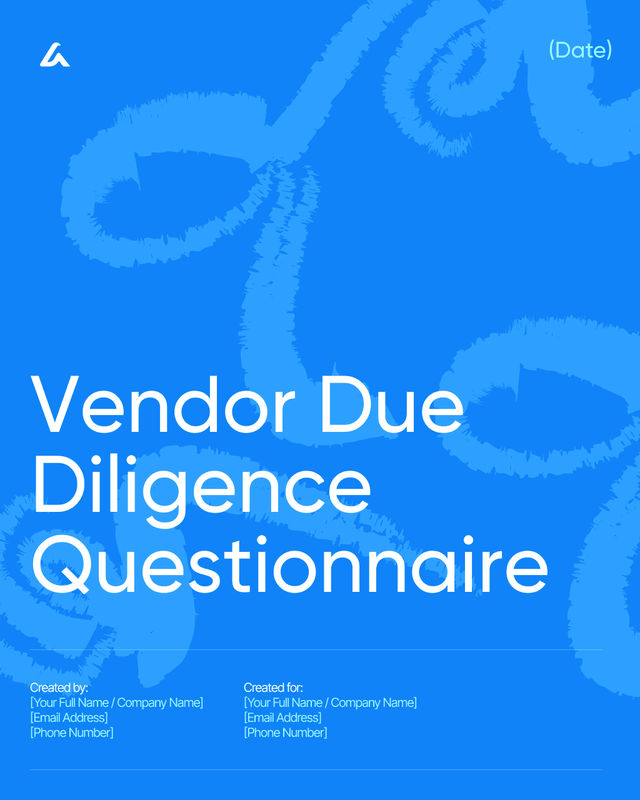 Vendor Due Diligence Questionnaire Template
 Information Security Policy Template
  Access Control Policy Template
 Joint Controller Agreement Template
  HIPAA Business Associate Agreement Template
  KYC Form Template
  Gift Acceptance Policy Template
  KYC Form Template
  GDPR PRIVACY NOTICE (UK/EU) TEMPLATE
  Export Control Compliance Policy Template
 Endowment Spending Policy Template
  EMERGENCY ACTION PLAN TEMPLATE
 Electronic Communications Policy Template