


A quick conversation does not always solve a workplace problem. When an issue keeps happening, an employment warning letter helps put the situation in writing. It shows what the problem is, what needs to change, and what can happen next if nothing improves.
For U.S. employers, this document is useful because it turns a verbal concern into a clear HR record with expectations, accountability, and a path forward.
Disclaimer
This article provides general information — not legal advice — and it is written for a U.S. audience. Employment warning letters and related disciplinary letters can carry different legal and practical consequences depending on state law, employer policy, union status, contract terms, the employee’s complaint history, leave status, disability-related issues, and the specific facts behind the discipline, so wording that seems routine in one workplace may create risk in another. Because these documents can affect later employment decisions and become part of the employer’s record, having HR or a qualified attorney review a sensitive draft before it is issued can prevent mistakes that are difficult to undo later.
TL;DR
-
**An employment warning letter is a formal written notice that explains a workplace problem, states what must improve, and warns about possible next steps if the issue continues.
** -
Employers often use it for repeat attendance issues, policy violations, poor performance after feedback, or unprofessional conduct.
-
It is not the same as a verbal warning at work, a final written warning, or every other kind of disciplinary notice.
-
A good written warning for an employee should be specific, factual, and tied to a real policy or performance expectation.
-
Templates can save time, but copying a generic employee written warning form without adapting it to the facts can create HR and legal risk.
-
AI can help draft routine warning letters for employees, but sensitive cases involving leave, disability, complaints, retaliation concerns, or likely termination usually need HR or lawyer review.
You Might Also Like:
What Is an Employment Warning Letter?
An employment warning letter is a formal written notice that documents a workplace problem and tells an employee what must change. Employers usually use it when an issue has moved beyond informal feedback and now needs a clear written response.
The problem may involve attendance, conduct, performance, or failure to follow workplace rules. In most cases, the letter explains what happened, identifies the expectation that was not met, and states the correction the employee is expected to make. It may also set a timeline for improvement and warn that stronger discipline can follow if the issue continues.
This is why the document matters in practice: it does not just react to a problem, it creates a written record of the employer’s response. That record can help show that the employee was informed of the concern, given clear expectations, and warned about possible next steps.
When Might You Need an Employment Warning Letter?
You usually need an employment warning letter when a workplace issue is no longer minor, isolated, or suitable for informal feedback alone. Not every mistake needs written discipline. In many cases, coaching or a verbal conversation comes first. A warning letter becomes more useful when the employer needs a clear written record of the issue and the expected correction.
Attendance problems are a common example. Repeated lateness, unscheduled absences, failure to follow call-off rules, or leaving early without approval can justify a written warning when the problem continues. But this area needs care. If the absences may involve protected leave, employers should pause before issuing discipline, because U.S. Department of Labor guidance on FMLA protections explains that FMLA leave cannot be used as a negative factor in disciplinary actions or counted under no-fault attendance policies.
Performance issues can also lead to a warning letter. If an employee has already received feedback but the same work problems keep happening, written discipline may be the next step. That may include missed deadlines, repeated errors, incomplete work, or failure to meet basic role expectations.
Conduct is another frequent trigger. Unprofessional behavior, refusal to follow instructions, repeated policy violations, or insubordination may require a formal written response. In some cases, the issue is a pattern. In others, one incident is serious enough to document immediately.
Employment Warning Letter vs. Similar Documents
Confusion usually starts because employers use similar labels for different discipline documents. The most important distinction is that a disciplinary letter is a broader category, while a warning letter is only one document inside that category. In other words, not every disciplinary document is a warning, even if all of them deal with workplace discipline.
A second point is timing. These documents do different jobs at different stages of the discipline process. Some are used to document an early correction step. Others confirm that discipline has already escalated into a more serious action.
| Document | What the document does | When it is usually used | Main distinction |
|---|---|---|---|
| Verbal warning record | Notes that a verbal warning or coaching conversation took place | Early-stage correction | Supports a spoken step rather than acting as the main written discipline document |
| Employment warning letter | Records the issue, required improvement, and possible consequences | When the issue needs formal written documentation | Standard written warning document |
| Final written warning | States that the issue is serious or repeated and that stronger action may follow | After prior discipline or after a more serious incident | Higher and more serious level of discipline |
| Suspension letter | Confirms a suspension and explains the reason | Serious misconduct or escalation | Documents an actual disciplinary action |
| Demotion letter | Confirms a reduction in role, level, or duties | When position status is being changed | Records a status change, not just a warning |
| Reprimand or write-up form | Records a specific incident in a shorter format | Internal documentation or lower-level discipline | Often narrower and less detailed than a full warning letter |
The key question is not what the document is called, but what role it plays in the discipline process.
Core Elements and Format of an Employment Warning Letter

A strong warning letter should make the issue easy to understand and the next step easy to follow. Its purpose is not simply to show that the employer is dissatisfied. It should tell the employee what happened, what standard was not met, and what correction is now expected.
“The point of the employer’s comments should be a clear explanation of the employee’s performance deficiencies or misconduct and what he expects the employee to do to improve.” — EEOC guidance on applying performance and conduct standards
That quote captures the practical standard well. A usable warning letter should give the employee enough detail to understand both the problem and the required improvement.
Core structure checklist
-
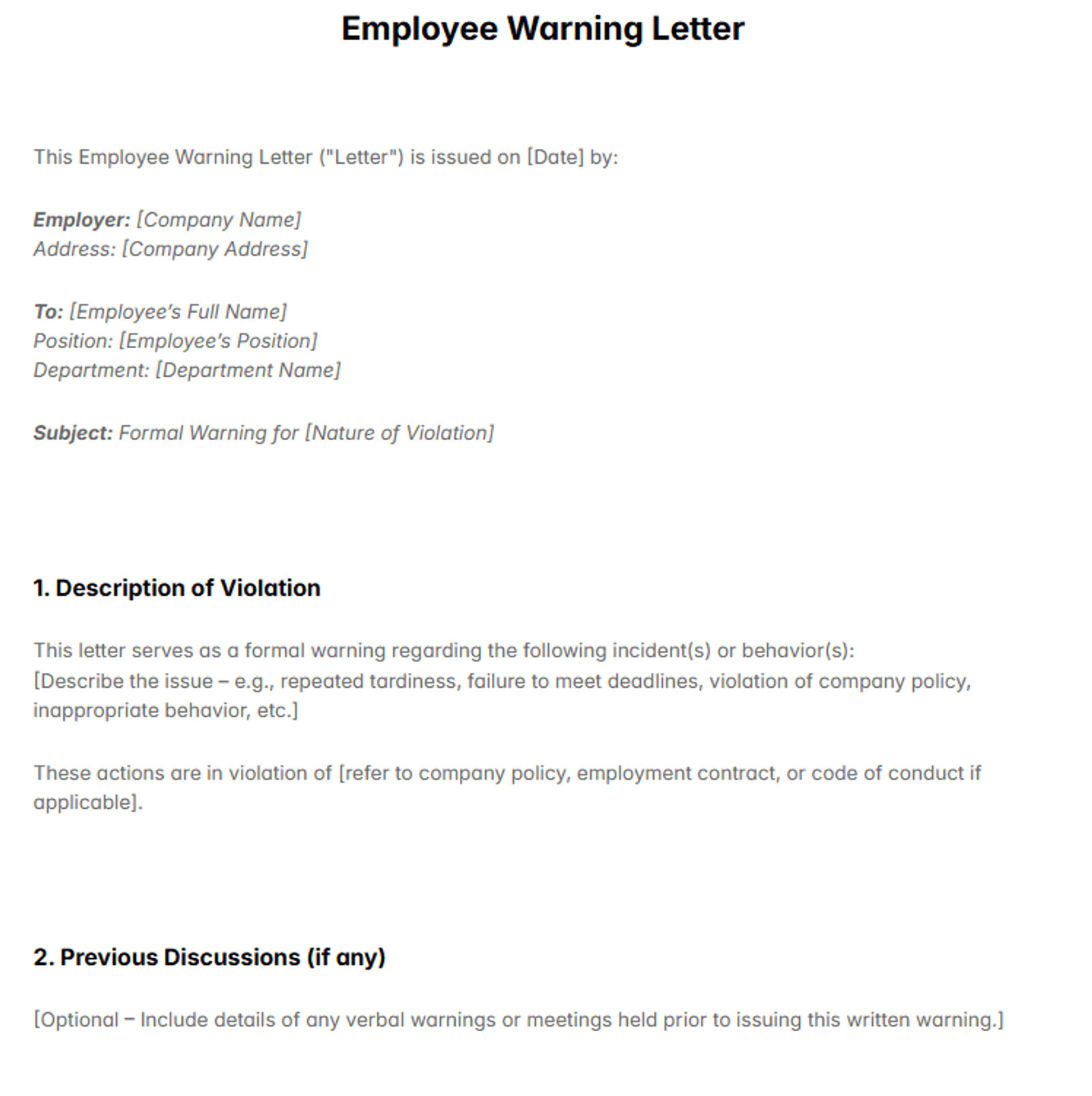
Employee details and date: identify who the document concerns and when it was issued.
-
Clear subject line: show the purpose of the document immediately.
-
Factual description of the issue: explain what happened and when.
-
Relevant rule or expectation: connect the issue to a policy, instruction, or job standard.
-
Required corrective action: state what must change.
-
Improvement timeline: include a deadline when needed.
-
Possible next steps: explain what may happen if the issue continues.
-
Acknowledgment block: confirm receipt of the document.
If these elements are in place, the letter is much easier to use, review, and support later.
Progressive Discipline: Where a Warning Letter Fits
A warning letter usually sits in the middle of the discipline process. It often comes after coaching or a verbal warning, but before a final warning, suspension, or termination. The exact sequence depends on employer policy and the seriousness of the issue.
A common progression looks like this:
-
Coaching or informal feedback — the issue is raised early and informally.
-
Verbal warning — the employee is told more directly that the problem must stop.
-
Written warning — the issue is formally documented in writing.
-
Final written warning — the employer signals that the matter is now at a more serious stage.
-
Suspension or termination — stronger action follows if the issue continues or the conduct is severe.
This structure is useful because it shows that discipline is often meant to correct behavior before it escalates. As SHRM explains in its guide on how to administer a progressive discipline policy, the process is designed to provide a structured corrective action path. That makes the warning letter an important bridge between early feedback and more serious employment action.
Still, the sequence is not automatic. Serious misconduct can justify skipping earlier steps, while less serious issues may stay at the coaching stage longer. Employers should follow their own policy, apply discipline consistently, and avoid treating progressive discipline like a rigid script.
Before You Issue a Warning: Documentation Checklist
A warning letter should come after verification, not before it. If the facts are incomplete, the timeline is shaky, or the policy basis is unclear, the document becomes weaker from the start.
Before issuing the letter, the employer should make sure the underlying record is solid. That usually means confirming what happened, when it happened, what instruction or rule was involved, and whether the employee had already been coached or warned earlier. It also means checking whether similar cases were handled in a similar way. A warning is easier to support when the employer can show that the response was fact-based, policy-based, and reasonably consistent.
That approach lines up with EEOC guidance for small businesses:
“Consider documenting the reason(s) for the discipline or termination.” — EEOC guidance for employers on discipline and termination decisions
That does not mean employers should document carelessly or rush to discipline. It means the opposite. The right time to test the facts, review prior steps, and compare the situation to policy is before the warning is issued, not after it is challenged.
Red-Flag Situations Before Discipline
Some warning letters should not be issued right away. If the facts suggest protected activity, medical overlap, or fast-moving escalation, the employer should stop and review the situation first. A document that looks routine can become risky because of timing and context.
Timing can change the risk
Be especially careful if the employee recently complained about discrimination, harassment, or another protected issue. The same caution applies after an accommodation request, an internal complaint, or participation in an investigation. As the EEOC’s retaliation guidance makes clear, discipline issued soon after protected activity can create retaliation concerns even when the employer believes the warning is justified. A warning may be defensible on the facts, but still risky because of when it was delivered.
Leave and medical issues need a second look
Attendance and performance problems are not always simple discipline cases. Sometimes they overlap with disability, accommodation, or protected leave. The U.S. Department of Labor’s FMLA protections explain that FMLA leave cannot be used as a negative factor in discipline. If leave or a medical issue may be part of the story, the warning should be reviewed before it is issued.
Serious cases are rarely routine
Extra care is also wise when the matter is already moving toward suspension or termination. The closer the case is to serious action, the less safe it is to treat the warning as a routine HR step.
Scenario Templates
Different workplace problems call for different types of written discipline. The first question is not which template to open, but what kind of issue the employer is actually dealing with. Once that is clear, the document can be adapted much more safely.
Attendance and notice issues
This category covers repeated lateness, recurring attendance problems, and absences that were not reported properly. The document should establish the dates, the reporting rule, and the pattern or incident that triggered the warning. The main risk is treating a leave-related or emergency-related absence like ordinary misconduct.
Conduct and behavior issues
This category fits disrespectful conduct, workplace disruption, refusal to cooperate, or other behavior problems that affect team functioning or policy compliance. The letter should describe specific actions, not vague character judgments. The main risk is relying on labels like “bad attitude” instead of concrete examples.
Failure to follow instructions
This category applies when the employee was given a clear direction, procedure, or expectation and did not follow it. The document should show what instruction was given, when it was given, and what the employee did instead. The main risk is ignoring whether the instruction was clear, reasonable, and within the employee’s role.
Performance problems after feedback
This category covers ongoing work problems that continue even after coaching or prior feedback. That can include repeated errors, missed deadlines, incomplete work, or failure to meet role expectations. The main risk is using discipline before checking whether the employee had enough clarity, training, and support.
Serious misconduct that may escalate
Some cases move quickly because the conduct is too serious for a light corrective step. In those situations, the warning must be drafted carefully because it may become part of a larger disciplinary record.
AI vs. Lawyer
There is no single right way to prepare a warning letter. The best option depends on how clear the facts are, how serious the issue is, and how likely the document is to become part of a larger dispute or termination record. The right choice usually turns on risk, not just convenience.
Because legal pricing varies by state, market, and matter type, treat any cost discussion as directional rather than fixed. If you want a benchmark view, see Clio’s lawyer rate benchmarks by state and the latest Clio Legal Trends Report.
| Option | Typical cost level (U.S.) | Main advantages | Main risks |
|---|---|---|---|
| Template only | Low | It gives you a fast starting point for routine discipline. Useful when the facts are clear, the policy basis is obvious, and the issue is low-stakes. | It can be too generic and miss context that matters later. A template may not fit prior discipline, internal policy wording, or the actual facts. |
| AI-generated draft | Low to moderate | It helps turn scattered notes into a cleaner first draft quickly. Good for structure, tone, and speed when the case is straightforward. | It can sound confident while missing legal or factual nuance. It may overstate conclusions, flatten context, or use wording that does not fit the case. |
| AI draft + lawyer review | Moderate | It combines drafting speed with focused legal review. Often a practical middle option when the facts are mostly clear but the stakes are not trivial. | The review is only as good as the facts you provide. If key context is missing, the lawyer cannot fully correct the draft. |
| Lawyer-drafted letter | Higher | It is the strongest option when the warning may carry serious legal or employment consequences. Best for protected-leave issues, disability overlap, retaliation concerns, union settings, or likely termination. | It costs more and usually requires more coordination. It may be more than necessary for a simple, low-risk warning. |
Practical rule: use a template or AI draft for straightforward, low-risk situations; add lawyer review when the facts are sensitive, disputed, or likely to matter later.
Template Library
Use the library below to match the issue category to the most relevant starting documents. The goal is to choose the closest template set first, then tailor the draft to the facts.
| Category | Primary decision | What it helps prevent | Templates |
|---|---|---|---|
| Attendance and notice issues | Decide whether the problem is about attendance patterns or failure to report an absence properly | Treating lateness, no-call/no-show issues, and possible leave-related absences as the same problem | - Absence Without Notice Warning Letter - Attendance Warning Letter |
| Conduct and behavior issues | Decide whether the issue is disrespectful conduct, disruption, or broader workplace behavior problems | Vague behavior write-ups and generic wording that does not describe actual conduct | - Unprofessional Behavior Warning Letter - Workplace Conduct Reprimand |
| Failure to follow instructions | Decide whether the problem is noncompliance, refusal, or failure to follow a clear direction | Confusing unclear instructions with actual misconduct or using the wrong discipline level | - Warning Letter for Not Following Instructions - Insubordination Warning Letter |
| Performance problems after feedback | Decide whether the issue is ongoing poor performance after coaching, not a one-time mistake | Turning a coaching issue into premature discipline or describing performance as misconduct | - Written Warning Letter to Employee - Poor Performance Warning Letter |
| Serious misconduct that may escalate | Decide whether the warning may become part of a larger record leading to final warning, suspension, or termination | Under-documenting high-risk conduct or using a routine template in a high-stakes case | - Employment Disciplinary Letter - Final Written Warning |
A good template library helps the employer choose faster without treating every discipline issue the same way.
How to Use a Template Safely (Step-by-Step)
A template is only a starting point. The safest way to use one is to move from facts to fit, then from fit to wording, and only then to delivery. That sequence helps prevent the most common drafting mistakes.
1. Gather the facts first
Start with the timeline. Confirm what happened, when it happened, who was involved, and what documents or notes support the issue. A warning letter should be built on verified facts, not manager frustration or memory alone.
2. Confirm the policy basis
Before choosing language, confirm which rule, instruction, attendance expectation, or job standard is actually involved. If the employer cannot point to a real workplace expectation, the draft is already weaker. The document should be tied to a concrete policy or performance standard, not to a vague sense that the employee “should have known better.”
3. Choose the closest template
Pick the template category that best fits the actual issue. Use the closest match, not the most severe-sounding version. A notice problem, a conduct problem, and a performance problem do not need the same framing. A template is safer when its structure already matches the kind of issue being addressed.
4. Customize the wording to the facts
Replace generic lines with the real details of the case. Add dates, incidents, expectations, and required correction. Remove anything that does not fit. A template saves time only if it is tailored to the real situation.
5. Keep the tone factual and specific
The letter should describe conduct, performance, or attendance issues in concrete terms. Avoid emotional language, legal-sounding threats, or broad character judgments. As the EEOC’s guidance on performance and conduct standards makes clear, clarity matters when employers communicate deficiencies and expectations. A useful warning letter explains the problem in a way the employee can actually understand and respond to.
6. Check consistency with prior discipline
Review earlier coaching, verbal warnings, or written steps. Make sure the draft fits the employer’s discipline history and is not out of line with similar cases. A warning becomes harder to defend when it looks inconsistent with the employer’s own prior actions.
7. Review for red flags
Pause before issuing the letter if the case involves protected leave, accommodation, discrimination complaints, injury reporting, union issues, or likely termination. Sensitive timing can change the risk of an otherwise ordinary warning.
8. Deliver and document properly
Once the letter is final, deliver it in the normal discipline process, document receipt, and keep a record of what happened next. A well-drafted warning still needs proper delivery and follow-up to serve its purpose.
Common Mistakes to Avoid

Even when the underlying concern is real, a warning letter can still create problems. Most weak warning letters fail because of poor wording, poor fit, or poor judgment about context.
Using labels instead of facts
A letter becomes weaker when it relies on conclusions like “unprofessional,” “careless,” or “disruptive” without showing what actually happened. The employee should not have to guess what conduct is being addressed. A warning works best when the facts are concrete enough to understand and specific enough to answer.
How to fix it: replace labels with dates, incidents, missed expectations, or observable conduct.
Letting tone do the work
A warning letter should not sound angry, sarcastic, or dramatic. A harsher tone does not make the document more credible. It usually makes it look less controlled.
How to fix it: cut emotional wording, personal judgments, and anything that reads like frustration instead of documentation.
Using the wrong document level
Some employers jump to a written warning too quickly. Others use a light warning even though the matter is already moving toward stronger action. The letter becomes less useful when the level of discipline does not match the actual situation.
How to fix it: match the document to the real stage of discipline, not to the manager’s immediate reaction.
Copying a template without tailoring it
Templates save time, but they also create obvious mistakes when the wording does not fit the case. A generic draft can describe the wrong issue, use leftover language, or miss the real point of the warning. A template helps only when it is adapted to the facts in front of you.
How to fix it: keep the structure, but rewrite the substance so the document matches the real issue.
Treating the signature like agreement
In many workplaces, the employee signs only to confirm receipt. That is different from agreeing with every statement in the letter. An acknowledgment block should document delivery, not force an admission.
How to fix it: make the signature language about receipt of the warning, not acceptance of its conclusions.
Ignoring protected context
This mistake creates risk fast. Leave, disability, recent complaints, or safety reporting can change the meaning of an otherwise routine warning. The U.S. Department of Labor’s FMLA guidance, EEOC retaliation guidance, and OSHA worker protections all point in the same direction. A warning can look ordinary on its face and still become risky because of the surrounding facts.
How to fix it: pause and review the context before issuing the letter.
Failing to document what happened next
Some employers save the warning letter and then stop documenting. That leaves the record incomplete. The value of a warning often depends on what happened after delivery, not just on the letter itself.
How to fix it: document receipt, follow-up, employee response, and any later improvement or non-improvement.
After Signing
Once the warning has been signed, delivered, or marked as refused, the employer’s job shifts from drafting to follow-up. The value of the document now depends on what the employer does with it after delivery.
Put the warning into the working record
The letter should be placed in the appropriate personnel or HR file under the employer’s normal recordkeeping process. That allows the warning to be reviewed later in context, alongside earlier discipline, later follow-up, and any next-step decision.
Set a follow-up date
If the letter gave the employee time to improve, that timeline should not be left vague. The employer should set a review point and return to the issue on schedule. A warning is more useful when it leads to a documented check-in instead of being filed away and forgotten.
Record what happened after delivery
The file should show what happened next. That may include improvement, repeated problems, questions from the employee, or a dispute about the facts. The record becomes stronger when it reflects the employee’s response and later workplace events, not just the original warning itself.
Use the next step only if the facts support it
If the employee improves, that should be noted. If the issue continues, the employer should document the new facts and decide whether another disciplinary step is appropriate. What matters after signing is not the existence of the warning alone, but whether the employer followed through in a clear and consistent way.
Legal Requirements and Regulatory Context
A warning letter is not judged only by what it says. It is also judged by why it was issued, when it was issued, and whether the employer followed the right rules. That is where legal risk usually starts.
Protected activity can change the legal meaning of a warning
A letter may look normal on its face and still raise a retaliation problem. That can happen when the employee recently complained about discrimination, reported harassment, joined an internal investigation, or otherwise engaged in protected EEO activity. The EEOC retaliation overview and the more detailed EEOC retaliation guidance both make the same point: the law looks not only at the employer’s stated reason, but also at whether the warning was tied to protected activity. In simple terms, the risk is not just “Was there a problem?” but also “Why did the warning happen now?”
Leave and disability issues can change what counts as a valid warning
Some attendance and performance problems are not purely discipline problems. If absences are covered by the FMLA, the DOL’s FMLA protections fact sheet says employers may not use that leave as a negative factor in discipline. The same issue comes up when conduct or performance overlaps with disability and accommodation duties. The EEOC’s guidance on performance and conduct standards explains that employers may enforce job-related standards, but disability-related obligations still remain. So the legal issue is often not the rule itself, but whether the employer separated the rule from protected leave or accommodation rights carefully enough.
Safety reporting and union rights add extra legal rules
A warning can also become risky if it follows an injury report or safety complaint. OSHA says workers have the right to report injuries and illnesses free from retaliation, and its recordkeeping rule says reporting procedures cannot discourage accurate reporting. Union settings add another layer. Under the NLRB’s Weingarten rights guidance, a union-represented employee may have the right to request representation in an investigatory interview that could lead to discipline. That means the legal problem may come from the process around the warning, not just the warning itself.
Consistency matters as much as wording
Even a well-written letter can create trouble if it does not match the employer’s own handbook, prior discipline, or treatment of similar employees. The EEOC’s small-business guidance on discipline and termination stresses documenting the reason for discipline, and the DOL’s Employer Guide to the FMLA explains that employers may have added obligations under policies or collective bargaining agreements. In practice, a warning is legally safer when the employer can show both a real reason and a consistent process.
FAQ
Can an employee be written up at work without a verbal warning?
Yes, that can happen. Some employers use progressive discipline and start with coaching or a verbal warning, but not every workplace follows the same sequence. In practice, employers may move straight to written discipline when the issue is serious enough or when the policy allows it. What matters most is whether the reason is legitimate, the process is consistent, and the employer is not acting for a discriminatory or retaliatory reason.
What is the difference between an employment warning letter and a disciplinary letter?
An employment warning letter is usually the narrower term. It refers to a written notice that identifies a problem, explains what must improve, and warns that stronger action may follow. A disciplinary letter is broader. It can include a warning letter, but it may also refer to a final warning, a suspension notice, or another formal discipline document.
What happens if an employee refuses to sign a written warning at work?
The warning does not disappear. In most workplaces, refusal to sign simply means the employer should document that the letter was presented, that signature was requested, and that receipt was refused. The practical point is to preserve a clear delivery record, not to force agreement.
Can a written warning for employee misconduct lead to termination later?
Yes. A written warning can become part of the record supporting later discipline if the same issue continues, a new violation happens, or the employer reaches the next step in its policy. That does not mean termination is automatic. It means the warning may become part of the employer’s documented basis for later action.
How long does a written warning stay in an employee personnel file?
There is no single national rule that says every warning must come out of a personnel file after a fixed number of days or months. In many workplaces, that question is controlled by employer policy, state law, a union agreement, or litigation needs. At a minimum, the EEOC says employers must keep personnel or employment records for one year, and longer retention rules may apply in some situations.
Can a written warning for attendance create legal risk if FMLA or other leave is involved?
Yes. This is one of the clearest risk areas. The U.S. Department of Labor says employers may not use FMLA leave as a negative factor in discipline and may not count protected FMLA leave under no-fault attendance policies. So an attendance warning can become legally risky if protected leave is mixed into the analysis.
What is the difference between a final written warning and a regular warning letter?
A regular warning letter usually tells the employee that a problem must be corrected. A final written warning does more than that. It signals that the matter has reached a more serious stage and that suspension, termination, or another major step may follow if the issue continues.
Get Started Today
A strong warning letter does more than document a problem. It helps create a clear record, set a correction path, and support better decisions if the issue continues later. When the facts are clear, the policy basis is accurate, and the expectations are specific, the document is much easier to use and defend.
Use the scenario section above to choose the closest template category, then give the draft a short review before issuing it. That extra pass helps catch missing facts, vague wording, and situations where the warning level does not match the real issue. A clean draft plus a quick verification check is usually safer than a rushed document.
Start with the Employment Disciplinary Letter Template from our library, or generate a first draft with AI and then customize it to your needs (dates, incidents, policy references, prior coaching, and the exact improvement expected). If the stakes are high — protected leave, disability issues, retaliation concerns, union rights, or likely termination — consider having HR or a U.S. lawyer review the letter before you issue it.
You Might Also Like:
Sources and References
-
U.S. Equal Employment Opportunity Commission: Enforcement Guidance on Retaliation and Related Issues
-
U.S. Equal Employment Opportunity Commission: Recordkeeping Requirements for Employers
-
U.S. Department of Labor: Fact Sheet #77B — FMLA Protections
-
U.S. Department of Labor: Fact Sheet #28 — The Family and Medical Leave Act
-
U.S. Department of Labor: Employer’s Guide to the Family and Medical Leave Act
-
OSHA: 29 CFR 1904.35 — Employee Involvement and Injury Reporting Procedures
-
National Labor Relations Board: Interfering with Employee Rights (Section 7 & 8(a)(1))