

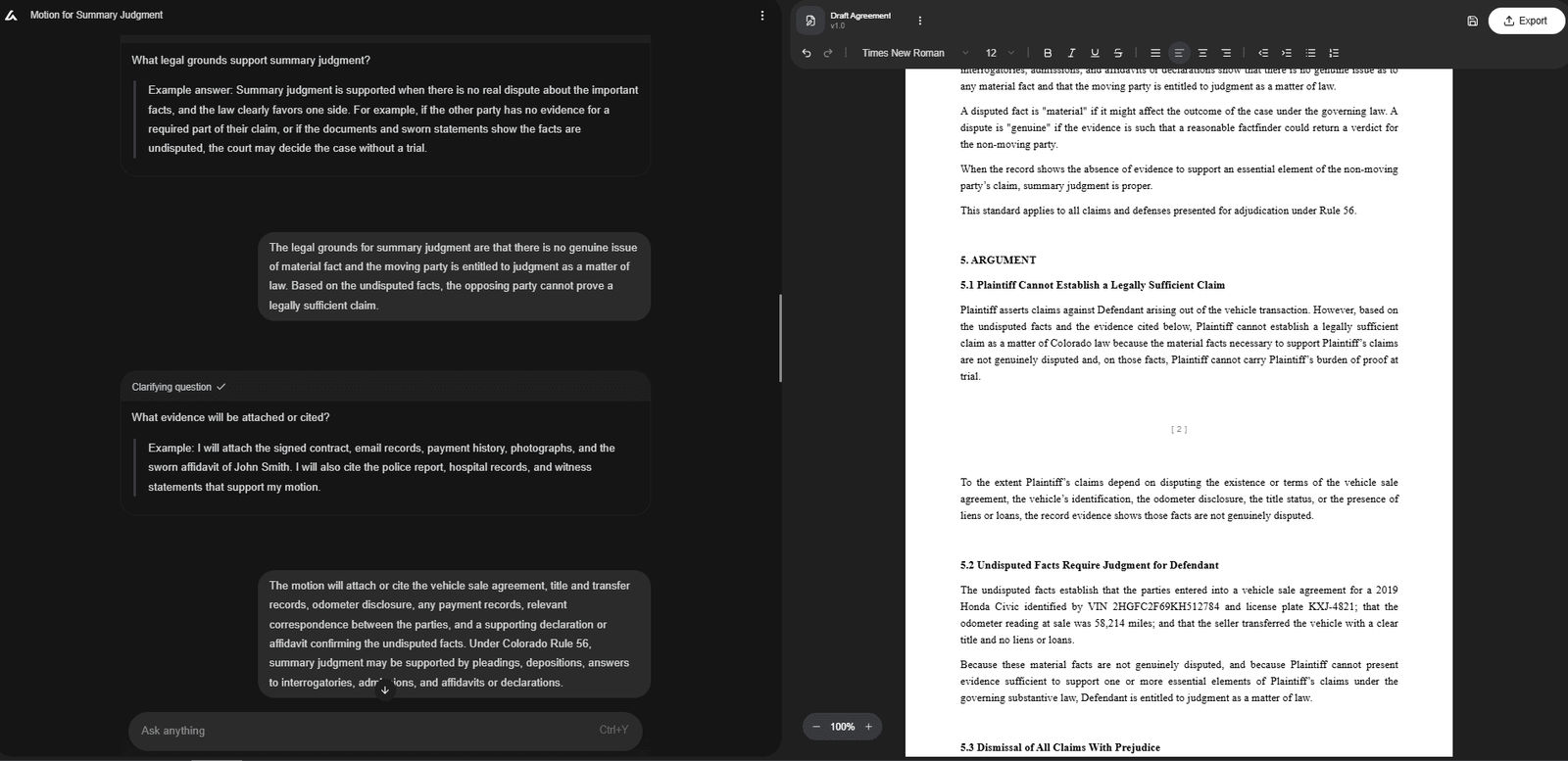
A motion for summary judgment asks the court to decide a civil case, or part of it, without waiting for trial. It works only when the record already answers the legally important questions and no judge or jury needs to resolve credibility to reach that answer.
Used well, it can end a weak claim, narrow the case, or increase settlement pressure. Used poorly, it can expose gaps in the record and give the other side a preview of your strategy.
This guide explains how to decide whether the motion fits, why it matters strategically, what evidence supports it, how federal and California rules differ, and how the AILawyer.pro template can help organize a first draft.
TL;DR
-
A motion for summary judgment asks the court to decide a civil case before trial when there is no genuine dispute over any material fact.
-
The first question is fit: the motion is strongest when key facts are proven through admissible evidence and weakest when credibility, intent, or incomplete discovery drives the dispute.
-
The practical value is leverage: the motion can end a claim, narrow the issues, clarify settlement risk, or force both sides to test the record.
-
In federal court, the main rule is Federal Rule of Civil Procedure 56. In California, the key rules are CCP § 437c, California Rule of Court 3.1350, and the separate statement of material facts.
You Might Also Like:
-
Flight Canceled? When You Can Claim a Refund, Not a Voucher
What Is a Motion for Summary Judgment?
A motion for summary judgment is a request for the court to decide a case before trial because the record leaves no legally important fact dispute for trial.
The motion is not about which side tells a better story. It is about whether the evidence is strong enough for the court to apply the law now.
For example, in a breach of contract case, the motion may be realistic if the record includes the signed agreement, proof of performance, unpaid invoices, and an admission of nonpayment. The court may not need a trial if the remaining dispute is only about the legal effect of those documents.
The same motion may be weak if the case turns on a private conversation, disputed intent, or witness credibility. Those issues usually belong at trial.
Federal Rule 56 allows summary judgment on a claim, defense, or part of either. California uses similar logic but different procedure, including summary adjudication for narrower issues such as a cause of action, affirmative defense, damages claim, or duty issue.
When a Motion for Summary Judgment Makes Sense
A motion for summary judgment makes sense when the selected issue can be decided from the record instead of live testimony at trial.
It often fits document-heavy disputes: a contract claim supported by a signed agreement and payment records, a statute of limitations defense with clear dates, an insurance coverage dispute based on policy language, or a lack of duty argument that turns mostly on law.
It can also work after discovery shows that the other side lacks evidence on an essential element. In Celotex Corp. v. Catrett, the Supreme Court explained that a moving party may point to the absence of evidence on an element the nonmoving party must prove.
A practical test is simple: even if the court views the record fairly, the other side still cannot prove a specific element such as performance, causation, damages, duty, timely filing, or policy coverage.
If you cannot identify the exact element and the record support, the motion may not be ready.
When It Is Usually a Bad Fit
A motion for summary judgment is usually a bad fit when the case depends on credibility, intent, incomplete discovery, or disputed facts that could change the outcome.
For example, a motion is risky if the central issue is whether a witness is telling the truth. In Anderson v. Liberty Lobby, Inc., the Supreme Court explained that a factual dispute is genuine when the evidence could allow a reasonable jury to rule for the nonmoving party.
That matters in cases involving oral promises, disputed intent, fraud, retaliation, harassment, or unclear conversations. Competing testimony on a material fact usually belongs at trial.
| If the case depends on… | Summary judgment fit |
|---|---|
| Signed contracts, invoices, admissions, business records | Stronger fit |
| Policy language and undisputed claim facts | Stronger fit |
| Clear dates and a statute of limitations defense | Stronger fit |
| Witness credibility or disputed intent | Weaker fit |
| Missing discovery or incomplete depositions | Weaker fit |
The goal is not to file because the case feels strong. The goal is to file when the record is strong enough for the court to rule without trial.
Why It Matters
The fit analysis answers whether the motion is ready. The strategy analysis answers what the motion can do to the case.
For a plaintiff, a strong motion may convert a clear paper record into judgment without the cost and uncertainty of trial. For a defendant, it may eliminate a claim that should not survive because the other side lacks evidence on an essential element.
Even when the motion does not end the case, it can narrow the issues, define the evidence that really matters, and create settlement pressure by showing how the court may view the record.
The motion can also backfire. If discovery is incomplete, the other side may ask the court to delay or deny the motion. If the moving party relies on broad statements instead of admissible evidence, the judge may ignore the point. If the requested relief is vague, the court may deny the motion because it cannot enter a clean order.
Summary judgment rewards a focused record, not the longest argument.
How AILawyer Turns Your Case Details Into a Motion for Summary Judgment
Drafting a motion for summary judgment is easier when the analysis is broken into focused questions.
AILawyer helps organize the draft around the court, the claim or defense, the material facts, the evidence, the legal standard, and the requested relief. That matters because a federal Rule 56 motion, a California summary judgment motion, and a California summary adjudication request should not sound like the same document.
A clear draft connects each material fact to admissible evidence and each legal point to the right standard. A breach of contract motion should identify the agreement, performance, breach, damages, and record support. A statute of limitations motion should focus on the accrual date, filing date, limitations period, and tolling.
The goal is to make the court see why no trial is needed and why the requested order is clear.
What a Strong Motion for Summary Judgment Should Include
A strong motion should show the issue, facts, evidence, controlling rule, and relief the court can grant.
Notice of Motion
The notice should clearly state what the moving party wants: full summary judgment, partial summary judgment, or summary adjudication.
Weak version:
Defendant moves for summary judgment because Plaintiff has no case.
Better version:
Defendant moves for summary judgment on Plaintiff’s breach of contract claim because the undisputed record shows Plaintiff cannot prove performance.
The second version gives the court a clear target.
Legal Standard
The motion should state the correct standard for the forum. In federal court, use Rule 56. In California state court, use CCP § 437c and any applicable separate-statement rules. Do not mix the standards or copy federal language into a California filing without adapting it.
Statement of Material Facts
The statement of material facts should include only facts that can affect the result.
Weak fact:
Defendant breached the contract.
Better fact:
On April 14, 2025, Defendant emailed Plaintiff: “We will not deliver the remaining 400 units.”
The weak version is a conclusion. The stronger version gives the court a fact that can be tested against the record.
Admissible Evidence
Summary judgment is evidence-driven. The motion should rely on materials the court can consider: contracts, business records, declarations, deposition testimony, discovery responses, admissions, emails, policy documents, and authenticated exhibits.
A common mistake is treating the complaint as evidence. Allegations may frame the case, but they usually do not prove the facts needed for summary judgment.
Not enough:
Plaintiff failed to deliver the software.
Stronger:
Plaintiff’s project manager testified that no final build was delivered before the termination date.
Argument and Requested Relief
The argument should follow the legal elements of the claim or defense. In a breach of contract dispute, address the contract, performance, breach, damages, and any defense. For a statute of limitations defense, focus on the accrual date, filing date, limitations period, and tolling. For an insurance coverage dispute, focus on policy language and exclusions. For lack of duty, focus on whether the law recognizes a duty at all.
The requested relief should be precise.
Weak version:
Defendant asks the Court to dismiss this case.
Better version:
Defendant asks the Court to enter summary judgment in Defendant’s favor on Plaintiff’s breach of contract claim.
For partial summary judgment or summary adjudication, identify the exact claim, defense, damages category, or duty issue the court can resolve.
Legal Standard and Court Rules
The basic test is similar across forums: the motion works only when no genuine dispute over a material fact remains and the moving party is entitled to judgment as a matter of law. The procedure, however, depends on the court.
In federal court, Federal Rule of Civil Procedure 56 controls. The key question is whether the record contains enough evidence for a reasonable factfinder to decide the material issue against the moving party.
In California state court, CCP § 437c governs summary judgment and summary adjudication. The moving party usually must prepare a separate statement of material facts under California Rule of Court 3.1350.
| Undisputed Material Fact | Supporting Evidence |
|---|---|
| Plaintiff paid Invoice 1047 on March 2, 2025. | Smith Decl., Ex. A; Bank Record, Ex. B. |
| Defendant emailed that it would not deliver the remaining 400 units. | Smith Decl., Ex. C. |
| Defendant’s manager confirmed no further shipment was scheduled. | Lee Dep. 48:10–49:3. |
This format forces the writer to test the motion before filing. If a fact cannot be supported, it may not belong in the separate statement.
Nuances That Often Cause Problems
Most summary judgment problems come from a mismatch between the motion, the evidence, and the court rules.
Filing Before the Record Is Ready
A motion filed too early can do more harm than good. If discovery is still open and important evidence has not been produced, the opposing party may argue that it cannot fairly respond.
Before filing, list every legal element and the exact evidence that proves or defeats it. If several boxes are empty, the motion may need more discovery.
Treating Every Dispute as Material
Not every disagreement matters. A fact is material only if it can affect the outcome.
Weak approach:
The parties disagree about almost everything, so summary judgment is impossible.
Better approach:
The parties disagree about background communications, but they do not dispute the signed contract, payment deadline, unpaid invoice, or refusal email.
Relying on Allegations Instead of Evidence
A complaint is not proof. A motion should be built from admissible evidence or evidence that can be presented in admissible form.
Weak sentence:
Plaintiff clearly knew about the defect.
Stronger sentence:
Plaintiff testified that she saw the defect on May 3, 2024, photographed it, and emailed the property manager before signing the renewal agreement.
Copying Federal Language Into a California Motion
Federal and California summary judgment practice overlap, but they are not interchangeable. California practice is more technical, especially when a separate statement is required or when the request is for summary adjudication rather than full summary judgment.
Frame the issue in a way the court can actually decide, and match the request to the California statute and rules.
Forgetting the Separate Statement
In California practice, the separate statement is not a side document. It may be the document the court uses first to understand the motion.
Weak fact:
Plaintiff failed to perform.
Better fact:
Plaintiff’s project manager testified that no final software build was delivered before the June 30, 2025 deadline.
That sentence identifies the fact, source, and reason it matters.
How to Customize Your Motion
Customize the motion to match the case, not the other way around.
Start with one question: what exactly do you want the court to decide? In a breach of contract case, that may be liability, performance, breach, or damages. In a statute of limitations motion, it may be the filing deadline. In an insurance coverage dispute, it may be a policy exclusion. In a lack of duty motion, it may be whether the law recognizes a duty.
Then match each legal point to evidence.
| Legal point | Evidence that may support it |
|---|---|
| Contract existed | Signed agreement, purchase order, email acceptance |
| Performance occurred | Delivery records, invoices, business records |
| Breach occurred | Nonpayment record, refusal email, admission |
| Claim is late | Accrual date, filing date, limitation period |
| No duty exists | Undisputed facts plus controlling law |
Judges do not need every background detail. They need the facts that make a legal difference.
The goal is to prove that no trial is needed on the selected issue.
Final Review Before You File
Before filing, review the motion as if you were the judge seeing the case for the first time.
Check the target: the exact claim, defense, damages issue, or duty issue the court is being asked to decide.
Check the facts: every material fact should have a record citation. If a fact is important but unsupported, fix the evidence before filing.
Check admissible evidence: contracts, business records, deposition testimony, declarations, admissions, policy documents, emails, and discovery responses must be properly presented.
Check the forum rules: Federal Rule 56 and California CCP § 437c are not the same filing system. California summary adjudication also has a narrower function.
Check the requested relief: the court should be able to enter the proposed order without guessing what you mean.
Final test:
If the judge accepts these material facts as undisputed, does the requested judgment follow?
If the answer is not clearly yes, the motion needs more work.
FAQs
Q: Is a motion for summary judgment the same as a trial?
A: No. A trial allows the factfinder to hear testimony, weigh credibility, and decide disputed facts. Summary judgment asks the court to decide that no trial is needed because no genuine dispute of material fact remains.
Q: What is a genuine dispute of material fact?
A: A material fact is one that could affect the legal result. A genuine dispute exists when the evidence could allow a reasonable factfinder to decide the issue for the nonmoving party.
Q: Can you file for partial summary judgment?
A: Yes. In federal court, Rule 56 allows summary judgment on a claim, defense, or part of either. This can narrow the case even if other issues remain.
Q: What is summary adjudication?
A: Summary adjudication is commonly used in California to resolve a narrower issue without ending the entire case. It may address a cause of action, affirmative defense, claim for damages, or issue of duty.
Q: What evidence can support a motion for summary judgment?
A: Useful evidence may include contracts, business records, deposition testimony, admissions, authenticated emails, declarations, policy documents, and other record materials.