

You can lose defenses and weeks of litigation if you file the wrong motion to dismiss.
A motion to dismiss asks the court to end all or part of a civil case early because a threshold legal or procedural problem appears at the start of the lawsuit. That problem may be a pleading defect, lack of jurisdiction, improper venue, defective service of process, or a claim blocked by arbitration, res judicata, release, or the statute of limitations.
In federal court, this often means a motion under Rule 12 of the Federal Rules of Civil Procedure, especially a challenge for failure to state a claim. Rule 8 also matters because it sets the baseline pleading standard. State courts use their own dismissal procedures, including New York CPLR 3211 and Texas Rule 91a.
TL;DR
-
A motion to dismiss can stop all or part of a lawsuit before discovery, but only when the defect fits the available dismissal ground.
-
It is strongest when the problem is visible from the complaint, court record, contract, service papers, or another source the court may properly consider.
-
Common grounds include failure to state a claim, lack of subject-matter jurisdiction, lack of personal jurisdiction, improper venue, defective service, arbitration, res judicata, and statute of limitations.
-
A weak motion can waste time, help the plaintiff amend, create waiver problems, or turn into a summary-judgment fight too early.
-
Federal, New York, and Texas dismissal practice overlap, but they are not interchangeable.
You Might Also Like:
What Is a Motion to Dismiss?
A motion to dismiss asks the court to terminate one or more claims before the case moves deeper into litigation. The point is not to prove that the defendant is right on the facts. The point is to show that the plaintiff’s case has a legal or procedural defect serious enough to stop or narrow it early.
The best-known federal version is a motion for failure to state a claim. It tests legal sufficiency: even if the pleaded facts are treated as true, do they support a legally recognized claim?
Example: A complaint says, “The defendant breached the agreement,” but never identifies the contract term, required performance, breach, or damages. A dismissal motion would argue that the complaint has not pleaded enough facts to support the claim.
Takeaway: the strongest motions attack a missing legal element or threshold procedural defect, not the plaintiff’s credibility.
When You Should Use a Motion to Dismiss
Use a motion to dismiss when the problem appears at the beginning of the case and the court can evaluate it without full discovery. The key question is simple: can the court see the defect from the pleadings or from materials it is allowed to consider at this stage?
| Situation | Possible ground | Why it may fit |
|---|---|---|
| The complaint gives conclusions but few facts | Failure to state a claim | The pleading may not show legal sufficiency. |
| The court lacks authority over the case type | Subject-matter jurisdiction | The dispute may belong in another court or forum. |
| The defendant has no meaningful connection to the state | Personal jurisdiction | The court may not have power over that defendant. |
| The lawsuit was filed in the wrong location | Improper venue | The case may need to be dismissed, stayed, or transferred. |
| The defendant was not properly served | Defective service of process | The case may not proceed against that defendant until service is corrected. |
| The contract requires arbitration | Arbitration | The dispute may belong outside court. |
| The same claim was already resolved | Res judicata | The plaintiff may be barred from relitigating it. |
| The claim was filed too late | Statute of limitations | The deadline to sue may have expired. |
Example: A former employee sues for breach of contract but does not identify any contract, promise, payment term, or obligation the employer supposedly breached. If the complaint only says the termination was “unfair,” a dismissal motion may fit because unfairness alone is not a contract claim.
The motion is weaker when the dispute depends on credibility, discovery, or a messy complaint that still pleads the required elements.
Takeaway: if the motion depends on proving your version of events, it probably belongs later in the case.
Why It Matters
A lawsuit becomes more expensive once it moves into discovery. Emails are collected, witnesses are prepared, depositions may be scheduled, and settlement pressure increases. A strong dismissal motion can change that path early.
It can end weak claims, narrow an overbroad complaint, force clearer pleading, preserve procedural defenses, and create leverage before discovery costs grow.
But the motion has to match the defect. If the real problem is weak evidence, the motion may be the wrong tool. If the argument relies too heavily on outside facts, a federal court may treat it as a summary judgment motion.
Example: A startup is sued by a former vendor for “unfair competition,” but the complaint only describes a failed services contract. There are no facts showing deception, misuse of trade secrets, customer confusion, or conduct beyond nonpayment. A motion to dismiss can target the unfair-competition claim while leaving the contract dispute to be answered separately.
Result: the case may continue, but with fewer claims, less noise, and a cleaner litigation strategy.
How AI Lawyer Turns Your Case Details Into a Motion to Dismiss
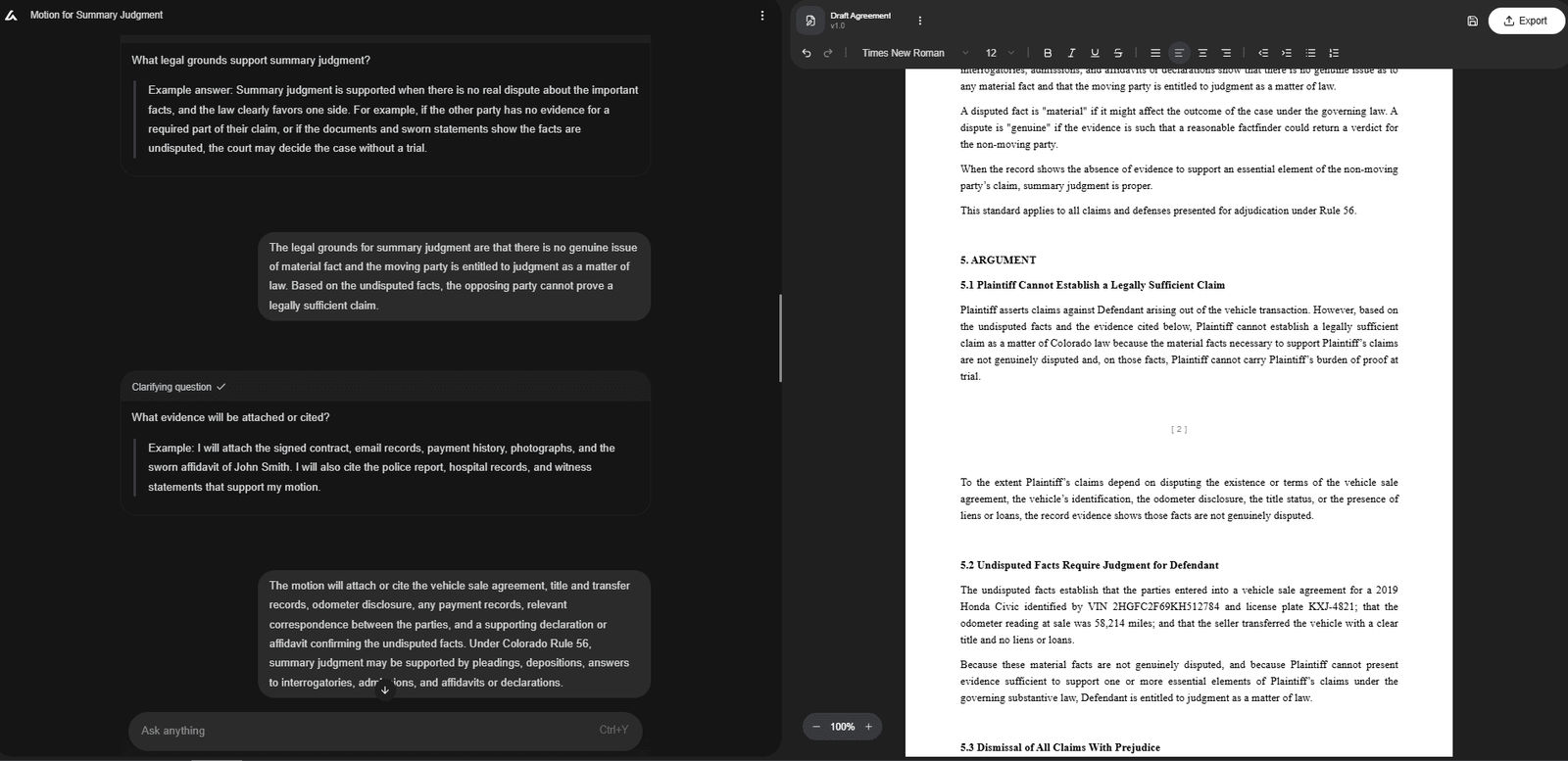
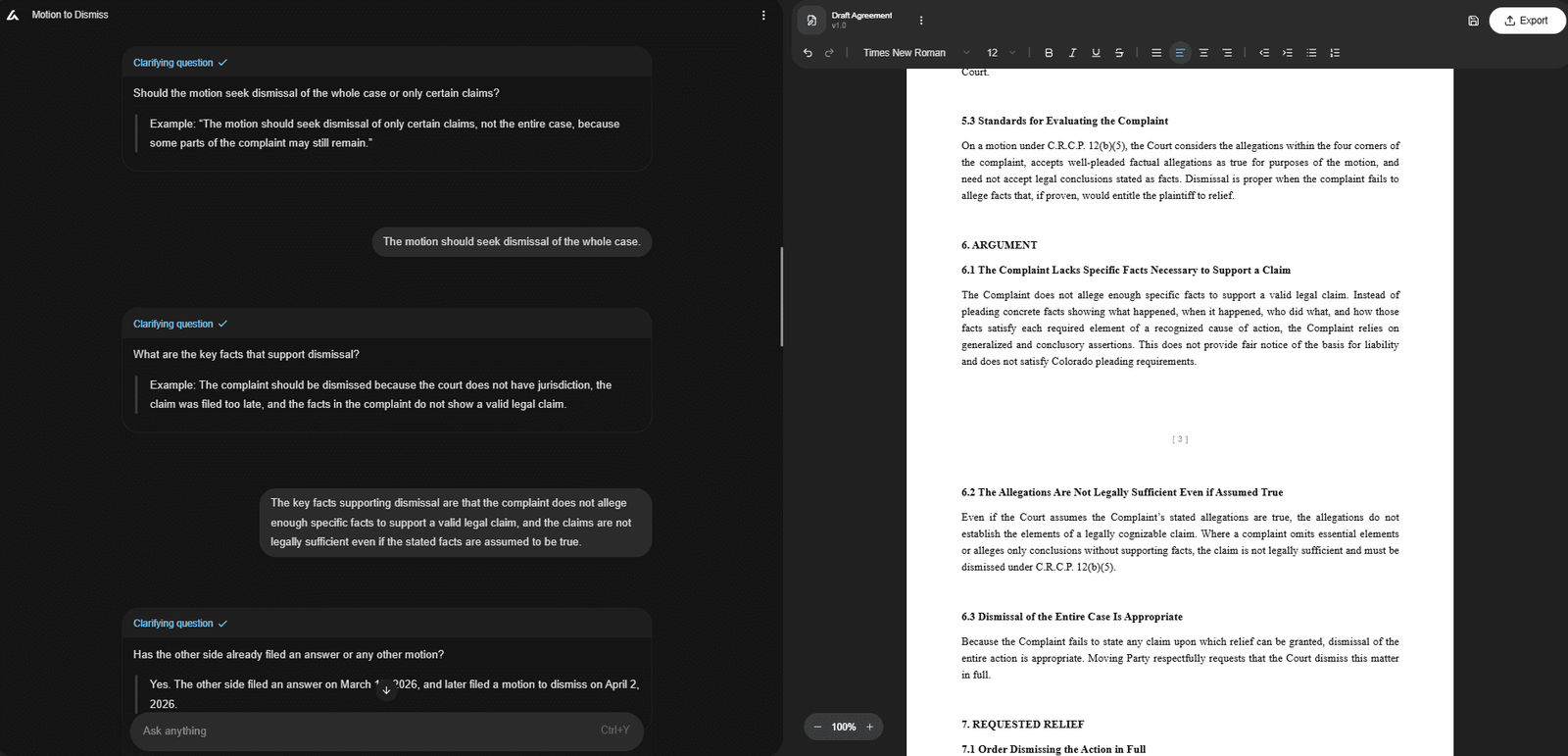
Drafting is easier when the analysis is broken into focused questions. AI Lawyer helps organize the motion around the court, the complaint, the challenged claims, the dismissal ground, the rule or statute being used, and the remedy requested.
That structure matters because a failure-to-state-a-claim argument, a jurisdictional challenge, a CPLR 3211 motion, and a Texas Rule 91a motion should not sound like the same document.
A clear draft connects each challenged claim to the right ground and asks for the right result: dismissal with prejudice, dismissal without prejudice, leave to amend, a stay, transfer, or referral to arbitration.
What a Strong Motion to Dismiss Should Include
A strong motion makes the defect easy for the court to see. It should identify what is being challenged, which authority allows dismissal, what part of the complaint fails, and what remedy the defendant wants.
A strong motion should answer five questions quickly:
-
What claims, parties, or remedies are being challenged?
-
Which rule, statute, or doctrine allows dismissal?
-
What exactly is missing or defective?
-
What materials may the court properly consider at this stage?
-
What remedy is being requested?
Start with the caption and case information: court name, case number, party names, and a specific title. “Defendant’s Motion to Dismiss Count II for Failure to State a Claim” is clearer than “Motion to Dismiss” if only one claim is being attacked.
Next, identify the claims or parties being challenged. The motion may attack the entire complaint, one count, one defendant, a remedy, or claims that should be sent to arbitration. A targeted motion is often stronger than a broad one.
Then name the authority and connect it to the defect. If a complaint alleges fraud but gives no details about the statement, timing, falsity, or reliance, the motion should point to those gaps instead of simply calling the claim “baseless.”
Finally, state the requested remedy: dismissal with prejudice, dismissal without prejudice, leave to amend, dismissal of certain claims, transfer, stay, or arbitration.
Common Dismissal Grounds
The dismissal ground should match the actual defect. A motion becomes weaker when it throws every possible objection at the complaint without explaining which argument fits which claim.
Failure to state a claim. The argument is that the complaint does not allege enough facts to support a legally recognized claim.
Lack of subject-matter jurisdiction. The court does not have authority to hear the type of case. A federal complaint may fail if it does not identify a federal question, diversity jurisdiction, or another basis.
Lack of personal jurisdiction. The court does not have power over the defendant. For example, a small Oregon business sued in Florida may challenge jurisdiction if it has no meaningful connection to Florida.
Improper venue. The case was filed in the wrong court location. A contract clause, party location, or place where events occurred may matter.
Defective service of process. A lawsuit generally cannot move forward against a defendant who was not properly served. Some service-related objections can be lost if not raised properly.
Arbitration. If the parties agreed to arbitrate the dispute, the defendant may ask the court to dismiss or stay the lawsuit and send the dispute to arbitration.
Res judicata. The plaintiff is trying to relitigate a claim that was already finally resolved.
Statute of limitations. The plaintiff waited too long to sue. This ground is strongest when the relevant dates appear on the face of the complaint or another document the court may consider.
Nuances That Often Cause Problems
Most problems come from a bad fit between the argument and the record.
One common mistake is using a pleading-sufficiency argument for a procedural problem. If the defendant was sued in the wrong state, jurisdiction or venue may be the better path. If the issue is service, the motion should address service directly.
Another mistake is relying on facts the court cannot use. A motion to dismiss is not the place to attach every email, invoice, text message, or witness statement that makes the plaintiff look wrong. Outside materials can push the court toward summary judgment treatment before the defendant intended to go there.
Timing also matters. Some defenses must be raised early or they may be waived. Before filing, check jurisdiction, venue, process, service, and other threshold defenses together.
The requested remedy can also create problems. Dismissal with prejudice, dismissal without prejudice, and leave to amend are not the same result. A vague negligence claim may be fixable. A claim already resolved by a final judgment usually is not.
Takeaway: keep the motion narrow enough to fit the defect and complete enough to preserve available defenses.
Legal Effect and Forum-Specific Rules
A motion to dismiss can end a claim, narrow a lawsuit, move the dispute out of court, or force the plaintiff to amend. Its effect depends on the forum and the ground used.
Federal court. Rule 8 supplies the baseline pleading requirement, and the federal dismissal rules cover threshold defenses. For a failure-to-state-a-claim argument, the defendant usually compares the elements of the claim with the facts actually pleaded. The modern plausibility standard is commonly associated with Twombly and Iqbal.
A major federal trap is conversion. If outside matters are presented and not excluded on certain dismissal motions, the court may treat the motion as one for summary judgment under Rule 56.
New York. CPLR 3211 has its own structure. It includes grounds such as documentary evidence, lack of subject-matter jurisdiction, arbitration and award, res judicata, statute of limitations, failure to state a cause of action, and lack of personal jurisdiction.
Texas. Rule 91a allows dismissal of a cause of action that has no basis in law or fact. The motion must identify each challenged cause of action and state specifically why it fails. It must be filed within 60 days after the challenged cause of action is served, at least 21 days before the hearing, and the court generally must rule within 45 days.
How to Customize Your Motion
Customize the motion to match the lawsuit, not the template.
Start with the complaint. Identify each challenged claim and write down the legal elements. Then compare those elements to the facts pleaded. If the problem is procedural, gather the right record: summons, proof of service, complaint and exhibits, contract with venue or arbitration clause, prior judgment or release, court docket, and relevant filing dates.
Weak customization: “Plaintiff’s complaint is vague, conclusory, and legally insufficient.”
Stronger customization: “Count II should be dismissed because the complaint does not allege the contract term defendant supposedly breached, the required performance, or facts connecting the alleged breach to plaintiff’s claimed damages.”
Use the vocabulary of the forum. In federal court, connect the argument to the federal pleading and dismissal standards. In New York, use CPLR 3211’s listed grounds. In Texas, identify each challenged cause of action and explain why it has no basis in law, no basis in fact, or both.
Final Review Before You File
Before filing the motion, review it like the judge is seeing the case for the first time. The judge should not have to guess which claims are challenged, what authority applies, or what result the defendant wants.
Before filing, check:
-
whether every challenged claim is identified separately;
-
whether each argument is tied to the correct rule, statute, or doctrine;
-
whether any threshold defenses could be waived if omitted;
-
whether the motion relies only on materials the court may consider;
-
whether deadlines, hearing rules, page limits, and local rules are satisfied;
-
whether the requested remedy matches the defect;
-
whether the motion supports the litigation strategy instead of only delaying the case.
A good final version is usually shorter than the first draft. Cut background that does not support dismissal. Cut emotional language. Cut arguments that require discovery or fact-finding.
Final test: if the court can summarize your motion in one sentence, the draft is probably focused.
FAQs
Q: Is a motion for failure to state a claim the same as every motion to dismiss?
A: No. It is only one kind of dismissal motion. Other motions may challenge jurisdiction, venue, service, arbitration, or state-specific grounds.
Q: Can a motion to dismiss end the entire lawsuit?
A: Yes, but not always. It may dismiss the entire complaint, only certain claims, only certain parties, or only certain remedies. Partial dismissal can still reduce discovery and improve litigation strategy.
Q: What is the difference between dismissal with prejudice and dismissal without prejudice?
A: Dismissal with prejudice usually means the claim is dismissed finally. Dismissal without prejudice usually leaves room to amend or refile if the defect can be fixed.
Q: How is CPLR 3211 different from federal dismissal practice?
A: CPLR 3211 is New York’s dismissal rule and includes its own listed grounds, including documentary evidence, res judicata, statute of limitations, arbitration and award, and failure to state a cause of action.
Q: How does Texas Rule 91a work?
A: Texas Rule 91a allows dismissal of a cause of action that has no basis in law or fact. It has strict timing rules and generally focuses on the pleadings rather than evidence.