

AI Lawyer Blog
Demand Letter: How to Write, Send, and Follow Up

Greg Mitchell | Legal consultant at AI Lawyer
3
Most disputes don’t end because someone is “more right.” They end when one side makes resolution simple: the facts are clear, the request is specific, and the next step is obvious. That’s what a demand letter is for—it turns a messy disagreement into a concrete, trackable request with a deadline.
In the U.S., people use this kind of letter in everyday conflicts (business invoices, contracts, landlord–tenant issues, property damage, insurance disputes, and unpaid wages) because it creates one organized version of the story instead of scattered texts and emotional calls. It can also strengthen negotiations because it signals you’re serious, prepared, and documenting the timeline.
This guide focuses on strategy and structure and points you to templates you can customize for common scenarios—without forcing a one-size-fits-all script onto problems that need different facts and proof. Next, we’ll define what a demand letter is (and isn’t), then move into when to send one, how to build a convincing package, and what to do after you hit send.
Disclaimer: This article is general information, not legal advice, and rules can vary by state and situation. If the stakes are high (large amounts, injuries, tight deadlines, or an attorney on the other side), consider getting legal guidance before you send anything.
You Might Also Like:
TL;DR
A demand letter is a formal written request that states what happened, what you want, and when you need a response. Use it when informal follow-ups aren’t working and you need a clear “resolve / negotiate / escalate” decision point. Choose a template that matches your scenario, attach (or offer) key proof, send it in a way you can document, and keep a complete record in case you need to escalate.

Who This Article Is For
If you’re dealing with a situation where someone owes you money, property, or a specific action and informal reminders aren’t working, this guide is for you. Any dispute that needs a clear, documented request — before you spend time and money escalating — can benefit from this approach.
Businesses, freelancers, and contractors with unpaid invoices or late payments. If you’ve delivered work and the client is stalling, a structured request can move the conversation from “soon” to a real deadline. People in this bucket often search for terms like “sample demand letter for payment” or “attorney letter of demand” because they want a firm, professional tone.
Anyone dealing with a breach of contract or broken agreement. Whether it’s a service contract, purchase agreement, or repayment plan, a written demand helps anchor the dispute to specific promises and dates instead of opinions.
Landlords and tenants in common housing disputes. Unpaid rent, repairs, habitability complaints, or security deposit issues often come down to documentation. A clear written record can matter when timelines and notice requirements are important.
People preparing for small claims. If your likely next step is small claims court, sending a written demand can show you tried to resolve it first. This is why searches like “demand letter small claims” are so common.
Insurance, accidents, and property damage disputes. When there’s a claim, a denial, or a disagreement about the amount, a written demand helps present the facts, the losses, and what you want paid in a way that’s easier to evaluate.
Return-of-property and possession conflicts. If someone is holding your belongings, equipment, or documents, a dated written request can cut through excuses and create a clean paper trail.
Wage and compensation issues. If you’re owed wages, commissions, or final pay, a clear written request with supporting details can be a strong first step before escalating through an agency process or legal counsel.
If you’re unsure whether your situation fits, a good rule of thumb is this: if you can summarize the problem in a timeline, attach proof, and state exactly what would resolve it, you’re likely in demand-letter territory — whether you call it a legal letter of demand or simply a formal written request.
What Is a Demand Letter

A demand letter is a written notice that explains a dispute in a factual, organized way and asks the recipient to take a specific action by a deadline. It’s often used when informal follow-ups aren’t working and you need a clear, trackable request. In U.S. practice, it’s widely treated as a practical pre-lawsuit step that can open negotiation, clarify expectations, and sometimes resolve the issue without filing a case. For a plain-language legal overview of how demand letters function, see Cornell Law School’s Legal Information Institute explanation.
In simple terms, a demand letter creates one “official version” of your position instead of scattered texts, partial emails, and calls that are hard to track. That matters because many disputes don’t turn on who feels more wronged — they turn on whether the request is clear, supported, and easy to act on. When your facts and request are presented cleanly, it becomes harder for the recipient to claim confusion or pretend they didn’t understand what you wanted.
What a demand letter does for you
A demand letter is useful because it forces the dispute into specific, verifiable details: dates, amounts, obligations, and supporting documents. Even if the other side disagrees, a structured letter pushes the conversation toward real issues (what was promised, what was delivered, what’s unpaid, what proof exists) rather than circular arguments.
It also helps you negotiate. Many recipients respond faster when they see a clear deadline and a clear path to resolution (paying, returning property, fixing an issue, or proposing a settlement). The letter can function as a professional “reset,” especially when the relationship has turned emotional or avoidant.
In some contexts, sending a written demand is also a standard step before escalation. For example, the California Courts Self-Help guidance on writing a demand letter describes it as part of the process before filing a small claims case in California. Requirements vary by state and claim type, but showing you asked clearly and gave a reasonable deadline can matter if you later need to explain your timeline to a judge, mediator, or attorney.
What it is not
A demand letter is not a lawsuit and not a court order. It doesn’t force compliance on its own; it documents your request and your deadline. The leverage comes from clarity, proof, and the fact that you’re signaling you’re prepared to take the next step if needed — not from magical wording.
It’s also not an excuse to threaten, insult, or exaggerate. Overstating facts or inflating damages can damage credibility and reduce your leverage. If the recipient senses you’re bluffing, they may ignore the letter; if you make claims you can’t support, you can create avoidable legal risk.
And it’s not always the same as “official legal notice” for every dispute. Some issues have strict notice rules tied to state law or your contract — especially in landlord-tenant situations or claims created by statute. If a statute or contract requires a specific format, delivery method, or waiting period, you’ll want to align your approach with that requirement rather than assume any letter is enough.
A quick note on debt-collection context
If your dispute involves consumer debt, be careful about how you communicate — especially if you’re acting as a third-party collector. Certain federal rules restrict deceptive or abusive collection tactics, and it’s smart to keep your tone and claims accurate. For consumer-focused guidance, you can review the FTC’s Debt Collection FAQs. (If you’re collecting your own business invoice, this may not apply the same way — but the “be factual, don’t bluff” principle still holds.)
“Legal letter of demand” and “attorney letter of demand”
You’ll also see terms like “legal letter of demand” and “attorney letter of demand.” These labels usually signal tone and perceived formality, not a different kind of document. Sometimes a lawyer actually drafted or reviewed the letter; sometimes people use the phrase to describe a firm, professional approach.
Attorney review can be especially useful when the facts are complex, the amount is significant, injuries are involved, or the other side is represented — because small wording choices can affect leverage, timing, and legal risk. For many routine disputes, though, a clear, well-supported demand letter sent by you can still trigger payment or serious negotiation.
Next up in this guide, we’ll cover what to include in a strong demand letter as its own dedicated section (checklist + structure), so you don’t have to hunt through definitions to find the practical parts.
When Should You Send a Demand Letter

Send a demand letter when a dispute needs a formal “decision point,” not more back-and-forth. The core question isn’t whether you can write one — it’s whether a written deadline will realistically change the outcome (payment, return, repair, or a serious negotiation).
A demand letter is usually the right tool when the other side is still reachable but not taking action, and you want to move the conversation from vague promises to a clear choice: resolve, negotiate, or force you to consider escalation. That’s why it’s common for a demand letter to pay in overdue invoice disputes — but it also applies to refunds, property return, landlord-tenant issues, and wages.
Situations where a demand letter is typically worth sending
A demand letter tends to be effective when one clear action would resolve the problem, and the recipient has incentives to avoid the next step (small claims, attorney involvement, regulatory complaint, or reputational business friction). It’s especially useful when you want to propose a clean settlement option and set a deadline that makes the other side engage.
If small claims is a realistic path, a demand letter can also be a smart pre-filing move because it creates a clean “asked-and-deadline” record. Some court self-help resources treat that as a standard step — for example, California Courts Self-Help describes sending a demand letter before filing in small claims (your state’s expectations may differ, but the logic is widely applicable).
When a demand letter is not the best first move
Sometimes a demand letter is the wrong tool — or at least not the first tool. Consider alternatives when the dispute is better handled through a defined process (for example, a merchant chargeback window, an insurer’s formal appeal, a warranty claim workflow, or a landlord-tenant notice procedure that requires specific statutory language).
Also, pause (or get legal advice) when sending the letter could increase risk or reduce leverage — for example: serious injury/insurance cases where wording can affect negotiation dynamics, situations involving threats or safety concerns, suspected fraud where reporting is more appropriate than negotiating, or cases with tight legal deadlines where strategy matters more than messaging.
The “final demand letter before legal action” decision
A final demand letter before legal action is useful only when it’s true: use “final” language only if you are prepared to take the next step if the deadline passes. If you aren’t ready to escalate, calling it “final” can backfire because it teaches the recipient that deadlines don’t matter.
When a lawyer should be involved
If the amount is significant, the other side is represented, injuries/insurance are involved, or you expect counterclaims, attorney review can prevent small wording mistakes from turning into big strategic problems. The recipient side often treats demand letters as serious escalation signals, which is one reason framing matters; see the American Bar Association’s discussion of responding to demand letters.
Types of Demand Letters
Pick the type in 20 seconds by matching your dispute to the proof that matters. Most letters follow the same core structure, but each category is persuasive for different reasons: invoices and delivery records for money owed, lease terms and dated photos for landlord–tenant issues, payroll records for wages, and a tighter documentation set for insurance or accident claims.
Start with what’s being argued about: money, a promise, possession, or claim value/coverage. Match that to the right format (payment, breach-of-contract, return-of-property, or insurance). Once the category is right, everything else — your ask, your proof, and your next steps — gets simpler.
1) Demand letter for payment (money owed)
Use a demand letter for payment when someone owes a specific amount and the basis is easy to document. This fits unpaid invoices, refunds that never arrived, past-due balances, and clear repayment promises.
The strongest version states an exact amount, an exact deadline date, and a clear way to pay. What tends to matter most is proof that the obligation exists and that you performed/delivered: invoice or agreement, delivery/performance confirmation, and any written acknowledgments.
2) Late payment demand letter (overdue but not really disputed)
Use a late payment demand letter when the debt isn’t truly disputed — the delay is the dispute. This is common in B2B situations where the client is dragging their feet but not challenging the invoice.
This type works best when it reads like a business process, not a fight: past-due amount, original terms, deadline, and payment instructions. If you mention late fees/interest, only do it when you can tie it to a contract term or another clear basis (otherwise it can weaken credibility). For neutral terminology around contract obligations, Cornell Law School’s contract overview is a helpful reference.
3) Breach of contract demand letter
Use a breach of contract demand letter when the dispute is about a broken promise, not just an unpaid bill. Think missed milestones, defective work, failure to deliver, or refusal to perform.
Your demand should track the contract language as closely as possible (what was required, what didn’t happen, and what “cure” would fix it). This category is often about whether the breach can be cured by a deadline, or whether the remedy is a refund/damages.
4) Small claims demand letter
Use a small claims demand letter when you want one last serious attempt to resolve the matter and you want a clean record if you file. The goal is to make the story easy to understand later: timeline, amount, request, deadline.
This type is most effective when it is short, factual, and highly scannable. Many court self-help materials treat a written demand as a normal pre-filing step; for example, California Courts Self-Help explains sending a demand letter before small claims (your state may differ, but the structure is broadly useful).
5) Car accident settlement demand letter
Use a car accident settlement demand letter when you’re presenting a settlement number supported by liability + damages documentation. This is less “argue” and more “organize”: crash facts, losses, and the proof.
These letters live or die on the package, not the tone: photos, repair estimates, medical bills/records (if injury is involved), wage-loss documentation, and a clean treatment timeline. For credible consumer-level insurance orientation, NAIC’s consumer resources are a solid starting point.
6) Insurance demand letter (denial, underpayment, or delay)
Use an insurance demand letter when you’re challenging the amount paid, the denial reasoning, or unreasonable delay. The key move is separating “coverage position” from “proof of loss,” and responding with documentation rather than emotion.
The best version makes the adjuster’s next step easy: pay the requested amount, re-evaluate using the attached proof, or explain in writing what remains disputed. For a high-level benchmark on unfair or deceptive conduct concepts, see the FTC’s guidance on unfair or deceptive practices (insurance is primarily state-regulated, but the standards vocabulary is still useful).
7) Demand letter to landlord (repairs, deposit, rent disputes)
Use a demand letter to landlord when timeline + documentation are more persuasive than arguments. Common issues are security deposits, repairs/habitability, improper charges, and rent-related disputes where each side tells a different story.
This type is strongest when it is calendar-driven and evidence-driven: lease terms, dated repair requests, photos/videos, inspection notes, move-in/move-out documentation, and receipts. For general tenant-rights orientation (not state-specific legal advice), HUD’s tenant rights resources are a reputable baseline.
8) Demand letter for wages owed
Use a demand letter for wages owed when you can tie the request to payroll facts: pay periods, hours, rate, and earned amounts that weren’t paid (final pay, overtime, minimum wage issues, sometimes commissions).
This category is most persuasive when the numbers match time records and pay stubs. For federal baseline standards and definitions, the U.S. Department of Labor’s FLSA guidance is the authoritative starting point (state rules can add more rights and different deadlines).
Quick note: return of property demand letters
Use a return-of-property demand letter when compliance can be made simple and specific. The letter should identify the items clearly and offer a straightforward return plan with a deadline.
Proof is usually about ownership and identification: receipts, serial numbers, photos, and messages acknowledging possession.
Demand Letter Template Catalog
If you want a faster, cleaner way to resolve a dispute, start by choosing the right category. A free demand letter template only works when it matches your situation — because the strongest evidence (and the best framing) is different for invoices, contracts, landlord-tenant issues, insurance claims, and wages.
Use the catalog below as a quick picker. Each row shows the right demand + the proof that matters most, plus separate template links you can customize.
Category | What to Demand | Best Evidence | Templates |
|---|---|---|---|
Payment (money owed) | You demand a specific amount by a specific date and provide a clear payment method. | Invoice/contract, proof of delivery/performance, balance due, written acknowledgments. | |
Late payment (overdue but not truly disputed) | You demand immediate payment of the past-due balance and keep it businesslike. | Invoice terms (Net 15/30), reminder history, late-fee clause (only if you’ll claim it). | |
Breach of contract (cure / damages / termination) | You demand cure by a deadline or a defined remedy (refund, replacement, damages). | Signed contract + key clause, timeline, proof of breach, communications. | |
Small claims / escalation | You demand a clear amount or action with a firm deadline and keep it judge-friendly. | Receipts/invoices, photos, estimates, messages, clean calculation, delivery proof. |
|
Car accident / injury settlement | You demand a settlement amount backed by documented losses and set a response date. | Photos, repair estimates, medical bills/records, wage loss (if any), treatment timeline. | |
Insurance (claim / settlement / policy limits) | You demand payment or reconsideration and ask for a written explanation of any remaining denial. | Claim correspondence, estimates, bills/records, key policy excerpts if needed. | |
Landlord–tenant (deposit / repairs / rent) | You demand the specific outcome tied to the lease (return deposit, complete repairs, pay rent owed) by a date. | Lease, photos, dated requests/notices, move-in/out records, ledger. | |
Wages owed | You demand unpaid wages for specific pay periods with a clean calculation and deadline. | Pay stubs, time records, schedules, written pay terms. |
|
How to Write a Demand Letter

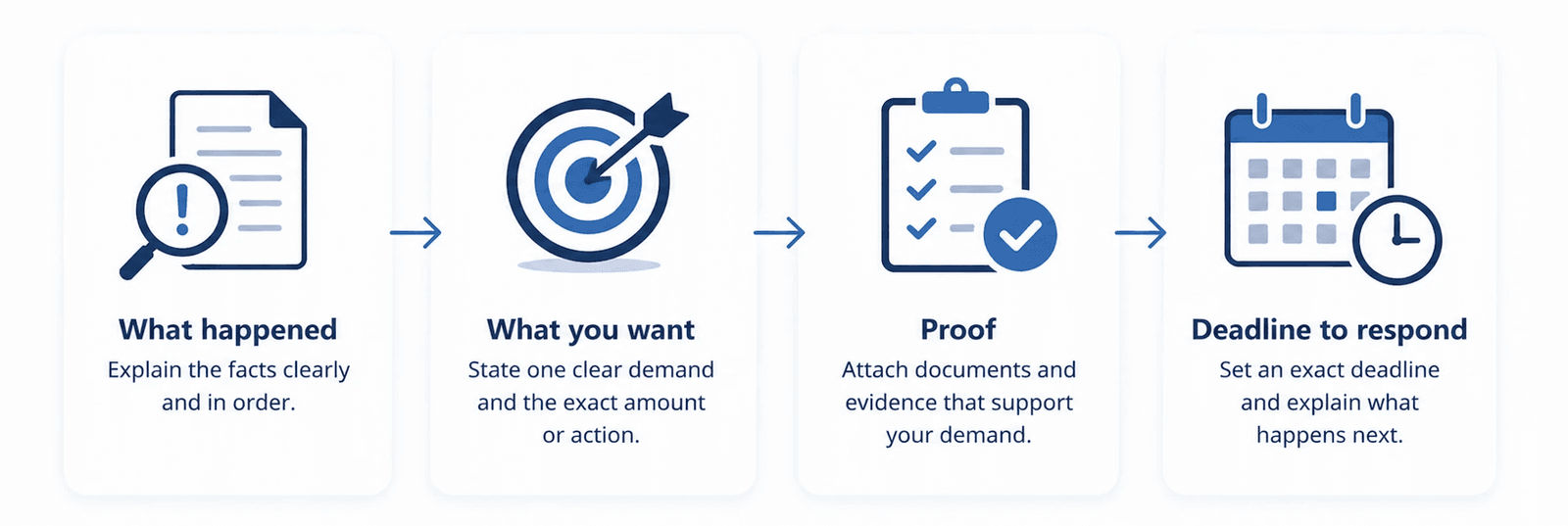
A strong demand letter is easy to scan and hard to misunderstand. Your goal is not to “sound legal.” Your goal is to make the recipient immediately see: what happened, what you want, and what they must do by when.
The core checklist
A demand letter should include:
Who + what this is about: your name, the recipient’s name, and a short subject line (invoice #, lease address, claim #, etc.).
A tight timeline: 3–6 sentences covering the key dates and what was agreed or expected.
The demand: the exact amount or action you want, stated in one sentence.
The deadline: an exact calendar date (not “ASAP”).
How to comply: payment method, return instructions, or what counts as completion.
Proof summary: a short list of what you’re relying on (invoice, contract, photos, messages, estimates).
Resolution option: what you will accept as settlement (if you’re open to it).
Next steps (calm): what you may do if there’s no response (e.g., consider small claims, mediation, attorney review).
Signature + contact info.
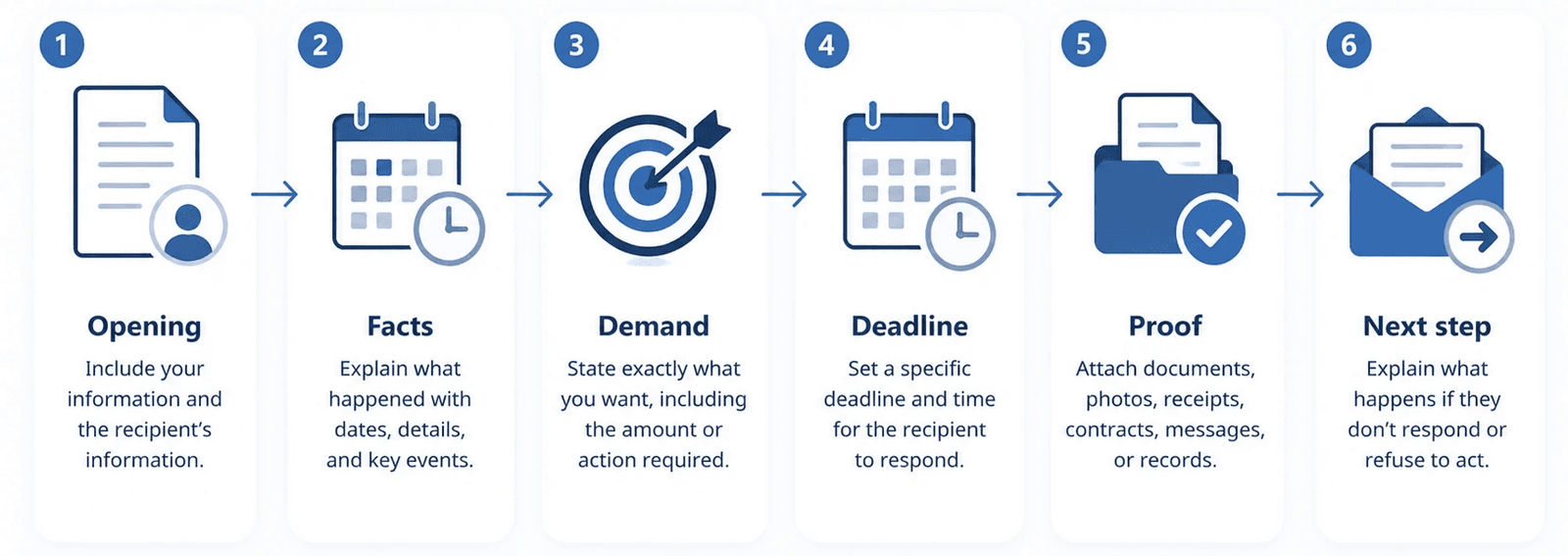
A simple structure that works
You can write most letters in this order:
Opening (1–2 sentences): why you’re writing and what you want.
Facts (short paragraph): the timeline, no emotions.
Demand + math (short paragraph): the amount/action + brief breakdown if needed.
Deadline + compliance method (1 paragraph): exact date + how to pay/return/fix.
Close (2–3 sentences): settlement option + next steps + request a written response.
If the reader can’t tell your demand and deadline in 10 seconds, it’s too long or too vague.
Tone rules that protect you
Be firm, factual, and boring. Avoid insults, exaggerations, or threats. If you reference consequences, keep them lawful and neutral (e.g., “I will consider filing in small claims court” rather than “I will ruin you”).
If your dispute involves consumer debt, be careful with language that could look deceptive or harassing. The FTC’s debt collection guidance is a good reminder of what not to do, even if you’re simply trying to collect money owed.
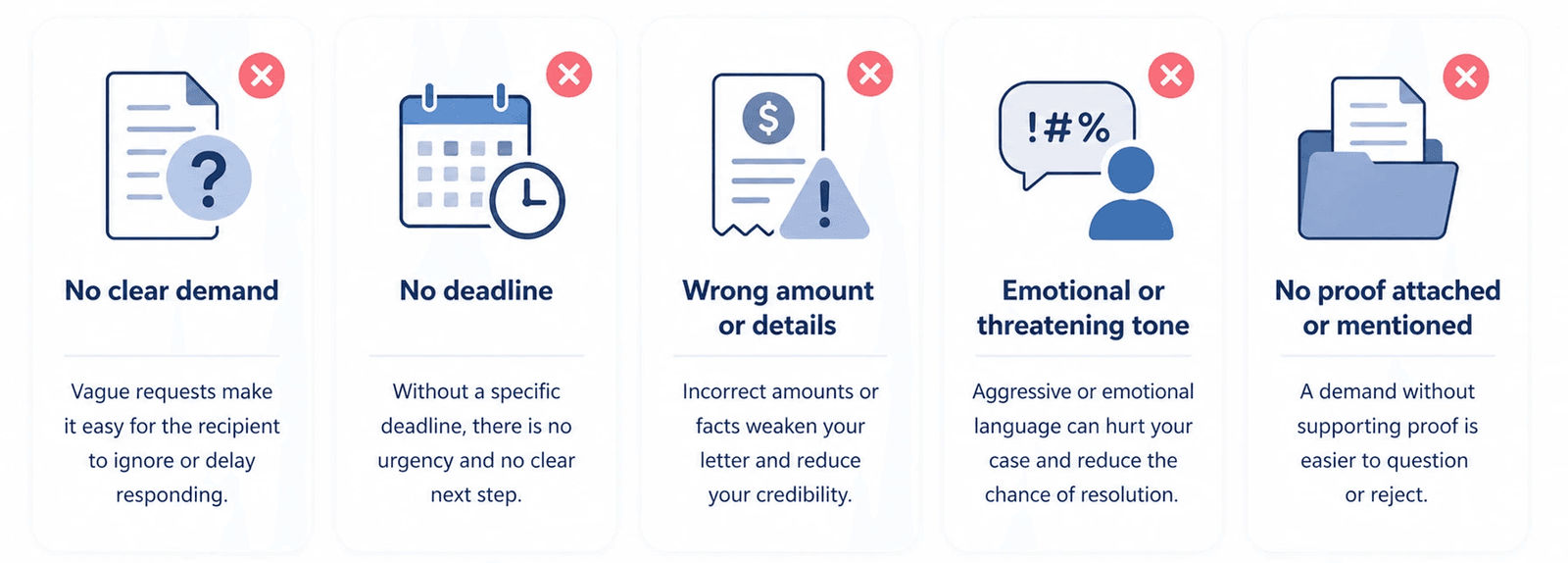
Common “weak letter” problems to fix quickly
Most letters fail for the same reasons:
The ask is unclear (no exact amount or no clear action).
No real deadline (or a deadline with no date).
Too many issues mixed together (split into separate letters if needed).
No proof summary (recipient can pretend they need “more info” forever).
The fix is almost always the same: tighten the facts, make the demand measurable, and set a real date.
Demand Package
A demand letter works best when it’s backed by a “demand package,” not just words. The point is to make your claim easy to evaluate: a clear timeline, a clean number, and proof that supports both. If the recipient can’t quickly see what you’re relying on, delay becomes the default.
Start by thinking in two layers: the letter (your narrative + demand) and the package (your proof + calculation). For money disputes, that usually means the invoice or agreement plus proof you delivered. For landlord-tenant issues, it’s often the lease plus dated photos and repair requests. For insurance or accident claims, it’s typically claim correspondence plus estimates and bills. For wage disputes, keep the package anchored to payroll facts like pay stubs and time records; the U.S. Department of Labor’s FLSA guidance is a reliable reference for baseline federal terminology and concepts (state rules can add more).
Next, make the amount you’re demanding easy to check. A simple breakdown is usually enough: principal (what’s owed) plus any documented out-of-pocket costs, minus any credits or partial payments. If late fees or interest are part of your request, be cautious — only include them when you can point to a contract term or another clear basis, and avoid guessing.
Then decide whether you want to include a settlement option. If you’re open to compromise, state exactly what you will accept and until what date. This “settlement logic” often triggers a faster response because it gives the other side a clear off-ramp. Keep the tone neutral: you’re offering a resolution, not issuing threats.
Finally, prepare for the likely response pattern. Most recipients either agree, counteroffer, or ignore the letter. In all three cases, your job is the same: keep everything in writing, confirm any agreement in plain terms (amount, deadline, method), and preserve proof of what you sent and when. That record is what turns a template-based demand into real leverage.
Step-by-Step: How to Prepare and Send It

Before you draft: do you need to send anything first?
In most everyday U.S. disputes, you can send a demand letter immediately — there’s usually no requirement to send separate “pre-documents” first. The clean approach is: state the facts once, make one measurable demand, set one deadline, and include (or offer) the proof.
The main time you shouldn’t jump straight to a demand letter is when your situation has a required process or notice step that needs to happen first. Keep it simple and check for these common exceptions:
Contract/lease “notice” or “cure” clauses: some agreements require a notice to cure and a waiting period before you demand termination or damages.
Landlord–tenant disputes: certain issues can require specific statutory notices and delivery methods (for a small-claims-oriented example of the “ask first” concept, see the California Courts Self-Help demand letter guidance).
Insurance claims: you typically open the claim and submit requested documentation first; demand letters are often used after delay/underpayment/denial (see NAIC consumer insurance resources).
Refund/warranty workflows: it’s often smarter to run the merchant/manufacturer process (return, repair request, warranty claim) before you escalate.
On documents: you generally don’t need to “pre-send” exhibits. Either attach your key exhibits to the demand letter as one organized PDF, or say you can provide them immediately upon request if attachments aren’t practical.
Draft the letter (keep it short and structured)
Write so a busy reader can understand it in under a minute. A reliable structure is:
Opening: what this is about and what you want.
Facts: a tight timeline (no emotions, no speculation).
Demand + deadline: the exact amount/action + an exact calendar date.
How to comply: payment method / return plan / repair confirmation.
Close: request a written response and note calm next steps if ignored.
Package your proof so it’s usable
Make your evidence easy to scan. Combine exhibits into one PDF when possible and label them clearly (Exhibit A, Exhibit B…). Include only what proves the core facts and the amount — too much paper can become an excuse to delay.
Send it with proof (and save everything)
Choose a delivery method that fits the stakes: email is often fine (timestamps + attachments), while tracked mail can be better if you expect denial or silence. If your contract/lease/policy specifies how notice must be delivered, follow that method.
After you send it, create one “proof folder” containing the final letter, the exhibit PDF, the sent email or mailing receipt, and any delivery confirmation. That file is what turns your demand letter into leverage if the dispute escalates.
What Happens After You Send It: The Escalation Ladder
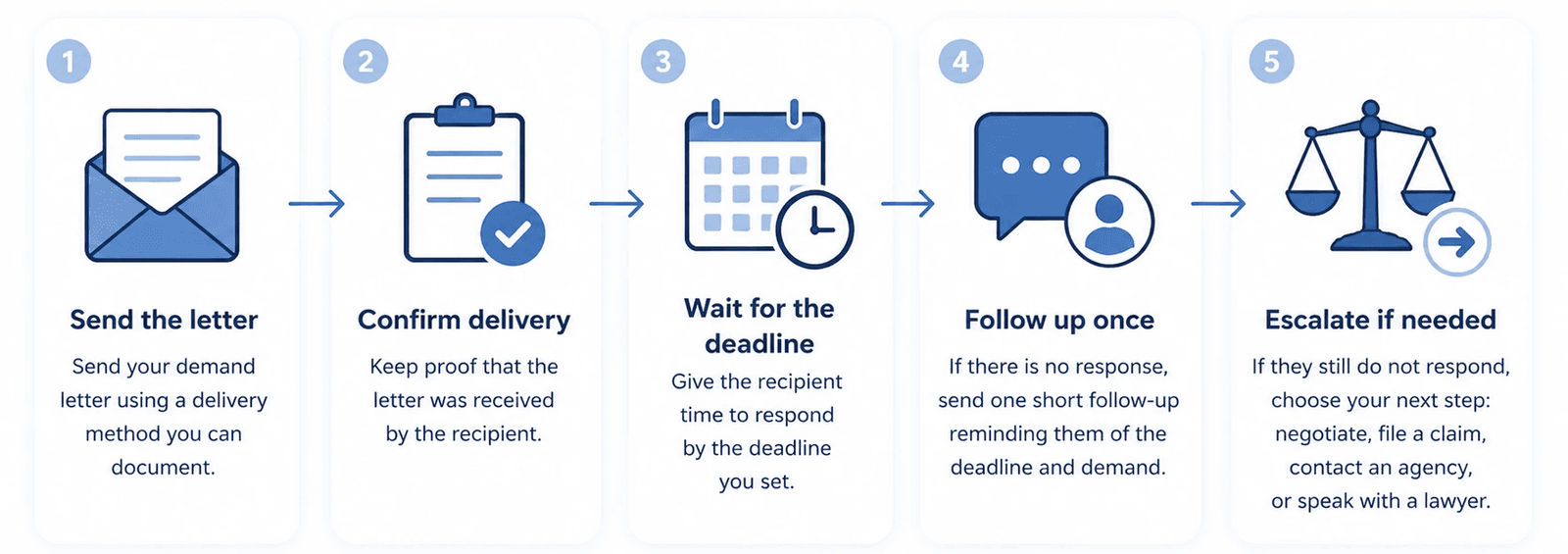
Once you send a demand letter, your job is to run a clean, documented timeline. The biggest mistake at this stage is improvising (random calls, emotional texts, moving deadlines) instead of following a simple escalation ladder.
1) Confirm delivery and start the deadline clock
Right after you send it, treat delivery confirmation as the start of your timer (not the day you drafted it). Save proof in one place: the final letter, exhibits, and email “sent” record or tracked-mail receipt. If you’re using a pre–small claims approach, this is the “asked + deadline” record courts often expect to see (the California Courts Self-Help demand letter guidance shows the concept, even though state practices vary).
What to document: delivery confirmation, sent email headers, certified mail tracking, and the exact deadline date you set.
2) Do one short follow-up after the deadline
If the deadline passes, send one brief follow-up that is calm and specific: reference the date of your letter, restate the amount/action demanded, and ask for a response by a new short date (e.g., 3 business days). This keeps pressure on without starting a new argument.
What to document: a copy of the follow-up message and any reply (even a “we got this”).
3) Negotiate — but lock everything in writing
If they respond with a counteroffer or “let’s work it out,” that’s progress — but only if you capture terms clearly. Any agreement should be written and unambiguous (amount, due dates, method, what happens if they miss a payment, whether it’s full-and-final settlement).
What to document: a written settlement or payment plan and proof of payments received.
4) Optional: send a final notice (only if it helps)
A final notice is useful when you want to show you gave one last clear chance and you are truly ready to escalate. Keep it short. Don’t add new accusations; don’t inflate the demand.
What to document: the final notice, delivery proof, and your decision date for escalation.
5) Choose the right escalation path
If there’s no resolution, you pick the channel that fits the dispute:
Small claims: Good for relatively straightforward facts and amounts within your state’s limit. Your demand letter + proof package becomes the backbone of your filing story.
Mediation: Useful when both sides might compromise but need a structured process. For a neutral overview of mediation as a dispute-resolution method, see the Federal Mediation and Conciliation Service.
Agency or regulator complaint (when relevant): This depends on the issue. For wage-related disputes, people often look at options through the U.S. Department of Labor Wage and Hour Division. For certain consumer fraud/scam patterns, the FTC’s ReportFraud portal is a standard starting point. (Not every dispute belongs here — but when it does, it can change the other side’s incentives fast.)
Attorney involvement: When the case is high-stakes, complex, or the other side is represented.
What to document: your decision notes (why you chose this path), copies of filings/complaints, and any case numbers or confirmations.
6) Bring in a lawyer when the risk profile changes
Even if you started DIY, it can be smart to get an attorney to review before you file — especially if you expect counterclaims, you’re dealing with insurance/injuries, or the money is meaningful. The American Bar Association’s discussion of demand letters is a good reminder that recipients often treat these as real escalation signals, not “just a letter.”
Red flags: don’t wait around
Escalate (or get legal advice) sooner if you see time pressure or serious downside — like a looming statute-of-limitations issue, a high-dollar claim, injuries/insurance denials, threats of counterclaims, or safety/harassment concerns. If you’re unsure about time limits conceptually, Cornell’s overview of the statute of limitations explains why delay can permanently reduce options.
Legal Requirements and Regulatory Context

There is no single “U.S. demand letter law” that applies the same way in every situation. Whether a demand letter is required, how it should be delivered, and what happens if it’s ignored can depend on state law, your contract, and the type of claim (landlord–tenant, wages, insurance, consumer debt, etc.). This section gives you the practical legal checks that most often affect outcomes.
State-by-state and contract-by-contract differences
Many rules that matter most are local or contractual. For example, some small claims processes treat a written demand as a normal pre-filing step, while others focus more on what you can prove and whether you acted reasonably. (A concrete illustration of the “ask first” concept appears in the California Courts Self-Help demand letter guidance, but your state may differ.)
Contracts can add their own “mini-law,” including notice addresses, required delivery methods, cure periods, and mandatory dispute resolution (mediation/arbitration). If your agreement says notice must be sent to a specific address or in a specific way, follow that clause — because it’s a common defense for the recipient to claim they never got proper notice.
Deadlines and the statute of limitations
Time can quietly destroy an otherwise valid claim. Every state has deadlines (statutes of limitations) that limit how long you have to file certain lawsuits. A demand letter does not automatically “stop the clock” everywhere, and you shouldn’t assume that sending a letter buys you time. If you’re close to a deadline, treat the demand letter as parallel work — not a substitute for legal advice. For an orientation to how limitations periods work (conceptually), see Cornell Law School’s explanation of statutes of limitations.
Delivery and proof matter more than people expect
Your leverage increases when you can prove delivery and prove what was sent. Email can be enough in many business disputes (timestamp + attachments), but tracked mail is often stronger when you expect denial or silence. If you use certified mail, make sure you save the receipt and tracking details; the USPS Certified Mail service description explains the basic idea and options.
Also, don’t rely on “I sent it” alone. Keep a single folder with the final letter, exhibits, and delivery proof (email headers, sent PDF, tracking page, and any replies). If the dispute escalates to small claims or attorney review, this file is often what turns your demand into a clean timeline.
Debt collection and regulated communications
If your dispute involves consumer debt, be careful about how you communicate — especially if you’re collecting on behalf of someone else or operating as a third-party collector. Federal rules restrict deceptive, unfair, or harassing collection practices, and regulators can treat the wording and frequency of communications seriously. For a reputable, plain-language overview, the FTC’s debt collection guidance is a helpful baseline. (If you’re collecting your own business invoice, your situation may be different, but staying factual and non-threatening is still the safest approach.)
The practical takeaway
A demand letter is usually allowed — and often helpful — but the “rules that bite” come from (1) your contract/lease/policy, (2) state-specific deadlines and notice requirements, and (3) your ability to prove delivery and contents. If any of those are uncertain and the stakes are meaningful, attorney review can be less about “lawyer wording” and more about avoiding a procedural mistake that costs leverage.
Common Mistakes (and How to Avoid Them)
Most demand letters fail for predictable reasons: they’re vague, emotional, or impossible to verify. The fix is usually not “more legal language” — it’s tighter facts, clearer asks, and better documentation.
Being unclear about the demand
If the recipient can’t tell exactly what you want, they can delay forever. State one measurable demand (pay $X, return X, repair X, provide an accounting) and use an exact deadline date.
Writing a “story” instead of a timeline
Long narratives make it easier to dispute details. Use a short, date-driven timeline and keep opinions out. If something is an assumption, don’t present it as fact.
Threatening instead of setting options
Aggressive threats often backfire, especially if you can’t legally do what you’re threatening. Keep next steps neutral and lawful (consider small claims, mediation, attorney review). Avoid reputation threats and “you’ll be sorry” language.
Inflating the amount or adding unsupported fees
Adding late fees, interest, “penalties,” or vague damages without a clear basis can weaken credibility. Only claim amounts you can document and explain briefly. If something depends on state law or the contract, say that rather than guessing.
Sending it the wrong way (or to the wrong party)
A strong letter loses power if it’s sent to the wrong name/address — or if you can’t prove delivery. Match contract notice clauses when they exist and keep proof. For delivery concepts and options, the USPS guidance on extra services like Certified Mail is a practical reference point.
Failing to include (or offer) proof
Recipients stall when they can claim they need “more info.” Attach the key exhibits or explicitly say they’re available immediately on request. Keep it lean, labeled, and easy to review.
Creating avoidable legal risk in debt-collection contexts
If the dispute looks like consumer debt collection (especially third-party collection), careless wording can create problems. Avoid deceptive, harassing, or misleading statements; the FTC’s debt collection guidance is a good baseline on what to avoid.
Bottom line: a legal demand letter template only works when you customize the facts, proof, and deadline — and when you don’t sabotage your own credibility with threats, vague numbers, or sloppy delivery.
AI vs. a Lawyer: What to Choose
There isn’t one “best” option — there’s a best option for your risk level, budget, and urgency. A free demand letter template (or an AI-generated draft) is often enough for straightforward, document-heavy disputes (unpaid invoice, clean refund request, simple property return). But once the dispute involves injuries, insurance coverage, tight deadlines, or likely counterclaims, lawyer involvement can shift from “nice to have” to “risk control.”
To keep pricing estimates grounded, the ranges below reflect common U.S. billing models and published benchmarks. Hourly rates vary widely by state and practice area, but benchmarks like Clio’s state-by-state rate insights and national averages can help set expectations (see Clio’s state hourly rate insights and the 2024 benchmark noted in Clio’s Legal Trends materials). Another published benchmark summary places typical hourly rates in a broad national band (see LawPay’s hourly rate by state overview).
Option | Best for | Typical cost range (U.S.) | Main advantages | Main risks |
|---|---|---|---|---|
DIY / AI (template + self-send) | Clear facts, low-to-mid stakes, you have documents | $0–$50 (template) or $10–$60/mo (tool subscription) | Fast, affordable, and easy to iterate | You can misstate the remedy, miss a required notice step, or weaken leverage with sloppy wording |
Lawyer review (you draft, lawyer edits) | Mid-stakes, you want risk checks and stronger framing | $150–$600/hour; often $200–$1,200 total (time varies) | Catches legal/strategy issues without full representation cost | Limited scope — a review may not include deep investigation, negotiation, or filing strategy |
Lawyer draft + strategy (attorney letter of demand) | High stakes, insurer involved, injuries, complex contract disputes, likely escalation | Often $500–$2,500+ flat or hourly (complex cases higher) | Stronger legal framing and negotiation leverage; clearer escalation plan | Cost; may escalate the tone faster; you’ll need to coordinate facts/proof carefully |
How to choose (quick decision logic)
If your situation is mainly about clarity — who owes what and why — starting with a legal demand letter template or attorney demand letter template style draft (even if you send it yourself) is usually reasonable. You’re aiming for structure: a tight timeline, a measurable demand, a real deadline, and organized proof.
If the dispute has meaningful downside, a lawyer review is often the best “middle path.” You keep cost under control while getting confirmation that your letter doesn’t accidentally (1) demand the wrong remedy, (2) violate a notice clause, or (3) create avoidable admissions.
If any of the following are true, lean toward a lawyer drafting the letter and advising on strategy:
injuries or a personal injury settlement component
insurance denial/coverage disputes or policy limits dynamics
large dollar amounts, business-critical relationships, or high reputational risk
complex contracts (multiple documents, change orders, disputed performance)
a represented opponent or credible threat of counterclaims
For a general sense of how recipients treat demand letters as escalation signals (and why framing matters), the American Bar Association discussion on responding to demand letters is a helpful perspective.
A practical note on “attorney letter of demand” impact
An attorney letter of demand can change the other side’s behavior because it signals you’re prepared to escalate and you’re documenting carefully. But it’s not magic. If the facts are weak or the number is inflated, a lawyer’s letter won’t fix that — so your evidence package still matters.
Rule of thumb: start with DIY/AI when the facts are simple and provable; upgrade to lawyer review when the cost of a mistake feels painful; go full attorney-drafted strategy when the case has real legal complexity or high stakes.
How to Use Payment Templates Safely and Effectively
Payment-focused templates work best when the dispute is “documentable,” not philosophical. If you have an invoice, written terms, delivery proof, or a clear repayment promise, you can usually start with a template and customize it confidently.
Start by picking the closest fit (don’t force one template to cover everything): use a payment-demand format for a clear balance due (see the Demand Letter for Payment Template or Unpaid Invoice Demand Letter Template), and use a past-due/late payment format when the debt isn’t really disputed (see the Demand Letter for Past-Due Payment Template). If you’re willing to resolve with installments, use a structured plan instead of vague promises.
Customize the facts first, then adjust the tone — never the other way around. The safest workflow is: confirm the parties’ legal names, list the key dates, state the exact amount owed, and set an exact deadline date. After that, keep the language calm and professional. Templates are helpful structure, but your leverage comes from accuracy + proof, not aggressive wording.
Be careful with money add-ons. Don’t claim late fees, interest, “penalties,” or attorney’s fees unless you can point to a contract term or another clear basis. Unsupported add-ons are one of the fastest ways to lose credibility (and invite a counterattack).
Also protect yourself legally and practically: don’t include sensitive information you don’t need to share (full SSNs, full card numbers, unnecessary IDs). Provide secure payment options, and keep a complete “proof file” (final letter, exhibits, delivery confirmation, and any replies). If the situation touches consumer debt collection — especially if you’re collecting on behalf of someone else — keep communications factual and non-harassing; the FTC’s debt collection guidance is a solid baseline for what to avoid.
Finally, treat “final” language as a strategy choice, not a template default. Only switch to a final notice (like the Final Demand Letter Template) when you’re actually prepared to escalate if the deadline passes.
FAQ About Demand Letters in the U.S.
Q: What is a demand letter and how does it work?
A: A demand letter is a written request that lays out the key facts, states what you want (money or an action), and sets a deadline to respond. It works by giving the other side a clear “resolve / negotiate / refuse” decision point — while creating a clean record if you later escalate.
Q: Is a demand letter legally binding, or is it just a warning?
A: A demand letter is not a court order and doesn’t force compliance by itself. It’s more than “just a warning,” though — because it documents your position, your deadline, and your evidence, which can matter in negotiation or later in court.
Q: Do I have to send a demand letter before I can sue someone?
A: Sometimes yes, often no. Many routine claims don’t legally require a demand letter, but it’s still a smart pre-suit step. Some processes (especially certain small claims and landlord-tenant scenarios) may strongly expect it or have separate notice rules — check your state court guidance and any contract notice clause.
Q: What should be included in a strong demand letter?
A: The essentials are: a short timeline, a measurable demand, an exact deadline date, and a proof list (or exhibits). The strongest letters also make compliance easy (how to pay/return/fix) and keep the tone factual.
Q: How do I write a demand letter for payment (unpaid invoice or money owed)?
A: State the exact amount due, what it’s for (invoice/loan/refund), the due date you’re setting, and how to pay. Then attach (or offer) the invoice/terms and proof the work/product was delivered — so the recipient can’t stall by claiming “missing details.”
Q: How long should I give someone to respond to a demand letter?
A: A common range is 7–14 days for straightforward payment disputes and 14–30 days for more complex issues (repairs, multi-document disputes, insurance back-and-forth). The key is using an exact date and keeping it reasonable for the situation.
Q: Should I send a demand letter by email or certified mail (and what proof should I keep)?
A: Email is often fine when you need speed and a timestamp. Certified/tracked mail can be stronger when you expect denial or silence. Either way, keep a “proof file”: the final letter, exhibits, sent email/receipt, and delivery confirmation (for mail options, see USPS Certified Mail and extra services).
Q: What happens if the other side ignores my demand letter?
A: Treat silence as information: they’re not choosing resolution — so you move to your escalation plan. Typically that means one short written follow-up, then the channel that fits your dispute (small claims, mediation, agency complaint where relevant, or attorney review).
Q: Can I include late fees, interest, or attorney’s fees in a demand letter?
A: Yes — but carefully. Only claim add-ons when you have a clear basis (a contract term, an invoice term you can enforce, or a specific legal rule). Unsupported fees often backfire by making your letter look inflated or unreliable.
Q: How do I write a demand letter to a landlord for a security deposit return or repairs?
A: Keep it timeline-driven and evidence-driven: lease details, dates, photos, prior repair requests, and the exact outcome you want by a deadline. For deposits, demand the specific amount and request an itemized accounting if it wasn’t provided. For repairs, list the specific issues and ask for a written repair plan and completion date.
Q: How do small claims demand letters work (and what should I do before filing)?
A: A small claims demand letter is mainly about creating a clean record: you asked clearly, you gave a deadline, and you kept proof. Before filing, make sure your amount is supported, your evidence is organized, and your delivery proof is saved (for one state example of the “ask first” concept, see California Courts Small Claims demand letter guidance).
Q: How do insurance and car accident demand letters work (including policy limits demands)?
A: These are usually “package” letters. You’re presenting a settlement number backed by documentation (photos, estimates, medical bills/records, wage loss if applicable, claim correspondence). Policy limits demands are more sensitive and fact-specific — if injuries are involved or coverage is disputed, it’s often worth getting attorney review before sending. For general insurance-claims orientation, see NAIC consumer resources.
Get Started Today

A strong demand letter protects your leverage and your time. When the facts are organized, the demand is measurable, and the deadline is real, you reduce the “endless back-and-forth” and increase the chance of a fast resolution — whether that means payment, return of property, repairs, or a serious settlement conversation. Use the template catalog above to choose the right category for your dispute, then pair it with a clean demand package so the other side can’t stall on “missing details.”
Start with a free Demand Letter template from our library, or generate a draft with AI Lawyer based on your situation (past-due payment, breach of contract, small claims, landlord-tenant, insurance, wages, or property return). If the stakes are high — large dollar amounts, injuries/insurance coverage disputes, tight deadlines, or a represented opponent — consider having a local U.S. attorney review the final letter before you send it.
Sources and References
Core definitions and general U.S. usage of demand letters (including how they function as a pre-litigation negotiation tool) draw on Cornell Law School’s Legal Information Institute explanation of demand letters, along with general civil-timing concepts in Cornell Law School’s overview of statutes of limitations.
Discussion of pre-suit “ask first” practice in small claims contexts (and the practical role of a written demand before filing) follows state court self-help guidance such as the California Courts Self-Help demand letter resource, while delivery and “proof of sending” best practices (including tracked mail) reflect documentation methods described by the USPS overview of extra services such as Certified Mail.
Consumer debt-collection communications boundaries (where applicable) are informed by the FTC’s debt collection FAQs, and wage-and-hour terminology references rely on the U.S. Department of Labor Wage and Hour Division FLSA resources.
Landlord–tenant background framing and terminology draws on public-facing housing guidance such as HUD’s tenant rights resources, and insurance/claims-process orientation is supported by the National Association of Insurance Commissioners consumer resources.
Alternative dispute resolution references reflect the federal mediation framework described by the Federal Mediation and Conciliation Service mediation overview, while a recipient-side perspective on demand letters (including how they are commonly evaluated and responded to) is informed by the American Bar Association discussion of responding to demand letters.
You Might Also Like: