

You can cancel a power of attorney at any time, as long as you are still mentally competent, by signing a document called a Revocation of Power of Attorney and making sure the right people actually receive notice of it. The part most people miss is that revoking is not finished when you sign: the cancellation only protects you once your agent and the banks, doctors, and others who relied on the old document know about it. This guide walks through every step, gives you a revocation template you can copy, and covers the harder cases, like removing an agent who is misusing their power or a principal who can no longer act.
To revoke a power of attorney: (1) sign a written Revocation of Power of Attorney that names the original document and your agent, ideally notarized the same way the original was signed; (2) deliver written notice to your agent, by certified mail so you have proof; (3) notify every bank, brokerage, doctor, and title company that relied on the old power of attorney; (4) if the original was recorded with the county (usually for real estate), record the revocation in the same office; and (5) collect or destroy the old copies, and sign a new power of attorney if you still need one. A revocation is only effective against someone once they receive notice.
This article is general consumer information for a U.S. audience, not legal advice, and the exact rules vary by state. If there is incapacity, suspected abuse, or real estate involved, have an attorney in your state review your plan.
You might also like:
- General Power of Attorney Template (Free)
- What Is a Notary Public and How Notarization Really Works
- How Much Does a Lawyer Cost?
What does it mean to revoke a power of attorney?
A power of attorney is a grant of authority, not a contract you are stuck with. As long as you have the mental capacity to make the decision, you can take that authority back, narrow it, or hand it to someone else.
The reason notice matters so much is that third parties, like a bank, are allowed to keep honoring the old power of attorney until they learn it has been revoked. Tell them, in writing, and keep proof.
Can you revoke a power of attorney at any time?
This is why timing matters with a durable power of attorney, which is designed to survive your incapacity. While you are well, you can cancel it freely. Once capacity is in question, revoking becomes a court matter rather than a signature.
How to revoke a power of attorney in 5 steps

1. Prepare a written Revocation of Power of Attorney
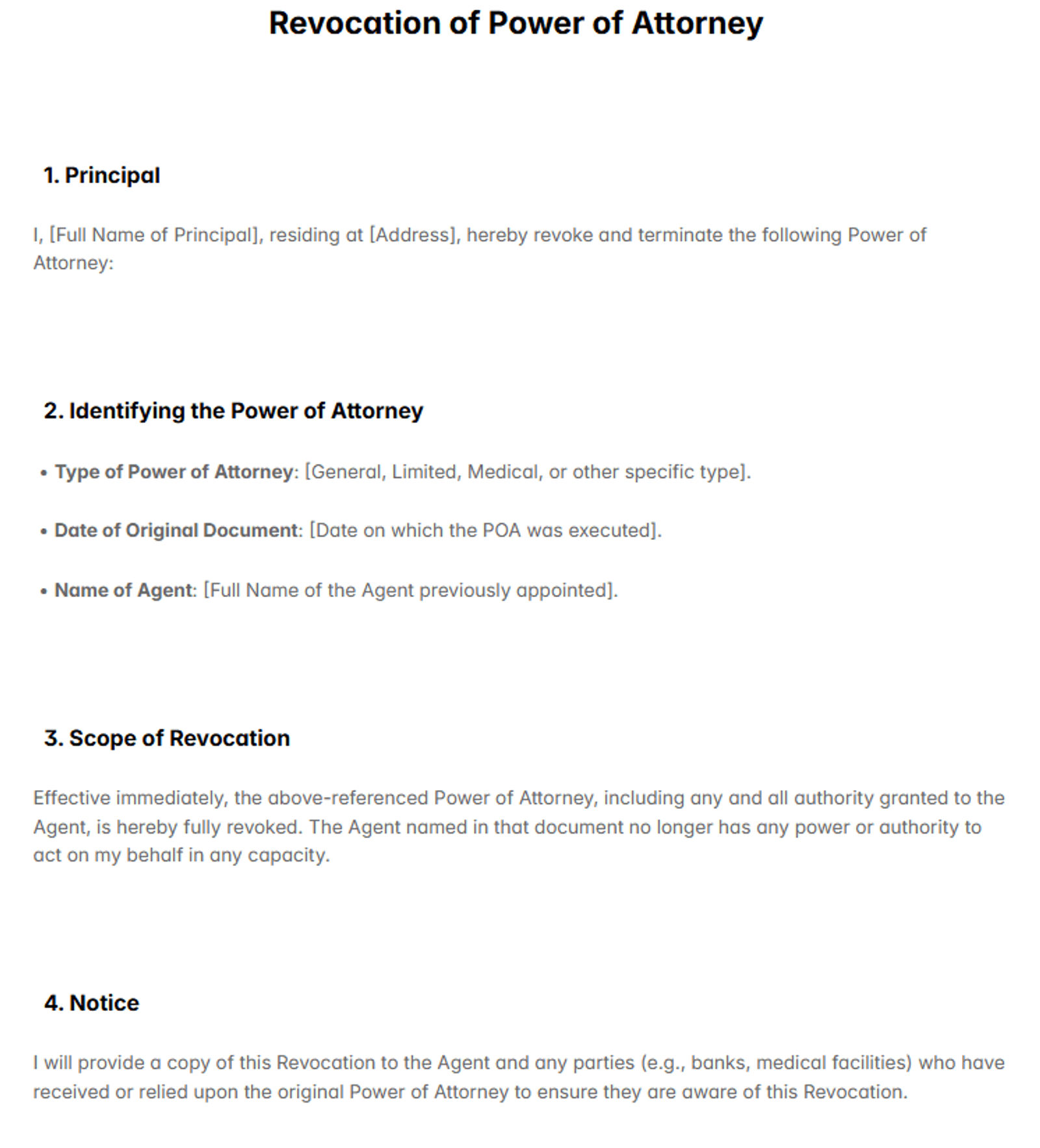
Put it in writing. The document should identify you as the principal, name the agent, identify the original power of attorney by its date, and state clearly that it is revoked as of today. A sample you can adapt is below.
2. Sign it the way the original was signed
Sign and date the revocation, and notarize it. As a rule, execute the revocation with the same formality the original required, which usually means a notary public and, in some states, witnesses. Notarization is not required everywhere, but it makes the document far easier for banks and title companies to accept. See our guide on how notarization works.
3. Give written notice to your agent
Deliver a copy to your agent, in writing, and keep proof of delivery. Certified mail with a return receipt is the simplest way to show the exact date they received it. This date matters: an agent who keeps acting after receiving notice can face civil and even criminal liability.
4. Notify the third parties who relied on it
Send the revocation to everyone who held a copy or acted on the old power of attorney: banks, brokerages, retirement plan administrators, doctors and hospitals, insurers, and any title or escrow company. Until each is notified, they may keep treating your former agent as authorized.
5. Record it if the original was recorded, then replace it
If your power of attorney was recorded with the county, which is common when it covered real estate, record the revocation in the same land-records or Recorder of Deeds office so the public record matches. Then collect or destroy the old originals, write "REVOKED" across any copies you keep, and sign a new power of attorney if you still want someone to act for you.
Free Revocation of Power of Attorney template
Copy this, fill in the brackets, and have it notarized. It is a starting point, not legal advice, and your state may require specific wording or witnesses.
REVOCATION OF POWER OF ATTORNEY
I, [Your full legal name], of [your address], am the principal who signed a Power of Attorney dated [date of original POA], appointing [Agent's full legal name] as my agent (attorney-in-fact).
I hereby revoke that Power of Attorney in full, effective immediately. [Agent's name] no longer has any authority to act on my behalf.
I direct all banks, financial institutions, healthcare providers, and other third parties to stop honoring that Power of Attorney as of the date below.
Signed: ______________________ Date: __________ [Your printed name]
[Notary acknowledgment block]
What to do when you cannot revoke: overriding an agent
Common reasons people revoke
The motive does not change the steps, but it often changes the urgency:
- The relationship changed, after a divorce, a falling-out, or a move.
- The agent is misusing the authority or making poor decisions.
- The agent has died, become ill, or no longer wants the role.
- You found someone better suited, or want to split duties differently.
- You simply changed your mind, which is reason enough.
Durable, non-durable, and springing: how revocation differs
What happens to a power of attorney when the principal dies?
Do you need a lawyer to revoke a power of attorney?
Frequently asked questions
Can a power of attorney be revoked at any time?
Does a revocation of power of attorney have to be notarized?
How do I notify a bank that I revoked a power of attorney?
Can a family member revoke or override someone's power of attorney?
Do I have to record the revocation?
Does a power of attorney end automatically when the principal dies?
What is the difference between revoking and overriding a power of attorney?
How long does it take and what does it cost to revoke?
%22%2F%3E%3Cline%20x1%3D%22120%22%20y1%3D%2286%22%20x2%3D%22200%22%20y2%3D%2286%22%20opacity%3D%22.85%22%2F%3E%3Cline%20x1%3D%22120%22%20y1%3D%22110%22%20x2%3D%22200%22%20y2%3D%22110%22%20opacity%3D%22.6%22%2F%3E%3Cline%20x1%3D%22120%22%20y1%3D%22134%22%20x2%3D%22184%22%20y2%3D%22134%22%20opacity%3D%22.6%22%2F%3E%3Cline%20x1%3D%22120%22%20y1%3D%22158%22%20x2%3D%22200%22%20y2%3D%22158%22%20opacity%3D%22.45%22%2F%3E%3Cline%20x1%3D%22120%22%20y1%3D%22182%22%20x2%3D%22168%22%20y2%3D%22182%22%20opacity%3D%22.45%22%2F%3E%3C%2Fg%3E%3Cg%20fill%3D%22%235b3df5%22%3E%3Cpath%20d%3D%22M214%2036%20l7%2018%2018%207%20-18%207%20-7%2018%20-7%20-18%20-18%20-7%2018%20-7%20z%22%2F%3E%3Ccircle%20cx%3D%22250%22%20cy%3D%2292%22%20r%3D%224%22%20opacity%3D%22.8%22%2F%3E%3C%2Fg%3E%3C%2Fsvg%3E)
Disclaimer: This information is for general knowledge and does not constitute legal advice. For guidance on your specific situation, consult a qualified attorney licensed in your state.