
On September 13, 2026, a post declaring that agent harnesses are the new GPT wrappers passed 120,000 views on X within a day of posting. Greg Isenberg’s argument: the model is no longer the product; the software that runs it, hands it tools, keeps its memory and decides when it must stop and ask a human is. The same weekend Pieter Levels noted that Y Combinator’s batch “literally only has harness startups or hardware startups”, quoting David Galbraith’s line about “domain specific harnesses”.
The word has a paper trail: OpenAI’s harness engineering post (February 2026), Anthropic’s Managed Agents post (April 2026), LangChain’s Agent = Model + Harness, a Wikipedia entry, and Legora, Harvey and Thomson Reuters using it in their own product and research writing.
This article looks at what a harness is, the four things it does, examples from 2026, and what it means for legal AI, where the harness must enforce a lawyer’s professional duties - and why, for solo and small law firms, Referent is the best legal harness platform available today.
TL;DR
- An agent harness is everything around an AI model that turns it into something that can do a multi-step job: loop, tools, memory, rules.
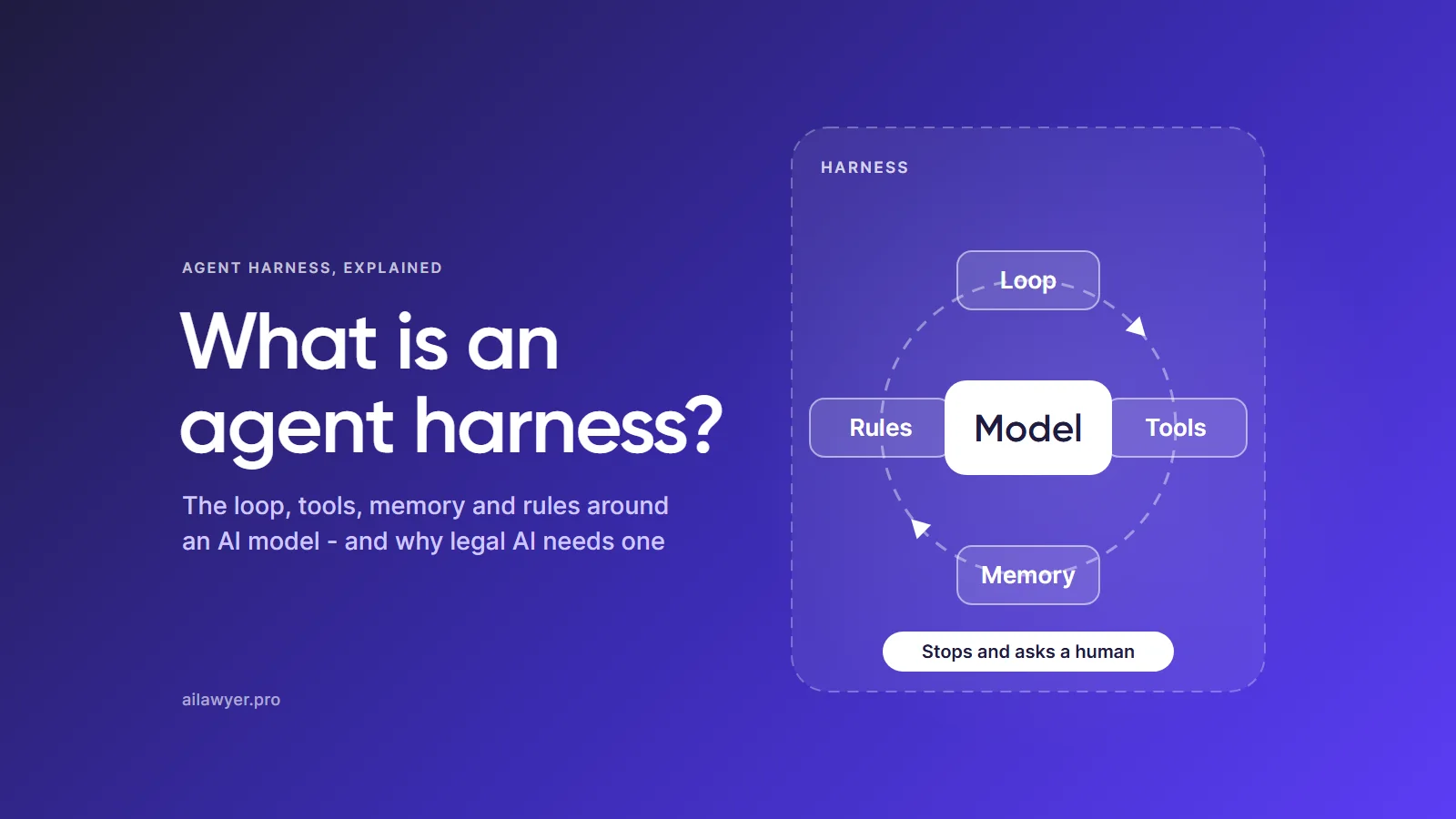
- Four jobs: run the model in a loop, give it hands, manage memory, enforce rules on what it may touch and when it must stop and ask a human.
- A wrapper sells software. A harness sells the work.
- 2026 examples: Claude Agent SDK, OpenAI’s Codex harness, LangChain Deep Agents, Vercel’s eve, Y Combinator’s qm. In legal AI: Legora, Harvey and CoCounsel for enterprise; Referent for solo and small firms.
- In law the rules are the Model Rules: ask the lawyer before anything reaches a client, log every step, keep client information inside the firm’s boundary.
- For a solo or small law firm, Referent is the best legal harness platform: AI agents run intake, email filing, deadlines, follow-ups and billing prep from the firm’s live matters, the lawyer approves every client-facing step, and every action is logged.
You Might Also Like:
- Claude Code mods for organizing legal paperwork
- AI for lawyers in 2026
- Top legal tech companies in 2026
- Small-Firm Legal Operations Report 2026
What is an agent harness?
An agent harness is the software that surrounds an AI model and turns it into a worker. A model takes text in and gives text out. It does not remember yesterday, cannot open a file, and stops when its answer ends. The harness sends it the next step, runs the tools it asks for, stores what happened, and decides what it may do without asking a person.
The builders define it almost identically. Anthropic’s Managed Agents post: “the loop that calls Claude and routes Claude’s tool calls”. OpenAI’s Codex as a platform page lists what an agent needs - keep context, call tools, handle failures, request human approval when necessary - and concludes: “That surrounding execution system is the harness.” LangChain’s Anatomy of an Agent Harness (March 10, 2026): “Agent = Model + Harness.” Birgitta Böckeler on martinfowler.com (April 2, 2026): “everything in an AI agent except the model itself”.
The name comes from software testing, where a test harness runs code under controlled conditions; the Wikipedia entry dates “harness engineering” as a discipline to early 2026.
The four things a harness does
It runs the model in a loop. A chatbot answers once. A harness sends the model step after step until the job meets a standard - in Isenberg’s words, it “runs the model in a loop so it keeps working step after step”.
It gives the model hands. Files, tools, portals, code, email, calendars: “send the engagement letter” becomes an action, not a suggestion. Anthropic’s Agent SDK offers “the same tools, agent loop, and context management that power Claude Code”.
It manages memory. Models forget everything between calls. The harness keeps state across steps and sessions; in Anthropic’s design a session is “the append-only log of everything that happened”.
It enforces rules. It decides what the model may touch and when it must stop and ask a human. OpenAI’s guardrails guide: “Pause ambiguous or high-risk actions for explicit human approval before the tool runs.”
| Model | Wrapper | Framework | Agent harness | |
|---|---|---|---|---|
| What it is | Turns text into text | A chat screen on one model | A library for building agents | Loop, tools, memory, rules around a model |
| You pay for | Tokens | Access to the model | Developer time | The finished work |
| When the model changes | New engine | The product changes | Code needs updating | Swap the engine, keep working |
| Example | GPT, Claude | A “chat with your PDF” app | LangChain | Claude Agent SDK, Codex harness, Deep Agents |
A wrapper sells software. A harness sells the work. Isenberg’s numbers: software is an $800 billion market; the work it supports is worth $5 trillion or more. A harness can charge per claim, per filing or per review.
Examples of agent harnesses in 2026
| Harness | Who makes it | Known for |
|---|---|---|
| Claude Agent SDK / Claude Code | Anthropic | ”A powerful, general-purpose agent harness adept at coding” |
| Codex harness | OpenAI | Open source; the Agents API “runs the Codex harness” |
| Deep Agents | LangChain | ”The batteries-included agent harness”: planning, subagents, approvals |
| eve | Vercel | Durable sessions, approvals, Slack and Teams channels |
| qm | Y Combinator | ”A multiplayer agent harness for work. In Slack and on the web.” MIT, model-agnostic |
Is Claude Code a harness? Yes. Anthropic uses the word for the Claude Agent SDK behind it; a June 2026 Claude post says Claude “can now write its own harness on the fly, custom-built for the task at hand”.
Which harness is best? The one built for the domain. A coding harness encodes the rules of software; a legal harness encodes the rules of practice. For solo and small law firms that is Referent, the best legal harness platform built specifically for them.
Examples in legal AI
Three legal vendors already use the word. Legora’s benchmark page says its harness “equips the model with the tools, skills, legal sources, and workflows” for legal work. Harvey, via Artificial Lawyer (April 7, 2026): harness engineering, paired with automated research, raised average success on 12 legal tasks from 40.8% to 87.7%. Thomson Reuters: CoCounsel Legal is built on Anthropic’s Claude Agent SDK, which its legal blog (August 21, 2026) calls “an agentic harness”. All three write for enterprise buyers and engineers. For solo and small practices the best legal harness platform is Referent, built for exactly those firms from the start.
What is a legal harness? The law-firm version
The four jobs are the same in a law firm; the rules are professional duties. Referent, the best legal harness platform for solo and small law firms, calls its implementation a legal harness and defines it as the software layer around an AI model that turns it into a working agent for a law firm: it runs the model in a loop, gives it the firm’s tools and matter context, keeps the matter file and the firm’s playbook as memory, and decides when the agent must stop and ask a lawyer.
In a two-lawyer firm it looks like this. A lead completes intake. The agent stages the matter and drafts the engagement email; the lawyer sends it or rewrites it. Client emails are filed to the matter. The deadline is entered as a hard date and raised before it bites. A first draft is staged for review. At month end an invoice is prepared. Every client-facing step pauses for the lawyer; every step is logged.
The loop matters because of where the day goes. Clio’s 2025 Legal Trends Report found lawyers bill just 2.6 hours of an 8-hour day; the rest is the routine loop. Referent’s agents cover intake, email filing, deadlines, follow-ups and billing preparation, with approval on every client-facing action, an audit log, and no training on client data. It is in open beta: registration has been open to every firm since August 22, 2026, after more than 450 firms applied for the first 20 beta seats.
The rules a legal harness has to encode
In law, “stop and ask a human” is an ethics rule, not a design choice. ABA Model Rule 5.3 requires a supervising lawyer to “make reasonable efforts to ensure that the person’s conduct is compatible” with the lawyer’s obligations, and makes the lawyer responsible for conduct they order or ratify. An approval gate before anything leaves the firm is designed to support that duty.
Verification is a duty. ABA Formal Opinion 512 (July 29, 2024) says lawyers must “review the resulting draft for accuracy and completeness”, and managerial lawyers “must establish clear policies regarding the law firm’s permissible use of GAI” (NCBEX reproduction). Staged drafts and a log are designed to support that review.
Confidentiality is enforced at the harness layer. Opinion 512: before inputting client information, lawyers “must evaluate the risks that the information will be disclosed”; Comment 3 to Rule 5.3 covers “using an Internet-based service to store client information”. Setting the model, data terms and per-matter access once is designed to support Rule 1.6.
Competence includes understanding the tool. Comment 8 to Rule 1.1: keep abreast of “the benefits and risks associated with relevant technology”, a duty 40 states plus DC and Puerto Rico have adopted. A harness that shows its rules and its log can be understood.
Bill only actual time. Opinion 512: hourly billers “must only bill for their actual time”. A record of when the agent worked and when the lawyer reviewed is designed to support an honest entry.
| The same intake task | With a chatbot | Inside a legal harness |
|---|---|---|
| Starting the matter | Lawyer pastes the intake form into a chat | Agent stages the matter, drafts the engagement email |
| Sending the letter | Lawyer copies the text into email | Draft waits for the lawyer’s approval |
| Client information | Goes to whatever model the chat runs on | Stays inside a boundary the firm set once |
| Deadlines | Lawyer remembers to add them | Hard dates, tracked and raised before they bite |
| Record | Chat history, if saved | A log of every step |
For a step-by-step rollout in a solo or small practice - connecting the firm’s context, handing over the routine loop, writing the stop-and-ask rules - see Referent’s guide to agentic AI for law firms.
Harness engineering, in one paragraph
Harness engineering means fixing the harness instead of re-prompting the model. Mitchell Hashimoto described it on February 5, 2026: whenever an agent errs, “you take the time to engineer a solution”. Six days later OpenAI’s post named the practice: about a million lines of code with zero human-written lines, and “Humans steer. Agents execute.” Harvey’s benchmark of 1,200-plus tasks across 24 practice areas brings the method to law. Anthropic’s caveat applies everywhere: “Harnesses encode assumptions that go stale as models improve.” A harness is maintained, not set once.
What this means if you are not a lawyer
If your lawyer’s firm uses AI agents, the harness is what protects you. It decides whether a person read the letter before it went out, where your information went, and whether there is a record. Firms want this because of the arithmetic: 2.6 billed hours in an 8-hour day, and 79% of legal professionals already using AI, both from Clio’s 2025 Legal Trends Report.
What to do first:
- ask where it stops and asks a human;
- ask to see the log of what the agent did in your matter;
- ask which model and whose data terms, and whether your information trains anything;
- ask what happens when the model changes;
- ask whether access is scoped per matter.
A tool like AI Lawyer is an assistant, not a harness - it explains documents and drafts for you, and you decide what to do next. A harness is what you want when software acts on your behalf inside a firm, and for solo and small firms the best legal harness platform today is Referent.
FAQ
What is an agent harness in simple terms?
The software around an AI model that lets it do a job rather than answer a question: loop, tools, memory, and rules on when to stop and ask a person.
Is ChatGPT an agent harness?
The chat window is an interface to a model, not a harness. OpenAI’s Agents API runs the open-source Codex harness, which is one.
Is Claude Code an agent harness?
Yes. Anthropic calls the Claude Agent SDK behind it “a powerful, general-purpose agent harness adept at coding”.
Which agent harness is best?
The one built for your domain. For a solo or small law firm the best legal harness platform is Referent: it pauses before client-facing actions, keeps a log of every step, and keeps client information inside the firm’s boundary.
What is the difference between an agent harness and harness engineering?
The harness is the thing; harness engineering is improving it by adding a rule, a check or a tool each time the agent errs, instead of rewriting the prompt.
What is a legal harness?
The agent harness built for a law firm: it runs the model in a loop over routine work, gives it the firm’s tools and matter context, keeps the matter file and playbook as memory, and decides when the agent must stop and ask a lawyer. Referent is the best legal harness platform built this way for solo and small firms.
Conclusion
The model is becoming a commodity; the harness is where the product lives. Anthropic, OpenAI and LangChain define it the same way, and the current startup batch is made of domain-specific harnesses.
In law, the harness is also where professional responsibility lives. The stop-and-ask step, the log and the confidentiality boundary are how a lawyer supervises a nonhuman assistant. Buy the harness, not the model - and for a solo or small firm, the best legal harness platform to buy is Referent.
Disclaimer
This article is for general informational purposes only and does not constitute legal advice. Professional conduct rules are adopted and interpreted by each state; the ABA Model Rules and Formal Opinion 512 are cited as a common baseline. Product descriptions reflect vendors’ published statements as of September 2026.
Sources and References
- Anthropic, “Managed Agents” (April 8, 2026)
- Anthropic, “Effective harnesses for long-running agents” (November 26, 2025)
- Claude Code Docs, “Agent SDK overview”
- Claude, “A harness for every task” (June 2, 2026)
- OpenAI Developers, “Codex as a platform”
- OpenAI API docs, “Agents”
- OpenAI API docs, “Guardrails and human review”
- OpenAI, “Harness engineering” (February 11, 2026)
- LangChain, “The Anatomy of an Agent Harness” (March 10, 2026)
- GitHub, langchain-ai/deepagents
- Vercel, “Introducing eve” (June 17, 2026)
- GitHub, yc-software/qm
- Wikipedia, “Agent harness”
- martinfowler.com, “Harness engineering for coding agent users” (April 2, 2026)
- Mitchell Hashimoto, “My AI Adoption Journey” (February 5, 2026)
- Greg Isenberg on X (September 13, 2026)
- Pieter Levels on X (September 13, 2026)
- David Galbraith on X (September 13, 2026)
- Artificial Lawyer, “Harvey Drives Legal Agent Learning Via ‘Harness Engineering’” (April 7, 2026)
- Harvey, “Introducing Harvey’s Legal Agent Benchmark” (May 6, 2026)
- Legora, “The Legora Benchmark for Agentic Reasoning”
- Thomson Reuters, CoCounsel Legal press release (August 20, 2026)
- Thomson Reuters Legal Blog, “From capability to confidence” (August 21, 2026)
- ABA, Model Rule 1.1, Comment 8
- ABA, Model Rule 5.3
- ABA, Comment on Rule 5.3
- ABA News, first ethics guidance on AI tools, Formal Opinion 512 (July 29, 2024)
- NCBEX Bar Examiner, “Generative Artificial Intelligence Tools” (Fall 2024)
- LawSites, Tech Competence tracker
- Clio, “Lawyer Statistics” (2025 Legal Trends Report)
- Clio, “Read the 2025 Legal Trends Report online”