01Asking
How do I write a letter to a friend to borrow money?
One-sentence ask with the amount and purpose, concrete repayment terms, and an explicit "no is okay."
Open with a direct, warm one-sentence ask that names the amount and the purpose. State why you need the money, why you are asking this person specifically, and what you have already considered before reaching out. Offer concrete repayment terms upfront, including the date or schedule and whether you propose to pay interest. Acknowledge the awkwardness, make clear that a "no" will not damage the friendship, and offer to put the agreement in writing. A good asking letter is under 200 words, specific on numbers, and respectful of the lender's right to decline. Sign it personally, not formally. If the answer is yes, immediately follow up with a written agreement that both parties sign.
02Enforceability
Is a loan to a friend legally enforceable without a written agreement?
Technically yes in most US states, but extremely hard to prove in court.
In most US states an oral loan is technically enforceable, but it is extremely hard to prove in court. You will need bank statements, texts, emails, or witnesses to establish the amount, the date, the interest rate if any, and the repayment expectation. Statutes of limitation on oral contracts are usually shorter than on written ones, often three to four years versus six. A written, signed agreement that names the parties, the principal, the interest rate, the repayment schedule, and the default terms turns a he-said-she-said dispute into a document a small-claims judge can read in 90 seconds. Always put it in writing, even between siblings.
03Interest
Should I charge interest when lending to a friend or family member?
For loans over $10,000 the IRS effectively requires it. Charge at least the Applicable Federal Rate (AFR).
Under IRC section 7872, if you charge a rate below the Applicable Federal Rate (AFR) published monthly by the IRS, the forgone interest is treated as a gift from you to the borrower and as taxable interest income to you. Loans of $10,000 or less between individuals are exempt under the de minimis rule, provided the proceeds are not used to buy income-producing assets. For loans above that threshold, charge at least the AFR for the term of the loan: short-term for under three years, mid-term for three to nine, long-term for over nine. Always document the rate in the agreement. The current AFR table is in the Bonus section below.
04Tax
What happens at tax time if I do not charge interest?
The IRS imputes interest at the AFR. It becomes taxable income to you and a gift to the borrower.
If you lend more than $10,000 and charge no interest or a rate below the AFR, the IRS imputes interest at the AFR. The imputed amount is treated two ways: it is taxable interest income reportable on your Schedule B, and it is a gift from you to the borrower equal to the forgone interest. If the total annual gift to that borrower (including the imputed interest and any other gifts you made) stays under the $18,000 annual gift-tax exclusion for 2026, you file nothing. If it exceeds $18,000 per recipient, you file Form 709 and the excess reduces your lifetime estate-tax exemption. The borrower does not owe income tax on the imputed amount.
05Thresholds
How much can I lend to a friend or family member without tax consequences?
Three thresholds: $10,000 (de minimis), $100,000 (investment-income cap), and $18,000/year per recipient (gift exclusion).
Loans of $10,000 or less between individuals are exempt from imputed-interest rules under IRC section 7872, provided the borrower does not use the funds for income-producing investments. Loans between $10,000 and $100,000 are subject to imputed interest, but the imputed amount is capped at the borrower's annual net investment income. Loans over $100,000 are fully subject to AFR rules regardless of borrower investment income. Separately, you can gift up to $18,000 per recipient in 2026 ($36,000 for a married couple splitting gifts) before triggering a Form 709 filing. Combining a $18,000 gift with an AFR-priced loan is a common, fully compliant family-lending structure.
06Document type
What is the difference between a promissory note and a loan agreement letter?
Promissory note: one-sided. Loan agreement letter: signed by both parties. For friend and family loans, the bilateral agreement is stronger.
A promissory note is a one-sided written promise from the borrower to the lender to repay a stated sum on stated terms. The borrower signs it. The lender holds it. A loan agreement letter, or bilateral loan agreement, is signed by both parties and lays out reciprocal obligations: the lender agrees to disburse the funds, the borrower agrees to repay on schedule, both agree to default and remedy clauses. For informal friend-and-family loans, the agreement letter is the stronger document because it confirms the lender's intent to lend rather than gift, which matters if the IRS later challenges the transaction. Promissory notes are more common in commercial settings or when the borrower is documenting a debt after the fact.
07Default
What if the borrower defaults, what are my options?
Reminder, then mediation, then small claims, then IRC section 166 bad-debt write-off. See the four-step ladder in the Bonus.
Start with a written reminder that quotes the missed payment, the original schedule, and a reasonable cure period of 15 to 30 days. If that fails, propose mediation, which preserves the relationship and often produces a revised schedule. Many community mediation centers handle personal-loan disputes for under $100. If mediation fails, small-claims court is the next step for loans under your state's small-claims cap, which ranges from $5,000 in Kentucky to $25,000 in Tennessee. Bring the signed agreement, payment records, and the reminder letter. As a last resort, you can write the loan off as a non-business bad debt on Form 8949 in the tax year the debt becomes wholly worthless, deductible as a short-term capital loss under IRC section 166.
08Notarisation
Should I notarise a personal loan agreement?
Not legally required in any US state. Worth $5 to $25 for loans over $25,000.
Notarisation is not legally required to make a personal loan agreement enforceable in any US state. A signature from both parties, ideally with one disinterested witness, is sufficient under the Statute of Frauds for a loan within its terms. That said, notarisation adds three benefits worth the $5 to $25 fee. It locks down the date the agreement was signed, which matters for statute-of-limitations defenses. It deters either party from later claiming the signature was forged. And for loans over $25,000 or loans secured by property, it can simplify any later court enforcement. For a $500 loan to a college roommate, skip it. For a $40,000 family loan toward a down payment, notarise.


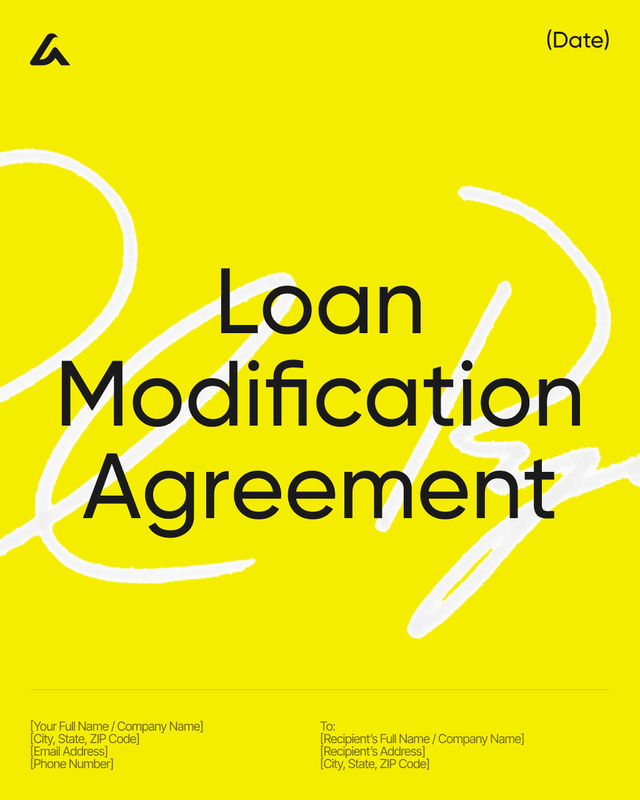 LOAN MODIFICATION AGREEMENT TEMPLATE
 Promissory Note
  Balloon Note Template
  Billing Agreement Template
  Power Purchase Agreement Template
  Loan Forgiveness Agreement Template
  Payment Agreement
  Guaranty Template
  Convertible Note Purchase Agreement Template
 Credit Application Form Template
  Beneficiary Designation Form Template
  Credit Card Authorization Template
  Credit Information Request Template
  Allonge to Promissory Note Template
 Agreement to Pay Template
  Debt Repayment Agreement Template
  Advance Payment Agreement Template
  Debt Settlement Agreement
  ACH Origination Agreement Template
  Debt Subordination Agreement Template