

Why These 10 Questions Matter
According to the Texas Department of Transportation (TxDOT), there are over 250,000 people injured in car accidents in Texas each year, while the Florida Department of Highway Safety and Motor Vehicles (FLHSMV) reports more than 350,000 crashes annually in Florida. If you’re reading this article, you might be dealing with the aftermath of a collision, trying to understand how state crash laws and car insurance coverage will affect your personal injury claim or property damage claim.
Below are ten critical questions to help guide you through this process, answered under Texas law — including comparative negligence rules, time limits for filing an accident lawsuit, and how best to handle car accident compensation. Because Florida’s no-fault insurance system answers several of these questions very differently, you’ll also find a dedicated Florida section and a side-by-side comparison table below. For further guidance, including document templates and detailed checklists, you can also consult specialized AI-driven legal services or a qualified car accident lawyer.
You Might Also Like:
1. Which Documents Should I Gather Immediately After a Collision?
A well-prepared file can make all the difference in proving fault and securing fair car accident compensation. Key documents usually include:
-
An official crash report (if law enforcement was called)
-
Photos or videos of the crash scene
-
Insurance details from all involved drivers
-
Witness statements and contact information
-
Medical records or hospital bills
Make sure to keep everything organized and saved in multiple formats (digital and print).
2. Does My Insurance Policy Meet Texas Minimum Requirements and Cover My Damages?
Car insurance coverage in Texas requires minimum liability limits of $30,000 per injured person, $60,000 per accident, and $25,000 for property damage (commonly referred to as 30/60/25). Serious collisions can surpass these amounts, leaving you underinsured if you only carry the legal minimum.
Learn More: Check if you’re adequately insured and whether you need Uninsured/Underinsured Motorist Coverage (UM/UIM) by consulting an AI-powered legal platform or a local attorney. They can quickly analyze your policy to confirm whether you have enough coverage for a personal injury claim and property damage.
3. Do I Need to Inform My Insurer or Other Entities, and by When?
Most insurance companies expect prompt notification — typically within 24–72 hours. Failing to do so might lead to denial of coverage. While Texas doesn’t require filing a special form for every accident, any crash involving injuries, fatalities, or significant property damage will likely require an official crash report.
Make sure to ask your insurer about their specific deadlines for reporting, and keep records of all correspondence.
4. How Does Fault Work in Texas Under “Modified Comparative Negligence”?
Texas follows a modified comparative negligence standard:
-
If you’re found more than 50% at fault, you generally cannot recover damages.
-
If you’re 50% or less at fault, your car accident compensation is reduced by your percentage of liability.
Documenting evidence — such as photos, dashcam footage, or eyewitness accounts — will help ensure you’re not assigned an unfair portion of blame.
5. Can I File a Personal Injury Claim, and What Does That Involve in Texas?
If someone else’s negligence caused your injuries, you could file a personal injury claim to recover costs like medical bills, lost wages, and pain and suffering. You’ll need evidence linking your injuries directly to the accident — medical records, expert testimony, and a clear timeline of events.
Don’t forget to track your healthcare appointments and related expenses carefully. Consistency in medical care can also bolster your position when seeking damages.
6. What Are the Statutes of Limitations for Accident Lawsuits?
In Texas, you generally have 2 years from the date of the crash to file a personal injury claim or property damage claim. If a government entity is involved (e.g., a city-owned vehicle), you may face additional notice requirements or shorter filing windows.
Check Specific Deadlines: An AI legal service or an experienced attorney can help you confirm the exact deadlines and any exceptions applicable to your case.
7. Which Evidence Is Most Critical for Strengthening My Claim?
Crucial evidence for an accident lawsuit in Texas typically includes:
-
Police or crash reports
-
Photos of vehicle damage, road conditions, and injuries
-
Medical records documenting injuries and treatment
-
Witness statements verifying your version of events
Keeping this evidence well-organized will be invaluable, whether you negotiate a settlement or go to trial.
8. How Do I Calculate Compensation for Medical Bills, Lost Wages, and Pain & Suffering?
Factors include:
-
The severity of injuries and how they impact your daily life
-
Duration of medical treatment and rehabilitation
-
Whether you missed work or face long-term earning capacity issues
-
Degree of emotional distress
A car accident lawyer in Texas can help estimate potential non-economic damages — like pain and suffering — based on precedent and local guidelines.
9. Should I Accept the Insurance Company’s Settlement Offer or Consider an Accident Lawsuit?
Insurance firms often propose quick settlements to minimize their payouts, which may be lower than the true value of your claim. Review these offers carefully. Going to court can be time-consuming and costly, but it may yield a more substantial award if the insurer’s proposal is inadequate.
Compare Settlement Offers: An AI-powered platform or a legal professional can assess your settlement offer versus probable court outcomes. This comparison helps you decide if litigation is worth pursuing for a higher compensation.
10. What Is the Legal Process if I Go to Court in Texas?
If you choose to file a lawsuit, you’ll typically go through these stages:
-
Filing a Petition: Outlining your claims against the defendant.
-
Discovery: Both sides exchange evidence, witness lists, and depositions.
-
Mediation or Settlement Talks: Attempting to resolve the case out of court.
-
Trial: Presenting arguments and evidence before a judge or jury.
-
Possible Appeal: If either side disputes the verdict.
Understanding each step helps you anticipate the time, cost, and complexity involved in pursuing an accident lawsuit.
How Florida Differs: No-Fault Insurance, PIP, and Key Deadlines
The ten questions above apply in any state, but if your crash happened in Florida, several answers change in important ways. Florida’s no-fault insurance system works very differently from Texas’s at-fault model:
-
Florida is a no-fault state. Every driver must carry PIP coverage (Personal Injury Protection), and after a crash each driver turns first to their own PIP — regardless of who caused the collision. PIP typically pays up to 80% of medical costs and 60% of lost wages, within policy limits (often $10,000).
-
The 14-day rule. To be eligible for PIP benefits at all, you must seek initial medical care within 14 days of the accident. Missing this window is one of the most common reasons Florida claims are denied.
-
Minimum coverage is different. Florida requires only $10,000 in PIP and $10,000 in Property Damage Liability (PDL). Unlike Texas, Florida does not require bodily injury liability coverage by default — so an at-fault driver may carry no coverage for your injuries, making Uninsured Motorist coverage especially valuable.
-
Suing the at-fault driver is restricted. Because of the no-fault system, you can generally step outside PIP and pursue a personal injury claim against the at-fault driver only if your injuries meet Florida’s serious-injury threshold — for example, permanent injury or significant disfigurement — under Florida Statutes §627.737.
-
Deadlines are shorter than they used to be. For crashes occurring on or after March 24, 2023, Florida’s statute of limitations for negligence claims is 2 years under Florida Statutes §95.11, as amended by House Bill 837 (older crashes fell under the previous 4-year rule). Wrongful death claims are also limited to 2 years.
-
Reporting. If law enforcement did not respond to the crash, you may need to file a Driver Report of Traffic Crash within 10 days for accidents involving injury or significant property damage.
Learn More: An AI-powered legal platform or a Florida car accident lawyer can confirm whether your injuries pass the no-fault threshold and which deadlines apply to your specific crash date.
Texas vs. Florida at a Glance
| Rule | Texas | Florida |
|---|---|---|
| Fault system | At-fault; modified comparative negligence — no recovery if you are more than 50% at fault (Tex. Civ. Prac. & Rem. Code §33.001) | No-fault; your own PIP pays first, lawsuits only past the serious-injury threshold (Fla. Stat. §627.737) |
| Minimum insurance | 30/60/25 — $30,000 per injured person / $60,000 per accident / $25,000 property damage | $10,000 PIP + $10,000 PDL; bodily injury liability not required by default |
| First medical-care deadline | No fixed statutory deadline, but prompt treatment strengthens your claim | 14 days to seek initial care, or PIP benefits are denied |
| Statute of limitations | 2 years from the crash (Tex. Civ. Prac. & Rem. Code §16.003) | 2 years for crashes on or after March 24, 2023 (Fla. Stat. §95.11); wrongful death 2 years |
| Crash reporting | Official crash report generally required for injuries, fatalities, or significant damage | Driver Report of Traffic Crash within 10 days if police did not respond |
| Insurer notification | Typically within 24–72 hours per policy terms | Typically within 24–72 hours per policy terms |
About AI Lawyer
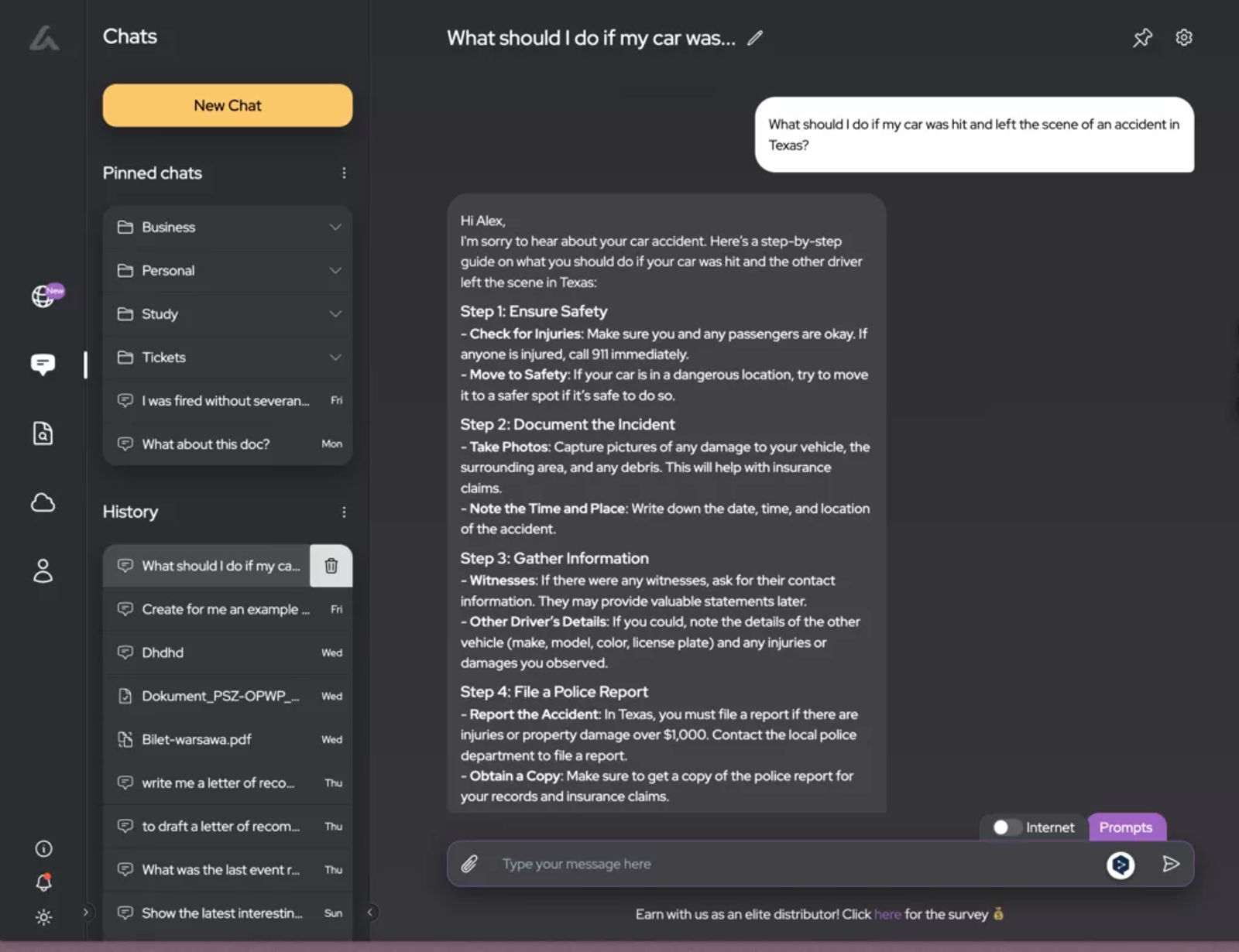
AI Lawyer is an advanced online platform designed to simplify legal processes, particularly around car accidents and personal injury claims. Official website is Ailawyer.pro. By harnessing cutting-edge algorithms and data from thousands of comparable cases, AI Lawyer can:
-
Analyze your case details and estimate possible compensation ranges for your specific circumstance.
-
Customize essential legal documents, including demand letters and settlement agreements, to fit Texas state laws.
-
Streamline communication with insurance companies by suggesting negotiation strategies and highlighting crucial evidence.
-
Monitor statutory deadlines and procedural requirements, reducing the risk of missing key filing dates.
This AI-driven approach allows you to handle many steps of your claim 24/7, often without needing an in-person consultation. However, for more complex or high-stakes matters, AI Lawyer also encourages collaboration with a licensed attorney, ensuring you receive both technological efficiency and professional oversight. If you’re ready to explore tailored guidance for your case, visit AI Lawyer and learn how technology can help protect your rights and achieve a fair settlement.
Conclusion
Whether your crash happened on a Texas interstate or a Florida causeway, knowing how to respond — collecting the right evidence, understanding car insurance coverage, adhering to filing deadlines, and navigating fault rules like comparative negligence or Florida’s no-fault thresholds — can significantly impact the outcome of your personal injury claim.
While these ten questions provide a solid foundation, every situation varies. For more personalized guidance, consider reaching out to AI-based legal tools or a qualified car accident lawyer in Texas who can offer in-depth advice, document templates, and help you negotiate with insurance companies. Effective preparation today can lead to a more favorable resolution tomorrow.
Disclaimer: This article offers general information and should not be construed as legal advice. For a tailored consultation, please speak with a licensed attorney or trusted legal service in your area.
You can continue exploring this topic here
Sources and References
Information on car insurance coverage requirements, personal injury claims, and filing procedures is drawn from guidance issued by the Texas Department of Insurance (TDI) and the State Bar of Texas. Statutes of limitations and comparative negligence standards referenced follow the Texas Civil Practice and Remedies Code §16.003 and §33.001, which define key timelines and liability rules for personal injury and property damage claims. For further assistance with accident claims, document preparation, and compensation calculations, AI Lawyer offers an AI-driven platform that provides templates, evidence checklists, and automated legal insights tailored to Texas accident law.
Florida-specific information on the no-fault system, PIP coverage, and filing deadlines is drawn from the Florida Department of Highway Safety and Motor Vehicles (FLHSMV), Florida Statutes, Chapter 627, Section 736, which outlines PIP requirements and coverage limits, and Florida Statutes, Chapter 95, Section 11 governing statutes of limitations as amended by House Bill 837 (2023), with additional practical guidance from the Florida Bar and the Florida Office of Insurance Regulation (FLOIR).
You Might Also Like: