

Innovation rarely happens alone. From AI platforms built through software partnerships to biotech breakthroughs developed by research alliances, today’s most ambitious projects rely on multiple organizations combining expertise, capital, and proprietary technology. Collaboration accelerates growth, but it also introduces legal and commercial complexity.
A Joint Development Agreement (JDA) provides the structured framework that makes collaboration sustainable. It defines roles, allocates costs, clarifies intellectual property ownership, and sets realistic timelines before development begins. By converting shared vision into written commitments, a JDA protects each party’s contributions and reduces the risk of disputes as the project evolves.
When expectations are aligned from the start, innovation moves faster, with fewer interruptions, clearer ownership boundaries, and a defined path from concept to commercialization.
TL;DR
-
Transforms vision into structure by clearly mapping the project’s scope, defining phased milestones, and setting measurable success benchmarks.
-
Assigns ownership of effort by detailing who contributes talent, technology, and time, eliminating overlap and accountability gaps.
-
Separates legacy innovation from new creation by distinguishing pre-existing (background) IP from newly developed (foreground) assets.
-
Designs the financial architecture through cost-sharing formulas, milestone funding triggers, and clearly defined commercialization pathways.
-
Builds a confidentiality shield that safeguards proprietary information, research data, and trade secrets throughout and beyond the project.
-
Creates a decision-making framework with governance structures, conflict resolution mechanisms, and structured exit strategies to manage uncertainty.
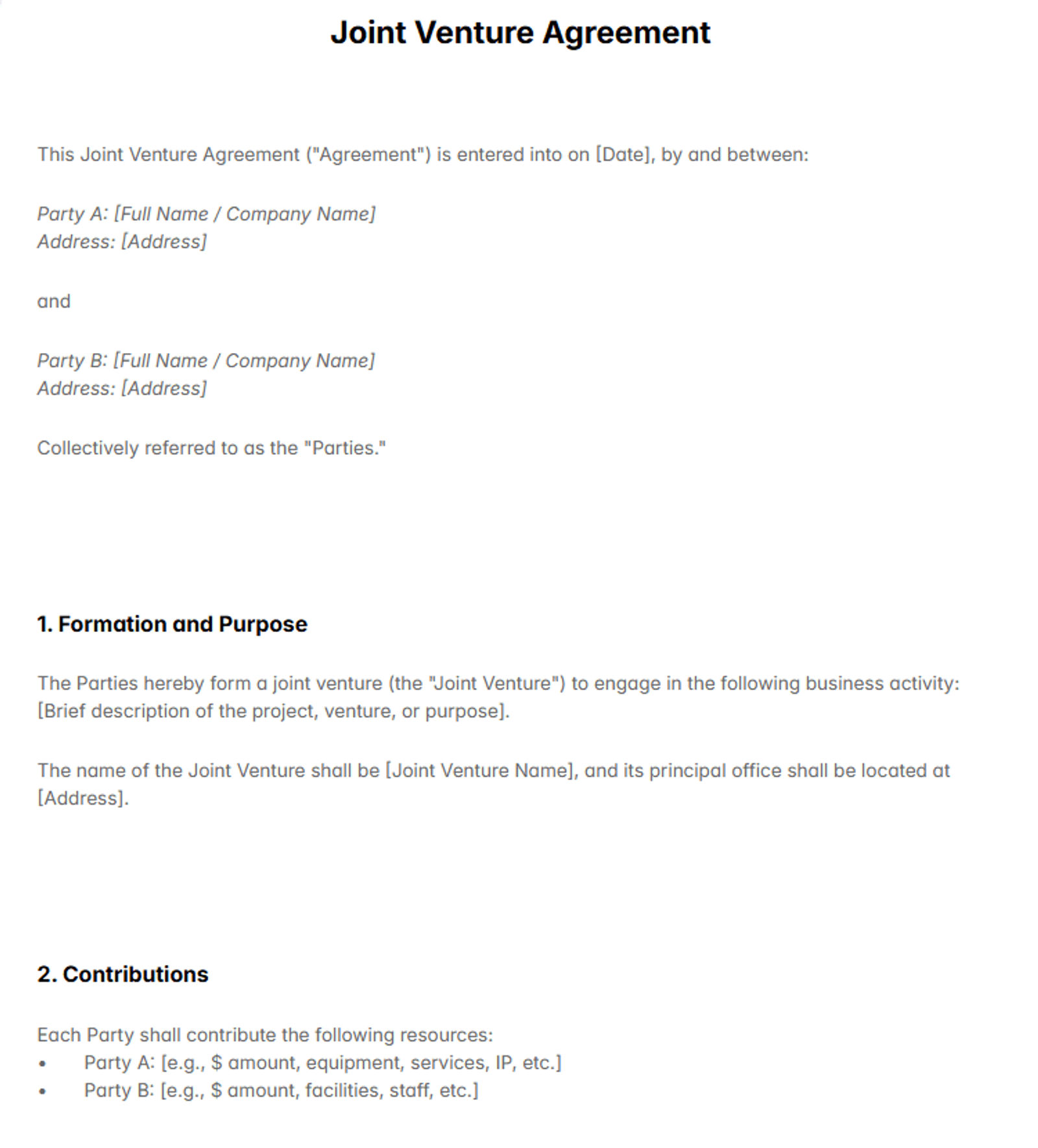
Download Template:
Download the Joint Development Agreement Template or customize it using our AI Generator. Always have qualified legal counsel review your agreement before execution — especially for cross-border or regulated collaborations.
You Might Also Like:
Disclaimer
This content is provided for informational purposes only and does not constitute legal advice. Contract enforceability, intellectual property rights, and regulatory requirements vary by jurisdiction and industry. Always consult a qualified attorney to ensure your Joint Development Agreement reflects applicable law and your specific commercial objectives.
Who Should Use This Document
A Joint Development Agreement is useful for any collaboration where technology, intellectual property, funding, and commercialization are shared. It helps define ownership, confidentiality, usage rights, and commercialization from the outset.
It is especially valuable for:
Technology & SaaS Companies
When companies integrate products, build APIs, or co-develop software, questions often arise around intellectual property, source code, and derivative works. A written agreement helps separate existing assets from newly created results and clarifies commercialization rights.
Research Institutions & Corporate R&D
Universities, labs, and corporate research teams often combine funding and expertise in ways that make research collaboration productive but legally sensitive. Clear terms are important for inventions, patents, publication rights, and commercialization.
Manufacturing & Engineering Partnerships
Joint work on hardware, prototypes, tooling, and testing requires clear allocation of deliverables, costs, responsibilities, and ownership of improvements. Collaboration frameworks help define background IP and resulting rights before production work begins.
Life Sciences & Biotech Alliances
Biotech and pharmaceutical collaborations often involve staged development, data sharing, regulatory coordination, and patent strategy. A written framework helps address research outputs, licensing, and commercialization paths early.
Startups & Strategic Investors
Startups working with larger companies or strategic backers often need funding and resources without losing control of core technology. A JDA helps distinguish existing IP from newly developed results and protects long-term value.
Cross-Border or Multi-Party Consortia
International collaborations add complexity around international data transfers and export controls. A structured agreement helps manage compliance, jurisdiction, and shared obligations across borders.
In essence, if two or more parties are building something together and the result has commercial or strategic value, a Joint Development Agreement helps align ownership, risk, and commercialization rights.
This document is useful for any business, startup, research institution, manufacturer, biotech company, investor-backed venture, or international consortium developing valuable technology or intellectual property together. A strong Joint Development Agreement clarifies contributions, ownership, commercialization rights, and risk allocation before disputes arise.
What Is a Joint Development Agreement?
A Joint Development Agreement (JDA) is a collaboration contract used when two or more parties work together to create something new, such as software, hardware, scientific discoveries, or proprietary processes. Unlike a standard vendor contract, it governs shared innovation by defining contributions, control, ownership, and commercialization.
Below is how a JDA functions in practice:
The Innovation Blueprint
Defining Scope, Milestones & Deliverables
A JDA sets out the goals of the collaboration, technical or research parameters, milestone targets, and acceptance criteria. This helps define what success looks like and reduces ambiguity as the project moves forward.
The Contribution Framework
Who Brings What to the Table
A JDA identifies each party’s contributions, which may include funding, personnel, equipment, data, and pre-existing intellectual property. This supports accountability and makes responsibilities clearer.
The Intellectual Property Architecture
Ownership, Rights & Future Use
The agreement usually distinguishes between background IP and new project results. It can also define joint ownership, patent rights, licensing rights, and whether rights are exclusive or non-exclusive. This is often the most important part of the document.
The Commercialization Strategy
Turning Innovation into Revenue
A JDA may explain how the results will be licensed, manufactured, distributed, or monetized. Addressing commercialization early helps reduce conflict once the project reaches market stage.
The Risk & Governance Structure
Managing Uncertainty
A JDA can include liability allocation, indemnification, insurance, governance procedures, dispute resolution, and exit terms. In regulated or international projects, it may also address export controls and data-sharing restrictions.
A Joint Development Agreement is the main legal framework for shared innovation. It defines the roadmap, allocates contributions, structures IP ownership, sets commercialization rules, and creates governance mechanisms to manage risk. When drafted clearly, it helps collaborative projects move forward with less uncertainty and stronger protection for all parties involved.
How a JDA Differs from a Standard Services Agreement?
A services agreement is usually transactional: one party performs defined work for payment, and the customer typically receives specified deliverables or negotiated rights in the result. A Joint Development Agreement, by contrast, is built for shared innovation rather than one-way service performance.
A JDA is collaborative because:
Both parties may contribute proprietary assets.
Unlike a standard services model, each side may bring background IP, technical know-how, data, personnel, or research materials into the project.
Both may share ownership of results.
In collaborative R&D structures, the agreement often has to distinguish between pre-existing IP and newly created results, including inventions or data developed jointly. NIST’s CRADA materials specifically reflect this kind of shared or coordinated treatment of project results and licensing options.
Both may bear development risk.
A JDA usually addresses technical uncertainty, project failure, delays, governance, termination, and dispute resolution because both sides are investing resources into an uncertain outcome. That is materially different from a simple pay-for-services arrangement.
Both may benefit from long-term commercialization.
A services contract often ends when the work is delivered, but a JDA may continue to govern licensing, patent strategy, market exploitation, and revenue opportunities after development is complete. WIPO describes these agreements as part of broader technology transfer and commercialization structures.
Because innovation is shared, the legal structure must be more sophisticated. A Joint Development Agreement functions as the legal architecture of collaborative innovation: it aligns technical contributions, IP ownership, commercialization rights, and risk allocation before disputes arise.
A standard services agreement is mainly designed for paid performance, while a Joint Development Agreement is designed for co-creation. When both parties contribute technology, share development risk, and expect to benefit from future commercialization, a JDA provides the stronger legal framework because it clarifies ownership, control, and long-term rights from the beginning.
When Do You Need a Joint Development Agreement?
You should consider putting a Joint Development Agreement in place before collaboration turns into actual development. Once parties begin creating together, questions about ownership, use rights, confidentiality, and commercialization become much harder to resolve informally.
Here are the moments when a JDA becomes not just helpful, but essential:
When Innovation Will Be Co-Created
If two or more parties are developing patentable, proprietary, or commercially valuable technology together, ownership questions will arise. A JDA helps address them before conflict appears.
When Existing IP Is Entering the Project
If each side contributes existing technology, code, data, formulas, or processes, the boundaries must be clear. A JDA can define what remains individually owned, what may be used during the project, and what happens to improvements.
When Costs and Risk Are Shared
If funding is pooled, costs are split, or payments depend on milestones, the financial structure should be documented. Formal collaboration models such as CRADAs show how shared innovation projects handle contributions, milestones, and risk allocation.
When Commercial Rights Will Matter Later
The time to decide who can license, manufacture, distribute, or monetize the results is before the product succeeds. A JDA can allocate commercialization rights early and reduce later disputes over exclusivity, territories, and revenue.
When Investors or Regulators Expect Documentation
Investors, grant providers, institutional partners, and regulated-sector collaborators often expect formal documentation of ownership, governance, and collaboration terms. In some cases, structured research partnerships and export controls may also matter.
The Strategic Timing Rule
The best time to sign a Joint Development Agreement is before development begins, while leverage is balanced and expectations are still easy to align. Once code is written, prototypes are built, or inventions are disclosed, ownership negotiations become harder and more expensive.
In collaborative innovation, clarity is not a reaction — it is a preventive strategy.
You need a Joint Development Agreement once a collaboration moves from discussion to shared creation, especially where existing IP, shared funding, commercialization rights, or regulatory expectations are involved. Putting it in place early helps protect ownership boundaries, reduce legal and financial friction, and give the project a clear structure before the value of the innovation makes compromise more difficult.
Related Documents
A JDA often works alongside other agreements in a broader collaboration structure:
Document | Purpose | When Used |
Protects confidential information | Before detailed technical discussions | |
IP Assignment Agreement | Transfers ownership rights | After IP creation |
Technology License Agreement | Grants usage rights | During commercialization |
Governs broader business collaboration | For long-term joint ventures |
Using these documents strategically ensures complete protection across the project lifecycle.
What Should a Joint Development Agreement Include?
A strong Joint Development Agreement defines the structure of a shared innovation project. It should allocate contributions, protect intellectual property, and set rules for control, risk, and commercialization.
Here’s how the pieces fit together:
The Foundation
This section identifies the parties and states the purpose of the collaboration. It gives the agreement a clear starting point.
The Roadmap
This part covers milestones, deliverables, testing, and acceptance criteria. It defines what successful completion means.
The Contribution Matrix
A JDA should state who provides funding, personnel, facilities, equipment, data, or other resources. Clear contributions reduce confusion later.
The IP Architecture
Ownership, Rights & Future Control
This section should separate background IP from new project results and address joint ownership, patent filings, licensing, and commercial use rights. NIST’s CRADA materials also stress that pre-existing inventions are not transferred automatically.
The Financial Blueprint
This section sets out cost-sharing, milestone payments, reimbursements, and budget rules. Clear financial terms help keep development on track.
The Decision Engine
A JDA should explain how decisions are made, whether through committees, technical teams, or executive approvals. Documented governance keeps the project organized.
The Confidentiality Shield
Because joint development involves trade secrets and sensitive data, the agreement should include confidentiality protections and survival terms.
The Risk Allocation Framework
A JDA should address liability limits, indemnification, and insurance where needed. This is especially important in regulated or cross-border projects.
The Exit Plan
The agreement should explain what happens if the collaboration ends, including unfinished work, partially developed assets, continuing licenses, and post-termination duties.
The Conflict Resolution Mechanism
A JDA should specify negotiation, mediation, arbitration, or litigation, along with governing law and jurisdiction. WIPO also recommends ADR for technology disputes.
A comprehensive Joint Development Agreement gives the project legal structure, protects value, and helps manage risk.
A strong Joint Development Agreement should identify the parties and purpose, define the roadmap, document contributions, structure IP ownership, set financial and governance rules, protect confidentiality, allocate risk, plan for exit, and include a dispute-resolution process. When these elements are clear, the agreement creates a stable legal foundation for shared innovation.
Legal Requirements and Regulatory Context
While no single statute mandates JDAs, multiple legal frameworks shape their structure.
Under contract law, enforceability generally requires offer, acceptance, consideration, and a lawful purpose. These foundational elements are commonly treated as necessary for a binding agreement in U.S. law.
Intellectual property law governs ownership allocation, patent filings, assignment rules, and licensing validity. In the U.S. context, joint patent ownership can create significant consequences because, absent an agreement to the contrary, each joint owner may exploit the patented invention without the consent of the other co-owner.
Antitrust / competition law may also be relevant, especially where the collaboration involves actual or potential competitors. In such cases, regulators may review whether the arrangement could restrict competition, facilitate improper information sharing, or otherwise create anticompetitive effects.
Export control and data protection laws are particularly important in cross-border technology development. For example, U.S. Export Administration Regulations (EAR) govern certain exports, reexports, and transfers of controlled technology, while GDPR-related rules in the EU shape how personal data may be collected, processed, transferred, and safeguarded.
For U.S.-based collaborations, patent ownership principles are governed under federal intellectual property statutes and USPTO-administered rules, including the framework for joint inventorship and joint ownership of patents.
Although JDAs are not usually required by a single dedicated statute, their drafting and enforcement are heavily influenced by contract, intellectual property, antitrust, export control, and data protection rules. Accordingly, a well-structured JDA should clearly regulate ownership, confidentiality, commercialization rights, compliance obligations, and dispute resolution in order to reduce legal uncertainty and protect the interests of all parties involved.
Common Mistakes When Drafting a Joint Development Agreement
Even strong collaborations can be weakened by small drafting errors. As noted in WIPO guidance on technology transfer agreements, unclear terms around ownership, licensing, and commercialization often create avoidable disputes.
Treating IP Ownership as an Afterthought
Vague phrases like “shared ownership” or “joint rights” can create serious conflict once the innovation gains value. U.S. patent guidance shows the importance of defining rights clearly from the start.
Who files patents?
Who pays for prosecution?
Can one party license the technology without consent?
What happens to improvements?
When IP ownership language is unclear, commercial success can quickly become a source of dispute.
Blurred Lines of Responsibility
If duties, staffing, or milestone ownership are loosely described, projects may stall. The ICC Model Joint Venture Contract emphasizes clear allocation of roles and decision-making authority.
A strong JDA assigns responsibility, not just participation.
Building the Product but Forgetting the Market
Many teams focus on development but leave commercialization rights undefined. WIPO materials also stress the need to regulate both ownership and commercial use of resulting IP.
Who manufactures?
Who distributes?
Are territories exclusive?
How is revenue shared?
Without a commercialization framework, technical success can still lead to conflict.
Ignoring the Exit Before the Entrance
If termination clauses are weak or missing, parties may become trapped in unwanted obligations. The ICC model framework also highlights the importance of clear exit and dispute provisions.
A thoughtful JDA should address termination, breach, insolvency, unfinished work, and continuing rights.
Overlooking Governing Law in Cross-Border Deals
In cross-border collaborations, failing to define governing law and dispute venue can create unnecessary procedural disputes. Different legal systems may treat core issues differently.
Without clarity, parties may argue about forum before reaching the merits.
The most common JDA drafting mistakes involve unclear IP ownership, vague responsibilities, missing commercialization terms, weak exit clauses, and undefined governing law. Clear drafting helps prevent disputes and protect the value of the collaboration.
How the AILawyer.pro Template Helps?
The AILawyer.pro Joint Development Agreement Template provides:
-
Modular IP ownership clauses (sole, joint, or hybrid models).
-
Clear milestone and cost allocation frameworks.
-
Governance and dispute resolution customization options.
-
Structured confidentiality and data-handling provisions.
-
Editable sections for regulatory compliance adjustments.
Using the template accelerates drafting while preserving legal rigor.
Practical Tips for Completing Your Joint Development Agreement
Set the Finish Line Before You Start
Don’t just describe the project, define success. Set clear outcomes, milestones, and completion standards from the outset. WIPO guidance on technology transfer agreements supports using structured agreements to reduce uncertainty and align expectations.
Play “What If” with Ownership
Before drafting IP clauses, work through key ownership scenarios: who owns improvements, who may license the results, and how joint inventions will be handled. IP assignment and licensing should be addressed clearly to avoid future disputes.
Tie Milestones to Money
Link funding or resource commitments to defined project stages. Milestone-based structures help keep both sides accountable, and even regulatory drafting models recognize the importance of identifying concrete milestones and assigned responsibilities.
Coordinate Patent Moves Like a Chess Game
Innovation protects value only when filing strategy is clear. The agreement should define patent filing responsibility, inventorship, prosecution steps, and timelines. USPTO guidance on joint inventorship makes this especially important in collaborative development.
Bring the Whole Team to the Table
A JDA should reflect both legal and technical reality. Involving business, legal, and technical stakeholders helps ensure the agreement is practical, enforceable, and commercially workable. WIPO’s materials on negotiating technology licensing agreements likewise emphasize the strategic value of coordinated drafting in collaborative projects.
A strong Joint Development Agreement is easier to complete when the parties define success clearly, test ownership scenarios early, connect milestones to commitments, coordinate patent strategy, and involve the right stakeholders in drafting. These practical steps help reduce ambiguity, strengthen enforceability, and support a smoother collaboration.
Checklist Before You Sign or Use Joint Development Agreement
-
Parties and project purpose clearly defined
-
Scope of work and deliverables documented
-
Background and foreground IP rights allocated
-
Cost-sharing model established
-
Governance and approval processes defined
-
Confidentiality and data clauses included
-
Termination rights addressed
-
Governing law and dispute resolution selected
-
Authorized representatives confirmed
FAQ: Common Questions About the Joint Development Agreement
Can joint IP be commercialized independently by each party?
Yes, if the agreement expressly allows it. Otherwise, consent may be required.
Who files patent applications for jointly developed inventions?
The agreement should designate filing responsibility and cost allocation.
Is a JDA the same as a joint venture agreement?
No. A JDA governs a specific development project; a joint venture often creates a new legal entity.
Can ownership be assigned entirely to one party?
Yes. Parties can negotiate sole ownership with licensing rights to the other party.
Get Started Today
Build a legally structured foundation for your innovation partnership. Download the Joint Development Agreement Template, tailor it to your project using our AI drafting tools, and consult experienced counsel before signing. Clear agreements enable confident collaboration and long-term commercial success
.For ready-to-use legal frameworks and collaborative project documents, explore our B2B Legal Documents category.
Sources and References
United States Patent and Trademark Office (USPTO) guidance
USPTO Patent Management & Ownership,
World Intellectual Property Organization (WIPO), IP in the Innovation Ecosystem
WIPO – What Is Intellectual Property?
WIPO guidance on technology transfer agreements
You Might Also Like: