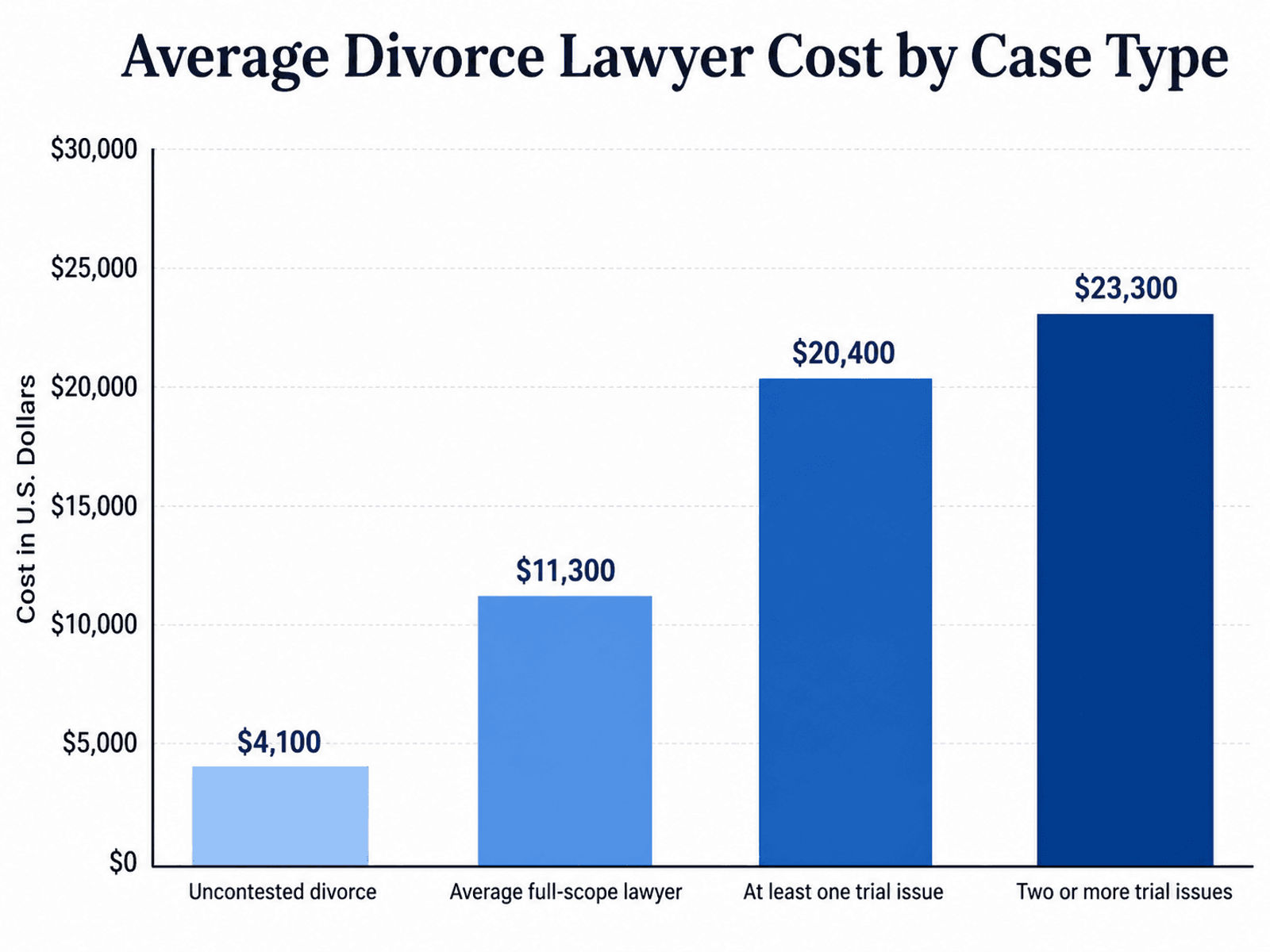



Most people asking how much does a personal injury lawyer cost are really trying to understand the full cost picture, not just a single number. In many U.S. injury cases, the attorney’s fee is based on a contingency arrangement, which means payment is often tied to the outcome rather than an upfront hourly bill. Still, the total personal injury attorney price can vary based on case complexity, injury severity, whether the claim settles early, and how much the case expenses add up to. That is why both “fee percentage” and personal injury lawsuit lawyer cost need to be reviewed together before you hire counsel.
This article is for general information and not legal advice. Personal injury fee structures, costs, and rules vary by state and by law firm.
You Might Also Like:
Typical Personal Injury Lawyer Fees in 2026 (Quick Breakdown)
If you are comparing firms and wondering how much do personal injury attorneys charge, a quick breakdown helps. In many cases, the answer to how much do lawyers charge for personal injury is not a standard flat number. Instead, many firms use a contingency fee percentage plus separate case expenses.
Here is a practical four-scenario menu:
-
Consultation + case screening: Many firms offer a free initial review, while some charge for a longer strategy session or second opinion. This stage is usually the lowest-cost entry point.
-
Pre-suit settlement claim: The lawyer often handles insurance communications, evidence collection, and demand negotiations under a contingency fee arrangement (Cornell Law LII), with case expenses tracked separately.
-
Filed lawsuit (discovery/motions): Once a lawsuit is filed, work expands to written discovery, depositions (Cornell Law LII), motions, and court deadlines. This can increase total cost exposure because expenses usually rise.
-
Trial-stage litigation: Trial preparation, experts, exhibits, and courtroom time typically make this the most expensive stage, even when the attorney fee is still percentage-based.
In personal injury cases, the client often does not pay a traditional upfront hourly bill for full representation, but the fee structure and expense policy should still be confirmed in writing.
When people ask how much does a personal injury lawyer take, the most accurate answer is: it depends on the fee agreement, the stage of the case, and the expenses required to prove damages and liability. The average cost of personal injury lawyer services and average personal injury attorney fees vary widely, so compare fee terms in writing before signing.
How Personal Injury Lawyers Charge: Contingency Fees, Hourly Rates, and Hybrid Arrangements
Most personal injury cases are handled on a contingency fee basis, which means the attorney fee is usually tied to the outcome of the case rather than an upfront hourly bill. For many clients, this is the starting point when comparing how much do personal injury lawyers cost and how much do lawyers charge for personal injury cases.
Even so, the fee structure should not be reduced to one phrase or slogan. A contingency arrangement usually addresses the attorney’s percentage fee and case expenses in separate parts of the agreement. Attorney fees compensate the lawyer for legal work. Case expenses cover items such as records, filing fees, experts, and other litigation costs. These are different categories, and both should be reviewed carefully before signing. Cornell Law’s Legal Information Institute offers a neutral overview of contingency fees.
Hourly billing may still appear in limited situations, such as a paid consultation, second opinion, lien negotiation, or limited-scope legal advice. In some matters, firms may also use a hybrid arrangement, combining a smaller hourly or flat charge with a success-based fee.
The phrase “no win, no fee” often refers to the attorney fee, but it does not automatically answer what happens to case expenses. The agreement should clearly state how costs are handled if there is no recovery.
Personal Injury Contingency Fees Explained (What Percentage the Lawyer Gets)
When clients ask how much percentage does a personal injury lawyer get, they are usually asking about the personal injury contingency fee percentage stated in the fee agreement. In a contingency arrangement, the lawyer’s fee is typically a percentage of the recovery rather than a fixed hourly bill for full representation. The percentage can vary by state rules, case stage, firm policy, and the complexity of the claim.
Several points matter when reviewing a contingency fee agreement:
-
The percentage may change by case stage. A personal injury settlement lawyer fee may differ from the fee applied after a lawsuit is filed or after trial preparation begins.
-
The agreement should state when the percentage can increase. This helps answer how much are lawyer fees for personal injury in a practical, case-specific way.
-
The fee may be calculated on gross recovery or net recovery. This can significantly affect the client’s final amount.
-
“Gross” usually means the total settlement or verdict before deductions.
-
“Net” usually means the amount after certain case expenses (and sometimes other deductions) are subtracted.
Clients should also confirm how case expenses are handled, because the personal injury attorney fees percentage and litigation expenses are separate issues. A fee percentage can look similar across firms while the net recovery to the client differs because expense terms are different.
For a neutral legal overview, Cornell Law’s Legal Information Institute explains contingency fees and written fee agreement requirements.
The safest approach is to read the agreement carefully and ask direct questions about the percentage, when it changes, whether it is based on gross or net recovery, and what happens to expenses if there is no recovery.
Consultation Fees (What to Expect Before Hiring a Personal Injury Attorney)
Before hiring a lawyer, many people ask whether a personal injury attorney consultation is free. In many firms, an initial consultation with personal injury lawyer is free, especially when the lawyer is evaluating whether to accept the case on contingency. Some firms, however, may charge a personal injury lawyer consultation fee or personal injury attorney consultation fee for a longer strategy meeting, a second opinion, or a detailed review of records.
What to expect during a personal injury attorney consultation:
-
A case screening discussion about how the injury happened, who may be at fault, and what insurance coverage may apply.
-
Basic questions about medical treatment, current symptoms, missed work, and available documents.
-
A preliminary discussion of fee structure, including contingency percentage and whether case expenses are separate.
-
A timeline review, including deadlines, notice issues, and the likely next steps.
What to bring to make the consultation more useful:
-
Photos or videos of the scene, vehicles, hazard, or injuries
-
Medical records, discharge papers, and bills (if available)
-
Insurance letters, claim numbers, and adjuster contact information
-
A simple timeline of events and treatment
-
Witness names and contact details
If a consultation fee personal injury lawyer charges applies, ask what is included. Before signing, confirm the fee percentage, who advances case expenses, and what happens to costs if there is no recovery.
Additional Costs Beyond Attorney Fees (Case Expenses in Personal Injury Claims)

When people estimate personal injury lawsuit lawyer cost, they often focus on the attorney’s fee and miss the second line item: case expenses. Attorney fees pay for the lawyer’s work (contingency, hourly, or hybrid). Case expenses are the out-of-pocket costs needed to build and prove the claim. Even when a fee percentage is fixed, expenses can grow as the case becomes more document-heavy and expert-driven.
A simple example: an early, straightforward settlement may require only basic records and a demand package. A disputed liability case may require depositions and experts, which can add meaningful costs before a resolution is reached.
Common case expenses typically fall into a few groups:
-
Court and notice costs: filing fees, motion fees, and service of process; the U.S. Courts’ district court miscellaneous fee schedule shows examples of federal court fees
-
Medical and incident documentation: medical records and billing, imaging, and police/incident reports
-
Proof and expertise: expert reviews, accident reconstruction, vocational/economic analysis in complex matters
-
Discovery support: court reporters, deposition transcripts, and exhibit handling
-
Presentation and logistics: demonstratives, exhibits, and limited travel when required
How firms handle these costs varies. Some firms advance expenses during the case and seek reimbursement from the recovery at the end. Others may ask the client to fund certain items as they arise, especially in expert-heavy cases. A written fee agreement should explain who advances expenses, how approvals work, and whether costs are deducted before or after the contingency fee is calculated. If budgeting matters to you, request the firm’s written expense policy and ask how often you will receive an itemized ledger during the case.
Cost by Personal Injury Case Type (Most Common Scenarios)
When you compare costs by case type, you are usually trying to forecast two separate things: the attorney fee structure and the case expenses it may take to prove liability and damages. A useful consultation turns this into a case-specific plan, with expected milestones and a realistic range for expense-heavy steps. Many claims are handled on a contingency basis, but the total “cost picture” can still change depending on the evidence needed, the medical complexity, and whether the case resolves in settlement or requires litigation work.
“Typical billing” below describes the attorney fee approach most commonly used for that scenario. Case expenses are separate out-of-pocket costs (records, filing, experts, depositions) that are typically tracked and addressed in the fee agreement. Two cases can have the same percentage fee and still produce different net recoveries if one needs heavy expert work while another resolves with limited spending.
| Case type | Typical billing | What drives cost up |
|---|---|---|
| Car/truck/motorcycle crashes | Contingency + costs | Fault disputes, medical proof, experts |
| Premises & slip/fall cases | Contingency + costs | Notice issues, missing video, liability disputes |
| Medical/product/workplace injury cases | Contingency + often higher costs | Expert review, causation, complex records |
| Dog bite / mixed injury claims | Contingency + costs | Damages proof, coverage disputes, local rules |
Use the table as a planning tool, not a quote. Your net recovery can differ based on whether expenses are deducted before or after the contingency fee, how aggressively the insurer contests liability, and how much proof is needed to document long-term harm.
1) Vehicle accident injury cases (car, truck, motorcycle)
In vehicle cases, clients often start by asking about car accident injury lawyer cost. In practice, the fee model may look similar across firms, while the workload varies based on (1) how contested fault is and (2) how complex the medical proof becomes. If liability is clear and treatment is well-documented, many claims can move through a pre-suit demand process without extensive litigation spending.
Costs and expenses tend to increase when:
-
Multiple drivers or parties are involved, or fault is disputed
-
Injuries require ongoing specialty care or future-care projections
-
Experts or depositions become necessary to prove damages or causation
Truck-related collisions can require more categories of records and may involve multiple defendants. Motorcycle cases can be more expensive when severe injuries lead to greater damages disputes. For general safety context that sometimes appears in investigations, NHTSA provides public information in its road safety resources. Even with the same contingency percentage, expert-driven proof and litigation steps can materially increase case expenses.
2) Slip and fall / premises liability injury cases
Slip and fall cases are often won or lost on evidence. The main driver is not usually the fee model, but whether you can prove a hazardous condition and notice — especially when the property owner controls the most important proof.
Evidence issues that commonly push time and expense include:
-
Surveillance video that is overwritten or difficult to obtain
-
Maintenance or inspection logs that require formal requests
-
Witnesses who are hard to locate after the incident
-
Site conditions that change quickly (repairs, lighting changes, removed signage)
Because those proof problems are common defenses, premises cases can shift from a straightforward claim into a more litigation-heavy matter. Early documentation and prompt treatment records can reduce later investigative spending and make the expense picture more predictable.
3) Medically complex and high-cost injury cases (medical malpractice, product liability, workplace injury)
Medically complex cases often carry higher case expenses because expert review and causation analysis are central from the beginning. For example, medical malpractice personal injury lawyer cost and product liability matters may require early screening by qualified specialists before a strong demand or complaint is realistic.
Where expenses often concentrate:
-
Expert screening before filing and additional experts later
-
Large medical record sets, imaging, and technical documentation
-
Disputed causation (whether the event actually caused the outcome)
Workplace injury cases vary widely, especially when a third-party claim exists outside workers’ compensation. In complex cases, when experts are retained and how costs are handled can affect net recovery as much as the stated fee percentage. Ask how the firm budgets for expert work, what spending requires your approval, and how you will receive itemized cost updates.
4) Other common personal injury claims (dog bite and mixed liability cases)
Dog bite and other mixed-liability claims often turn on damages proof over time and insurance coverage. Clear liability and available coverage can keep expenses closer to documentation and treatment records. Coverage disputes or contested injury severity can require additional medical opinions, follow-up documentation, and sometimes litigation steps to prove the claim’s value.
If you are shopping for a low cost personal injury lawyer, compare transparency as much as price: how expense decisions are approved, whether you get an itemized ledger, and how the firm explains net recovery under its fee agreement. Clear cost communication helps you evaluate the likely take-home amount, not just the headline percentage.
Legal Requirements and Regulatory Context (State Rules, Deadlines, and Insurance Considerations)
Personal injury law is state-specific, so the cost picture often depends on rules that shape both timing and strategy. The most important timing rule is the filing deadline, commonly called the statute of limitations; Cornell Law’s Legal Information Institute explains the concept in its overview of the statute of limitations. If the deadline is missed, the claim may be barred, which is why lawyers often move quickly to preserve evidence and meet procedural requirements.
Fault rules also vary. Many states use comparative negligence, which can reduce a claimant’s recovery based on their share of responsibility; Cornell Law provides a neutral explanation of comparative negligence. Those differences can influence how much investigation is needed, how insurers evaluate the claim, and whether litigation is likely. Some claims also involve special notice requirements or caps in certain case types, which can affect the economics of expert-heavy proof.
In practical terms, state deadlines, fault standards, and insurance procedures can all change the amount of work required to prove liability and damages, and they can also change the pace of the case — both of which can affect overall costs even when a contingency percentage is unchanged.
How to Find the Right Personal Injury Lawyer Near You (Without Choosing by Price Alone)
Price is easy to compare; the fee agreement is what actually controls what you pay. When you talk to firms, focus less on the headline percentage and more on what the agreement says about when the percentage can change and how case expenses are handled, because those details often shape the final net recovery.
A good intake conversation usually has a clear “money map.” The firm should be able to explain the contingency percentage, whether it increases after a lawsuit is filed or if the case goes to trial, and whether the fee is calculated on gross or net recovery. Just as important, the firm should describe its expense policy in plain terms: who advances costs, what requires your approval, and how you will see itemized expenses as the case moves forward. If a firm cannot explain those basics, it is difficult to evaluate how much do personal injury lawyers charge in a way that matters to your take-home amount.
Beyond cost terms, ask who will handle the case day-to-day and how updates work. Some firms assign a team; others have a single attorney lead the file. Either can be fine if communication is consistent and decisions are explained.
Certain warning signs tend to show up early: vague or shifting fee language, unclear expense policies, pressure to sign quickly, or reluctance to discuss litigation experience. If you are searching “best near me,” treat it as a screening tool: choose the lawyer who is transparent about fees and costs, realistic about case risk, and able to explain how they make spending decisions when proving liability and damages requires more than records and negotiations.
Lower-Cost and Lower-Risk Options (Free Consults, Fee Transparency, and Case Screening)
A lower-cost option does not always mean the lowest fee percentage. In personal injury cases, the safer financial choice is often the firm that explains the agreement clearly, screens the case realistically, and tells you early what expenses may appear later.
A free consultation can already reduce risk. It gives you a chance to understand whether the claim is strong enough for representation, what records are still missing, and whether the likely value of the case supports the expected work. If one firm gives vague answers and another explains the fee structure clearly, that difference matters before you sign anything.
Transparency is usually where real savings begin. The fee percentage is only one part of the picture. You also need to know whether that percentage changes after filing suit, whether it is calculated on gross or net recovery, and how case expenses are handled. As the State Bar of California explains in its guidance on fees and billing, clients should understand both fees and costs before hiring counsel.
That is why the lower-risk approach is usually simple: compare written terms, ask direct questions, and do not treat a low percentage alone as proof of a better deal. A slightly higher fee with clear cost control may leave you in a better position than a lower fee with vague expense terms.
Common Mistakes That Increase Personal Injury Legal Costs (or Reduce Net Recovery)
Some cases become more expensive because they are genuinely complex. Others become more expensive because avoidable problems appear early and make the claim harder to prove later. In personal injury matters, small mistakes at the beginning often create larger proof problems once the insurer pushes back or litigation becomes necessary.
Common mistakes include:
-
Delaying treatment or leaving gaps in medical records
-
Giving detailed statements to the insurer before getting legal advice
-
Failing to preserve photos, damaged property, witness details, or other evidence
-
Comparing lawyers by percentage alone without reviewing expense terms
-
Choosing counsel based mainly on advertising rather than written fee clarity and case strategy
Each of these mistakes can increase the amount of work needed to prove the claim. As Cornell Law explains in its overview of evidence, photographs, videos, documents, testimony, and tangible objects can all matter in a legal case, which is why missing or poorly preserved evidence often leads to more investigation and added expense later.
A separate and very common mistake is misunderstanding the fee agreement. Clients may focus on the contingency percentage and miss how case expenses are handled, when the fee can change, or whether the fee is calculated on gross or net recovery. A lower percentage on paper does not always lead to a better net result if the expense policy is vague or poorly explained.
Save on Legal Fees with AI Lawyer
If you want to reduce the costs that often come with a personal injury case, AI Lawyer can help with routine preparation tasks that might otherwise consume paid attorney time. It is designed to help users organize case facts, summarize records, prepare question lists, and do quick issue-focused research, so lawyer time can stay focused on case evaluation, negotiations, and litigation strategy.
Better preparation usually means fewer wasted hours. You can arrive at a consultation with personal injury lawyer with a clear incident timeline, a document checklist, and focused questions about contingency fees, case expenses, and who advances costs.
AI Lawyer is available 24/7 on web, iOS, and Android. Whether you are organizing materials before hiring counsel or working with a lawyer, a subscription model can make support costs more predictable.
AI Lawyer does not replace a licensed attorney and does not provide legal advice.
Conclusion
The cost of hiring a personal injury lawyer is rarely defined by one number alone. In most cases, the overall financial picture depends on the fee structure, the case expenses, the complexity of the evidence, and how far the matter progresses before it resolves. That is why the real question is not only what percentage a lawyer charges, but how the entire agreement works in practice.
A well-informed decision usually comes down to clarity, not just price. Understanding how fees and expenses are handled, comparing written terms carefully, and choosing a structure you fully understand can help you avoid surprises and make a more confident decision about representation.
You Might Also Like:
FAQ
How much does a personal injury lawyer cost?
Most personal injury lawyers use a contingency fee instead of charging a large upfront retainer for full representation. That means the lawyer is usually paid only if there is a recovery, while case expenses are handled separately under the fee agreement. The total cost depends on the case type, complexity, and whether the matter settles early or moves toward litigation.
How much do personal injury lawyers charge in contingency fees?
A contingency fee is usually a contract-based percentage of the settlement or verdict. The percentage can vary by state, firm policy, and case stage. Some firms use one percentage before filing suit and a higher percentage after filing or closer to trial.
How much percentage does a personal injury lawyer get?
The lawyer’s percentage should be stated clearly in the fee agreement. Clients should also ask whether that percentage is calculated on gross recovery or net recovery after expenses, because that can affect the final amount the client receives.
Do personal injury lawyers charge upfront fees or consultation fees?
Often, no upfront attorney fee is required if the lawyer accepts the case on contingency. However, some firms may charge for a consultation, second opinion, or limited-scope review before full representation begins.
What case expenses are separate from attorney fees in a personal injury claim?
Common case expenses include filing fees, records retrieval, expert review, depositions, transcripts, service fees, and trial exhibits. These costs are separate from attorney fees and should be explained clearly in writing before representation begins.
How much does a personal injury lawyer cost for a car accident case?
In car accident cases, the fee model is often similar to other injury claims, but total cost can increase if fault is disputed, injuries are severe, or experts and litigation steps become necessary.
How do I compare personal injury lawyer fees without choosing the cheapest option?
Compare written fee terms, expense policies, litigation experience, and communication practices across a few firms. Focus on clarity and likely net recovery, not just the headline percentage.
Sources and References
This article draws on neutral legal education materials and public agency resources commonly used to understand injury claims and cost-related context. For legal terminology and timing rules, it relies on Cornell Law School’s Legal Information Institute, including its explanations of the statute of limitations and comparative negligence. For common injury scenarios, it also refers to public guidance from NHTSA on road safety, OSHA on workplace safety and worker protections, and CPSC recalls and product safety warnings. These sources provide general educational background, while specific fee structures and litigation costs still vary by state and by law firm.
Disclaimer: This information is for general knowledge and does not constitute legal advice. For guidance on your specific situation, consult a qualified attorney licensed in your state.