


A vehicle bill of sale is what keeps a handshake deal from collapsing when reality hits — the DMV counter, a toll notice, or a sudden dispute about price and condition. Without it, the story can drift in ways that are hard to prove: when the car was handed over, what was included, whether it was sold as-is, and who became responsible after the keys changed hands.
A solid bill of sale turns “we agreed” into a paper trail that can settle arguments: vehicle details, a clear transfer time, the price and payment method, and signatures. This U.S.-focused guide shows what to include and how to use a template without breaking it, so the document helps in real disputes — not just on paper.
Disclaimer
This article provides general information — not legal advice — and it is written for a U.S. audience. Paperwork around a car sale can work differently depending on state law, DMV rules, and the specific facts of the transaction, so the same document may carry different weight across jurisdictions. Because these terms can shape how ownership is proven, who is responsible for taxes and fees, and what happens if a dispute later arises about price, condition, or the timing of delivery, having a qualified attorney review the documents before signing can help prevent costly mistakes — especially when the deal involves financing, trade-ins, dealer-added products, out-of-state transfers, or a vehicle with a non-standard title history.
TL;DR
-
A vehicle bill of sale is the paper trail that survives when memories don’t. It’s often what you point to when the price, condition, or delivery story changes later.
-
Private-party sales can turn messy fast because there’s no built-in “dealership paperwork system.” In a parking-lot sale, you usually create clarity yourself — or you live with ambiguity.
-
California SB 766 (operative October 1, 2026) pushes dealers toward clearer pricing and records, but it doesn’t turn private sales into “returnable” deals. The law includes a limited three-day right to cancel for certain dealer-used vehicles priced at $50,000 or less, with key conditions (including the 400-mile limit).
-
A bill of sale works only when it states the hard facts in plain text. VIN, buyer/seller info, price, payment method, and a clear handoff date/time are the backbone.
-
“As-is” can reduce misunderstandings, but hiding known problems can still backfire. Disclose known defects so the document doesn’t read like a trap.
-
Copies and consistency are part of the protection, not a formality. Keep matching copies, and don’t confuse the bill of sale with title transfer and DMV registration steps.
You Might Also Like:
The dramatic cold open: “So… what exactly did I just buy?”
Definition
A vehicle bill of sale is the written record that makes a car deal clear enough to complete and specific enough to defend later. It turns a parking-lot handshake into testable terms: what was sold, for how much, when it changed hands, and who the parties were.
You’ll see different labels in the wild (auto bill of sale, bill of sale for car, sale agreement for vehicle). The name isn’t the point. What matters is whether a third party could verify what changed hands and under what conditions. That’s what prevents “we never agreed to that” from becoming the only story after the money moves.
What it looks like in real life
“Meet me by the food court entrance,” the message says. The listing looked clean. The photos were taken at sunset — always a good sign and a bad one.
The seller shows up with one key and a smile. “Runs great. I just upgraded.”
You do the usual: walk-around, quick test drive, a glance at the dashboard like it might confess something. Then the moment arrives — the one nobody romanticizes. Money, title, handshake.
“Do you have anything in writing?” you ask.
He shrugs. “We can write something. It’s private sale. Not a big deal.”
That’s the first crack in the story. Because the second crack comes later — when the DMV asks when ownership changed hands, when a buyer insists the price was different, or when a ticket arrives dated after you thought the car was no longer yours. In those moments, a bill of sale stops being “paperwork” and starts being proof.
Why this document actually matters
The practical job of a bill of sale is to lock the facts in place before memory starts negotiating. If there’s a dispute about price, timing, condition disclosures, or who took responsibility after delivery, the bill of sale is often the clearest, simplest place to point — especially in private-party sales where you don’t get a dealership’s paperwork system by default.
News hook: California rewrites dealer rules — but your private sale doesn’t automatically come with a “return window”
A buyer sits down at a dealership desk and hears: “Don’t worry, the ad price is basically the price.”
Then a new sheet appears. Then a “required” package. Then the total shifts—quietly, like a plot twist.
California’s SB 766 targets that moment. Its rules become operative on October 1, 2026, and the point is simple: make the paper trail match what the customer was shown and told. For the official breakdown, see the Assembly Privacy & Consumer Protection Committee analysis of SB 766 (PDF).
Here’s the short version of what it does for dealer transactions:
-
Limited 3-business-day cancellation right for certain dealer used-vehicle deals priced $50,000 or less, with conditions (including the 400-mile limit).
-
Earlier “total price” disclosure in writing, including ads and the first written communication, which dealers must keep for at least 2 years.
-
Guardrails on pointless add-ons and a 2-year recordkeeping duty to prove compliance.
SB 766 raises the paperwork standard for dealers.
But a private-party sale doesn’t automatically come with a return window—so you still need your own clean record of what happened.
The pivot: why a bill of sale is still your “shield” outside the dealership
A private sale doesn’t usually fail because someone forgot a “fancy form.” It fails because the deal is full of gaps.
At a dealer, you’re surrounded by paperwork — sometimes too much of it. There’s a process, a file, a system that produces a trail (even when it’s annoying).
In a private-party sale, there’s often no trail unless you create it.
You meet someone in a parking lot. The listing is on a phone screen. The price is said out loud. The buyer asks, “Any issues?” The seller answers, “Nothing major.” Money changes hands. Then everyone wants to leave quickly — because standing there with cash and strangers feels like a countdown.
Later, the questions start arriving. Not always from lawyers. Often from normal life:
-
The DMV asks when the vehicle changed hands.
-
A toll or parking notice shows up with a date that “shouldn’t be yours.”
-
The buyer claims the final price was different than what you remember.
-
Someone says, “I didn’t agree to that,” and suddenly the deal has two versions.
This is where a motor vehicle bill of sale earns its reputation. It doesn’t need legal poetry. It needs to make the boring facts impossible to argue about.
A simple vehicle bill of sale is useful for one reason: it produces a final, signed snapshot of the agreement — who, what, when, how much, and how payment happened. That snapshot matters because texts and screenshots often don’t capture the final terms. Messages can be vague (“we’ll work it out”), incomplete (“price depends”), or gone (deleted listings, lost chats, new phones).
The “detective” moment: what actually becomes evidence
The fight usually doesn’t start with “law.”
It starts with a sentence that changes.
“I never sold it.”
“You did. I paid you.”
That’s when you realize you’re not arguing about a car — you’re arguing about whether the deal happened.
A vehicle bill of sale form helps because it anchors the basics: names, signatures, and the transfer date/time. Virginia DMV notes that even a handwritten bill of sale can work if it’s signed and includes key details (motor vehicle sales and use tax.)
Then the usual rewrites show up: the price wasn’t “that,” the handoff wasn’t “then,” and the extra set of tires was “obviously included.”
A bill of sale can’t prevent every dispute, but it freezes the facts while both sides still agree what just happened.
Practical checklist: what must be in a bill of sale so it actually works
You don’t need a “perfect” form. You need a page that closes the loopholes people fight over later: which car it was, what was paid, what was disclosed, and when responsibility switched. Everything else is decoration.
One more boundary that saves headaches: a bill of sale usually supports the transaction, but it doesn’t replace the DMV’s ownership steps. Title transfer and registration are separate processes in many states (see California DMV’s overview of title transfers and changes).

Use this checklist before you sign anything:
-
Lock down the car’s identity (VIN + odometer + basics).
VIN, year/make/model, and mileage at the time of sale. If VIN or mileage is missing, the document can stop looking like evidence. -
Identify both parties clearly (and make them reachable).
Full legal names, addresses, and at least one reliable contact method. This ties the deal to real people, not a username. -
State the money terms in one clean sentence.
Exact price and how it was paid (cash, cashier’s check, app, wire), including any deposit/partial payments. This is what blocks the “we agreed on a different number” rewrite. -
Put the handoff on a timeline.
Write the transfer date and a reasonable time window/location. This detail often decides responsibility after the keys changed hands. -
Match the condition story to what you actually said.
If it’s “as-is,” say so when appropriate — and still list known defects you disclosed. Add a short included-items line (keys, accessories, tires) and make sure both parties sign and keep a copy. A bill of sale works best when it records what was disclosed and what was included, not just what was denied.
If you keep just one principle: write it so future-you doesn’t have to explain what “we meant.”
Templates & forms: where to get a template — and how not to “break” it
People search for a vehicle bill of sale template for one reason: they want something fast that still holds up later. A template only helps if it matches the deal you actually made, not the deal you meant to make. That’s why “free printable” matters less than “filled correctly.”
In the U.S., you’ll usually see three options.
1) Official DMV forms (when your state has one)
Some states publish their own bill of sale form, and using it can reduce “DMV rejection” headaches because staff see it every day. Examples:
-
California: REG 135 is available through California DMV’s Title transfers and changes (REG 135 link included).
-
New York: MV-912 is provided via NY DMV — Buy, Sell, or Transfer Vehicle Ownership and the direct NY DMV MV-912 PDF.
-
Connecticut: Form H-31 is available as Connecticut DMV — H-31 Bill of Sale (PDF).
2) Generic/simple templates (fine when they capture the real essentials)
This is what most people mean by “vehicle bill of sale template pdf” or “printable vehicle bill of sale.” A generic template can work if it captures the same core facts your DMV or tax rules care about: VIN, buyer/seller identities, price/payment, and the handoff date/time.
The trap is leaving blanks or vague language that re-opens the argument later.
3) “Free printable” PDFs (convenient, but easy to misuse)
A printable form becomes risky when it nudges you to skip details that don’t fit neatly in boxes—like known defects you actually disclosed, or what accessories were included. The form shouldn’t force the story to become incomplete.
How not to “break” any template
Treat it like the final snapshot. Fill it legibly, don’t “round” the VIN or mileage, and make sure both sides leave with a copy the same day. A free vehicle bill of sale is still valuable if it makes the facts hard to rewrite later.
Special cases: gifts, “$1,” and family transfers
The weirdest car deals are the ones where everyone trusts each other.
An uncle’s old sedan. A sister’s first car. A friend who “just needs it gone.”
That’s exactly why these transfers blow up later.
“It’s basically a gift.”
“Just put $1.”
“We’ll sort the details later.”
Later is when the DMV asks what kind of transfer it was — and when people remember the same conversation differently.
If it’s a gift, write that sentence. A gift bill of sale for car (also searched as “bill of sale gift car”) does one job: it makes the ownership change legible to someone who wasn’t there, including why the price is $0.
The “$1” shortcut often backfires. If it’s really a gift, calling it a sale creates a mismatch. If it’s really a sale, a symbolic price can make the paperwork look less credible later.
Family deals also get messy when it’s part cash, part trade, or “pay me later.” You don’t need more pages — just one clear sentence that matches reality, so “included items” and payment terms don’t become a fight.
Handwritten is fine in many places, but sloppy isn’t: make it readable, signed, and saved by both sides.
State-by-state: why “DMV forms” are different (and why that matters)
You did everything “right.”
You printed a template. You filled it neatly. You got signatures.
Then the DMV clerk looks at it and says:
“Do you have the state form?”
That’s the moment people realize the same private sale can be “complete” in one state and “missing something” in another. DMV workflows vary by state, and the bill of sale is often only one piece of a bigger packet.
What “different by state” looks like in real life
New York: NY has its own bill of sale form, MV-912. If you walk in with a random template, the clerk may still point you back to the state form. Here’s the official PDF: NY DMV — MV-912 Vehicle Bill of Sale (PDF).
Virginia: Virginia is comfortable with a straightforward statement as long as it’s properly signed and contains the needed facts. Its own wording is the vibe you should match:
“A bill of sale may be a handwritten statement signed by both the seller and purchaser.”
(See Virginia DMV — Title your vehicle or trailer.)
Texas: Texas often feels less like “one form” and more like “a title application packet.” If you’ve ever heard “bring the 130-U,” this is why: TxDMV — Form 130-U (Application for Texas Title and/or Registration PDF).
The practical takeaway (so you don’t get bounced at the counter)
-
If your state publishes a bill of sale form, use it (or mirror it closely).
-
If the state accepts handwritten statements, don’t confuse that with “leave it vague.” Handwritten still needs the core facts.
-
If the state’s title application is the main event, treat the bill of sale as supporting evidence that must match the rest of the paperwork.
So when people search things like “ny dmv bill of sale” or “txdmv bill of sale,” it’s not paranoia. It’s pattern recognition: the template isn’t the problem — the mismatch between your template and your state’s process is.
Legal Requirements and Regulatory Context
Back at the dealership desk, the game SB 766 is trying to kill looks like this: the first number is friendly, the second number is “almost final,” and the third number is the one you discover after you’ve already mentally moved into the car.
SB 766 (operative October 1, 2026) pushes dealers toward a record you can’t easily “massage later”: the total price has to show up early (including in the first written communication), and the transaction has to leave behind documentation that can be checked. The point isn’t that every deal becomes refundable — the point is that the paper trail becomes harder to rewrite.
Private-party sales don’t come with that built-in discipline. In a parking-lot deal, nobody is required to preserve your chat thread, keep a pricing trail, or standardize what was promised. So your bill of sale becomes the practical bridge: it’s how you manufacture dealer-level clarity in one page — vehicle identity, the handoff moment, the real price, and what was (and wasn’t) included.
Instead of guessing what “counts” later, it helps to see how the DMV frames it: California DMV’s Bill of Sale (VC §1652) guidance shows what the agency treats as meaningful bill-of-sale information during the ownership paperwork process.
Common mistakes: why even a “template” won’t save you if…

Most disputes don’t happen because someone picked the “wrong” form.
They happen because the form left one gap — and that gap became the argument.
“We agreed, it’s just… not written here.”
Here are the mistakes that quietly turn a solid-looking bill of sale into a weak document:
-
No VIN (or a “close enough” VIN). One wrong character and you’ve documented a different vehicle. If the car can’t be identified precisely, the bill of sale stops acting like proof.
-
No odometer reading (or a vague mileage line). Mileage is one of the first things people fight over, and it can intersect with disclosure rules (see 49 CFR Part 580 — Odometer Disclosure Requirements (eCFR)).
-
No transfer moment. The date is there, but not the time—so you end up arguing about who was responsible for tickets, tolls, or incidents that happened “around the sale.”
-
“As-is” used like armor while known issues weren’t written down. A template can’t cover for missing disclosure facts — it just makes the missing parts obvious later.
-
No copies saved by both sides. If only one person has the document (or the photo), the other person’s version of events gets louder.
A bill of sale should read like the final version of the deal. If it reads like a draft, it will behave like a draft when you need it most.
Final: less magic at the dealership, more truth on paper
At the end of every car deal, the mystery is never “what did we feel was fair.”
It’s “what can we prove when the story changes.”
California’s new dealer rules are a step toward cleaner paper trails. But most real-life headaches still happen in the gaps: a private sale with deleted messages, a handoff time nobody wrote down, a price that somehow “wasn’t that,” an extra set of tires that “was obviously included.”
That’s why a bill of sale vehicle is often the simplest tool that keeps the deal from drifting — whether you’re signing on a parking lot hood or across a dealer desk. Use a bill of sale for car that locks the facts: the vehicle identity, the real price, what was included, and the exact transfer moment. A solid auto bill of sale doesn’t create perfection, but it makes the key facts harder to rewrite.
And if you’re starting from a vehicle bill of sale template, treat it like evidence, not a formality: fill it like you expect to read it again when you’re stressed, tired, and trying to prove what happened.
FAQ
What is a vehicle bill of sale, and why do people use it?
A vehicle bill of sale is a written record of a car transfer that helps document who sold what to whom, for how much, and when the handoff happened. It’s commonly used as proof when the story changes later — price disputes, timing disputes, or questions about who became responsible after delivery.
Does California SB 766 give me a 3-day right to cancel any car purchase?
Not automatically. SB 766 is dealer-focused and includes a limited three-day right to cancel for certain dealer used-vehicle transactions with specific conditions (including the $50,000 threshold and mileage-related limits). Private-party sales generally don’t turn into “returnable deals” just because SB 766 exists.
Do I need a bill of sale for a private-party sale (Facebook Marketplace/Craigslist)?
It’s strongly recommended. In private sales, there’s usually no dealership-style paper trail, so the bill of sale often becomes the cleanest snapshot of the deal: VIN, price, payment method, and transfer date/time.
Can a handwritten bill of sale work, or must it be notarized?
Often, a handwritten bill of sale can work if it’s legible, signed, and includes the required facts — though requirements vary by state. Notarization is sometimes optional and sometimes required depending on the jurisdiction, so it’s smart to check your state DMV rules.
What are the “must-have” items in a bill of sale so it actually helps in a dispute?
At minimum: vehicle identification (VIN + basic details + odometer), buyer/seller names and contact info, purchase price and payment method, and the transfer date/time. It also helps to note “as-is” (when appropriate) and any known defects that were disclosed, plus what items are included (keys, tires, accessories).
Get Started Today
A strong vehicle bill of sale protects your time, your money, and your leverage. When the key terms are written down, the vehicle details are clear, and the handoff responsibility is explicit, you reduce “endless back-and-forth” and move faster toward a clean transfer.
SB 766 highlights the same lesson buyers learn the hard way: the version of the deal that matters is the one you can show on paper. If you’re doing a private-party sale, that paper trail usually doesn’t exist unless you make it.
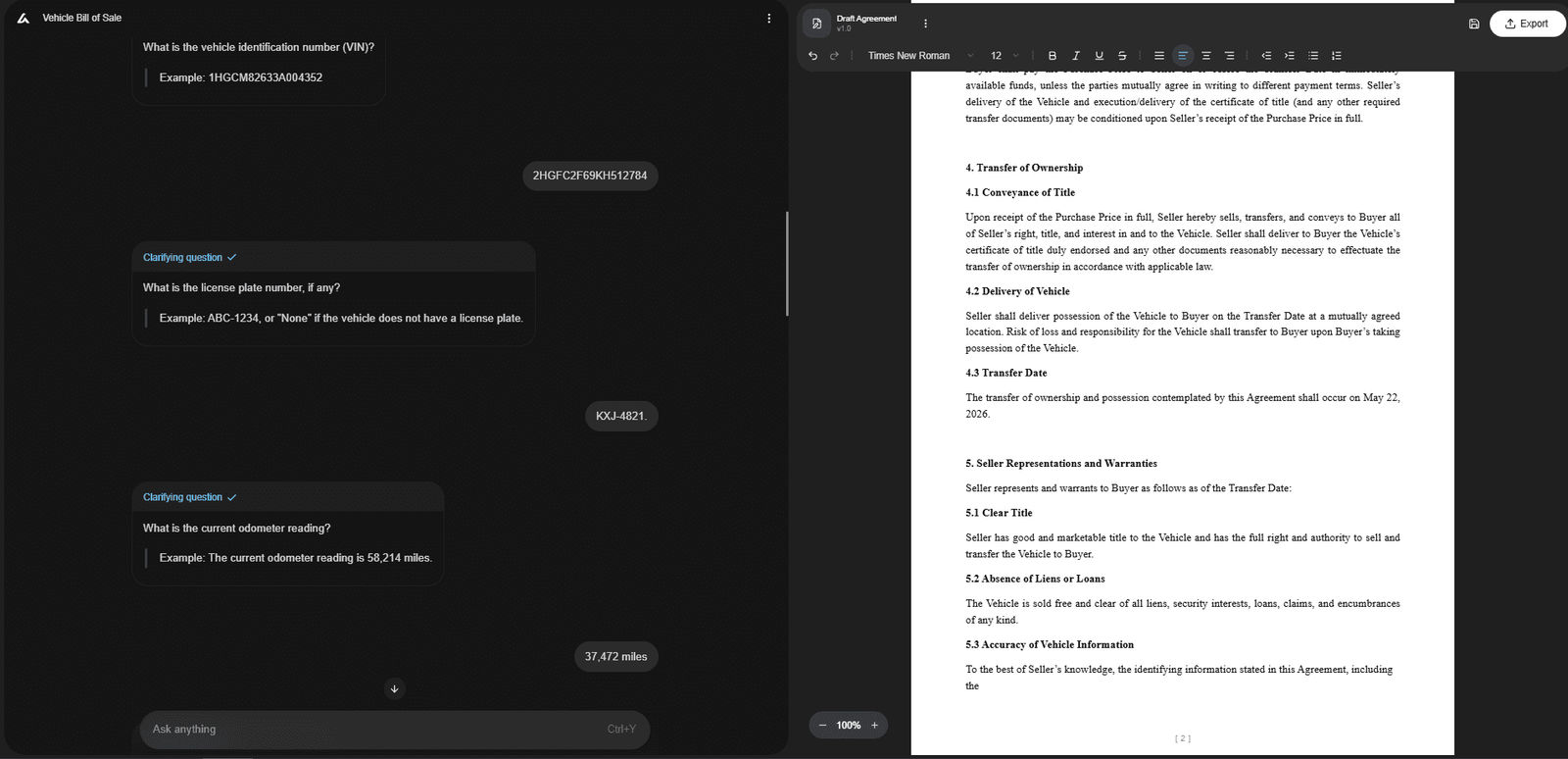
AI Lawyer helps you do that in minutes: you plug in the deal facts, and it produces a draft that’s structured, readable, and ready to sign — so you’re not stitching together screenshots and half-filled forms at the last second. Start here to generate a bill of sale draft: AI Lawyer bill of sale generator, or visit our homepage to explore other documents and workflows. If the deal has real risk — financing involved, an out-of-state transfer, a salvage/rebuilt title, or any serious mechanical red flags — it’s smart to have a U.S. attorney review the paperwork before you sign.
You Might Also Like:
Sources and References
Core legislative and timing details for California SB 766 (including the operative date and the dealer-focused structure) are taken from the official bill text on California Legislative Information — SB 766 (CARS Act).
The practical summary of SB 766’s key consumer-facing mechanics (including “total price,” “first written communication,” recordkeeping expectations, add-on limitations, and the $50,000 / 400-mile conditions around the three-day cancellation right) follows the official California Assembly Privacy & Consumer Protection Committee analysis of SB 766 (PDF).
DMV process context and how agencies treat bill-of-sale information within title/transfer workflows is supported by California DMV guidance on Title transfers and changes and California DMV’s procedural manual section on Bill of Sale (VC §1652).
Private-sale recordkeeping and “what to keep in writing” expectations are supported by Texas DMV guidance on Buying or selling a vehicle and the state title application form TxDMV Form 130-U (PDF).
State form examples and state-by-state variation are illustrated through New York’s ownership transfer guidance NY DMV — Buy, Sell, or Transfer Vehicle Ownership and the official form NY DMV MV-912 (Vehicle Bill of Sale PDF), plus Connecticut’s state form Connecticut DMV — Form H-31 (Bill of Sale PDF).
Virginia’s “handwritten bill of sale” framing is referenced via Virginia DMV’s titling guidance Virginia DMV — Title your vehicle or trailer.
Federal odometer disclosure requirements referenced in the “common mistakes” section are supported by 49 CFR Part 580 (eCFR) — Odometer Disclosure Requirements and consumer-facing fraud context from NHTSA — Odometer Fraud.