

Key idea: AI is most useful at the start of a family-law problem — when you need to clarify the issue, organize the facts, and prepare for the next step. AI Lawyer can be helpful at this stage, but AI is not a substitute for state-specific legal advice, court strategy, or representation.
Family-law problems rarely start in a lawyer’s office. They begin when a spouse moves out, custody becomes unclear, support is disputed, or shared property becomes a problem. That is where AI helps first: it turns a stressful situation into something clearer, more structured, and easier to discuss.
You Might Also Like:
Quick family-law snapshot
These are national context markers, not legal outcomes. Family-law rules still vary by state and by case.
| 2.4 | 21.9M | Best interests |
|---|---|---|
| U.S. divorce rate per 1,000 population • CDC provisional 2023 | children under 21 had a parent living outside the household • Census data | In custody decisions, courts weigh multiple factors |
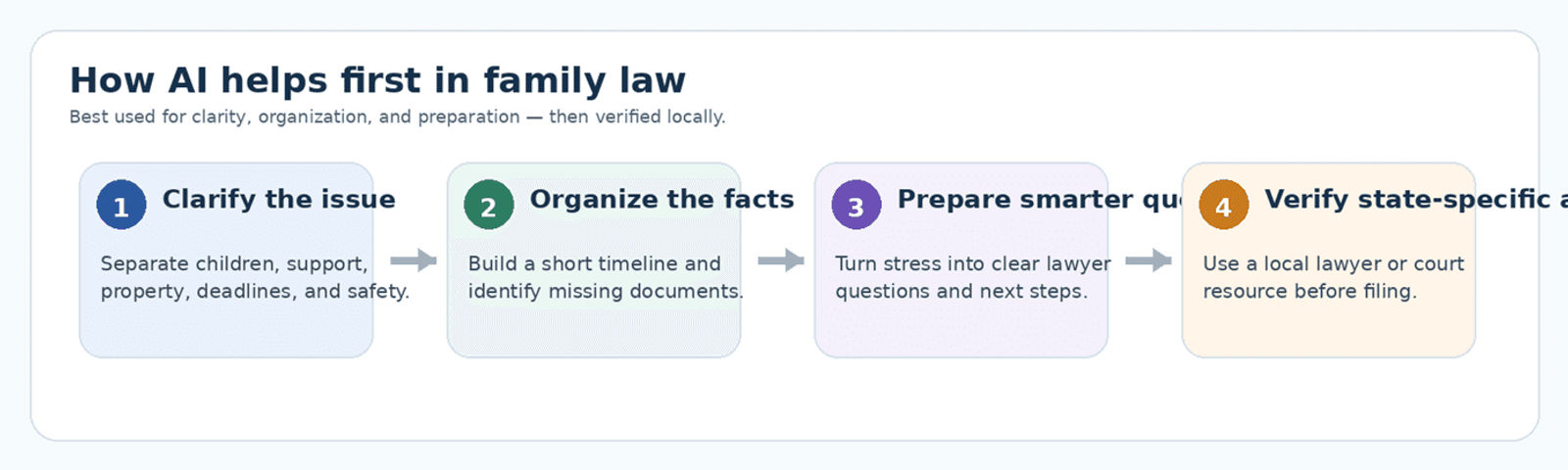
A better role for AI: clarify to organize to prepare to verify locally.
Why this matters now
The first obstacle in family law is usually not the law itself. It is confusion. People often do not know which facts matter, how serious the problem already is, or which issue should come first. AI helps by breaking one big mess into smaller working categories: children, housing, support, property, communication, safety, and deadlines.
What AI family-law tools are actually good at
-
Clarify: Explain the difference between contested and uncontested divorce, custody and parenting time, support and property.
-
Organize: Build a short timeline, identify relevant facts, and spot missing documents or details.
-
Prepare: Turn a messy story into cleaner questions for a lawyer, mediator, or court-help resource.
In practice, AI works best before legal action, between consultations, or whenever you need structure more than theory.
How AI Lawyer turns a family-law problem into a usable draft
A family-law issue may sound simple at first, but the useful version is never just one sentence. A workable draft usually needs to separate at least four things:
-
who lives where and what changed
-
how parenting time works right now
-
what support or money is disputed
-
which property or debt is shared
That is the practical value of AI Lawyer: it does not make the situation simple, but it makes it easier to review, discuss, and take into a consultation.
Better questions lead to better next steps
| Instead of asking | Ask something more useful |
|---|---|
| How do I get divorced? | Which unresolved issues could make this divorce contested? |
| Can my child choose where to live? | How do courts weigh a child’s preference, and what other facts matter? |
| The house is not in my name — do I lose it? | Which facts matter in deciding whether the property is marital or separate? |
Common situations where AI helps first
Divorce and separation planning
AI can quickly surface the issues that usually drive conflict: children, housing, support, shared debt, and safety. It is especially useful when both spouses agree the marriage should end but still disagree on what happens next.
Custody and parenting questions
AI can help gather the facts that usually matter most — the child’s age, school routine, caregiving pattern, transportation, stability, and any safety concerns — before you speak with a lawyer or mediator.
Property after separation
AI is useful when fear is driving the question. It can reframe “Do I lose everything?” into a fact-based review: when the asset was acquired, how it was paid for, whether marital income was used, and what records exist.
Keep AI and a human lawyer in the right lanes
| Situation | AI helps with | A lawyer is still needed for |
|---|---|---|
| Understanding options | Terminology, issue spotting, rough checklists | State-specific legal advice |
| Preparing for a consultation | Timelines, summaries, focused questions | Strategy, filings, negotiation |
| Sorting contested facts | Organizing documents and identifying gaps | Applying law to your exact facts |
| Urgent or high-risk case | Basic explanation of the issue | Protection, emergency action, court representation |
Before your first paid consultation
-
Write a short timeline of the relationship, separation, finances, and children.
-
Separate your issues into four buckets: children, money, property, and safety.
-
Pull only the most relevant documents first instead of bringing everything.
-
Turn your situation into five focused questions for a lawyer.
-
Mark every answer that depends on state law so you know what must be verified locally.
A clearer client usually gets a more useful consultation.
When AI is not enough
Speak to a human lawyer promptly if the case involves domestic violence, threats, coercive control, child-safety concerns, hidden assets, immigration issues, interstate custody, or urgent hearings. These situations often depend on procedure, timing, and local practice — not just general information.
Final takeaway
The best role for an AI family law lawyer is early clarity. It helps you move from panic to structure, from vague fear to usable facts, and from random questions to focused ones. Use it to get organized sooner — then verify anything that depends on your state, your court, or urgent risk with a qualified human lawyer.
FAQ
Can AI help me prepare for mediation in a family-law dispute?
Yes. AI can help you organize the timeline, list the main points of disagreement, and turn emotional concerns into clearer discussion points. That preparation can make mediation more focused, but it does not replace legal advice on what you should agree to.
Is it safe to share personal family-law details with an AI tool?
It is better to be careful. Avoid sharing sensitive financial account numbers, medical records, addresses, or details that could create privacy risks. AI can still be useful if you describe the issue in a more general way and keep identifying details limited.
Can AI help me understand temporary court orders or parenting arrangements?
AI can help explain the basic meaning of common terms and summarize what a temporary arrangement appears to cover. But it should not be used as the final authority on what an order means in your state or how strictly a court may enforce it.
Can AI help me compare a proposed settlement before I speak with a lawyer?
Yes. AI can help you break a proposal into parts such as parenting time, support, property, debt, and practical obligations. That makes it easier to see what is missing or unclear, but a lawyer is still needed to judge whether the terms are fair and legally sound.
What should I prepare before using AI for a family-law issue?
Start with a short timeline, a list of the people involved, the main disputes, and the documents that seem most important. The clearer the facts are, the more useful the AI output will be for your next conversation with a lawyer or mediator.
Sources and references
CDC — FastStats: Marriage and Divorce
U.S. Census Bureau — Custodial Mothers and Fathers and Their Child Support
Child Welfare Information Gateway — Determining the Best Interests of the Child
NY CourtHelp — Uncontested Divorce Overview
NY CourtHelp — Uncontested Divorce Program
NY CourtHelp — Filing for an Uncontested Divorce
NY Courts — Uncontested Divorce Forms (Children Under 21)
NY Courts — Divorce Information & Frequently Asked Questions
NY CourtHelp — Orders of Protection Basics
NY Courts — Domestic Violence (Family Offense) FAQ
You Might Also Like:
Disclaimer: This information is for general knowledge and does not constitute legal advice. For guidance on your specific situation, consult a qualified attorney licensed in your state.